
Share your experience of traditional dress
Tell us whether you wear traditional or cultural dress, on which occasions, and whether you buy it or have it made. Your answers are combined with other people's and reported only as totals.
Start the traditional and cultural dress surveyAbout 5 minutes. No account needed. You can stop at any time.
What traditional and cultural dress means
Traditional dress, sometimes called national or folk costume, is clothing linked to a particular culture, region, ethnic group or religious community. It has often developed over centuries and reflects local climate, materials, crafts and beliefs. Examples from different parts of the world include the sari and salwar kameez in South Asia, the kimono and yukata in Japan, the hanbok in Korea, the qipao in China, the kente and other woven cloths of West Africa, the dashiki, the kilt in Scotland, the dirndl and lederhosen in parts of central Europe, the huipil in Mexico and Central America, and many forms of Indigenous dress in the Americas, the Pacific and elsewhere.
Cultural dress is a wider term. It includes traditional dress but also clothing that expresses identity in a modern way, such as contemporary designs made from traditional fabrics, or everyday clothes with cultural patterns and symbols.
When people wear it
Patterns of wear vary greatly:
- Every day. In many countries traditional dress is ordinary clothing worn to work, school and the market.
- Religious and cultural festivals, such as Eid, Diwali, Lunar New Year, Christmas, Vaisakhi and harvest festivals.
- Weddings and life events: births, naming ceremonies, coming-of-age celebrations, graduations and funerals.
- National days and parades, when people wear dress linked to their country or region.
- Performances: dance, music and theatre groups often keep traditional costume alive.
- Diaspora events, where communities living abroad wear traditional dress to celebrate and pass on their heritage.
Example
A family that moved to a new country a decade ago wears everyday Western-style clothes but buys new traditional outfits each year for a major religious festival. The children's outfits are ordered from relatives in their home country, because local shops have little choice in children's sizes.
Buying, making and inheriting
People obtain traditional dress in several ways:
- Buying ready-made from specialist shops, markets, department stores or online sellers.
- Having it made by a tailor or dressmaker, often from fabric the customer chooses. This is common for weddings and for garments that need exact measurements.
- Making it at home, where sewing, weaving or embroidery skills are passed down in families.
- Inheriting or borrowing garments from relatives, especially jewellery and wedding clothing.
- Renting, increasingly common for expensive wedding outfits and one-off events.
Example (hypothetical figures)
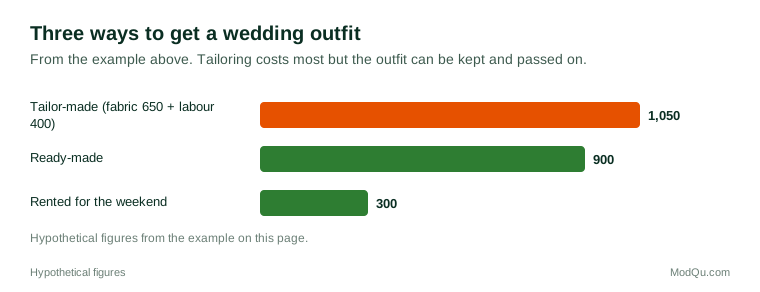
A bride compares three options for a wedding outfit. Buying ready-made costs 900, having a tailor make one from chosen fabric costs 650 for fabric plus 400 for labour (1,050 in total), and renting a designer outfit costs 300 for the weekend. She chooses the tailored option, the most expensive at 150 more than ready-made, because she wants to keep the outfit and pass it on.
Many people combine methods, such as buying fabric at a market abroad and having it made up by a tailor at home.
Costs and craftsmanship
Costs range widely. Simple everyday garments can be inexpensive, while hand-woven, hand-embroidered or silk pieces can cost a great deal and take weeks or months to make. Prices reflect the materials, the skill involved, any gold or silver thread or jewellery, and whether the item is made by hand or by machine. Mass-produced versions are cheaper and make traditional dress more affordable, but some people feel they lose the craftsmanship and meaning of the original.
For many communities traditional dress supports local craftspeople: weavers, dyers, embroiderers, tailors and jewellers. Some governments and cultural organisations support these crafts, and some traditional textiles and techniques are recognised by UNESCO as intangible cultural heritage.
Where traditional dress is sold
Traditional dress is sold through a wide range of outlets. In many countries there are whole market streets of fabric sellers and tailors, and specialist shops in larger towns sell ready-made outfits for festivals and weddings. Department stores in some countries carry national dress, especially before major holidays. Online shops and social media sellers now reach customers around the world, which matters to communities living abroad. Fabric is often bought separately from making, and many shoppers have favourite tailors they return to for years. Prices tend to rise in the weeks before major festivals and the wedding season, when demand is highest and tailors are busiest.
Care, storage and passing it on
Traditional garments often need special care. Silk, hand-dyed fabrics and embroidery may need hand-washing or professional cleaning, and garments may be stored folded in particular ways, wrapped in cloth or kept with natural insect repellents. Many families keep garments for decades and pass them down, especially wedding clothing and jewellery. Alterations allow garments to be worn by a new generation.
Example
An adult inherits a parent's hand-embroidered festival outfit. It no longer fits, so they take it to a tailor who lets out the seams and replaces a worn lining while keeping the embroidery intact. They now wear it each year on the same festival day.
Changes and debates
Traditional dress is changing in several ways:
- Modern versions. Designers make shorter, lighter or simpler versions for daily wear, or mix traditional fabrics with modern cuts.
- Online access. Communities living abroad can now buy from sellers in their home regions.
- Fewer craftspeople. In some places younger generations are less likely to take up traditional crafts, and skills risk being lost.
- Workplace and school rules. Some people face dress codes that restrict cultural or religious dress, and rules differ between countries and organisations.
- Cultural appropriation. There is debate about when wearing another culture's dress is appreciation and when it is disrespectful, for example wearing sacred items as costumes. Many people say being invited, understanding the meaning and buying from the community makes a difference. Views differ widely.
Questions that businesses and cultural organisations want answered include how often people wear traditional dress, where they get it, what they spend, and whether it is becoming more or less common among younger generations.
Key terms
- Traditional dressClothing linked to a particular culture, region or community, often developed over centuries.
- DiasporaA community living outside the country or region its members or their ancestors came from.
- TailorA person who makes or alters clothes to fit an individual.
- Hand-wovenFabric made on a loom by hand rather than by machine.
- EmbroideryDecoration sewn onto fabric with thread.
- HeirloomA valued item passed down through generations of a family.
- Cultural appropriationAdopting elements of another culture in a way that members of that culture may see as disrespectful.
- Intangible cultural heritagePractices, skills and knowledge that communities recognise as part of their heritage.
Full glossary: fashion design terms on EditingTests.com.
Traditional and cultural dress vocabulary test
How well do you know the language of this topic? Try 8 quick questions. Your score is shown straight away and is not saved.
What the traditional and cultural dress survey asks
This survey is part of ModQu's Fashion and Style survey. The traditional and cultural dress part takes about five minutes and covers:
- Whether you wear traditional or cultural dress, and how often.
- On which occasions you wear it: daily, festivals, weddings, national days or others.
- How you get it: buying ready-made, a tailor, making it yourself, inheriting or renting.
- How much you spend on traditional dress in a typical year.
- Where you buy it: local shops, markets, online or abroad.
- Whether younger people in your family wear it more or less than older generations.
After that you can choose to continue with other short parts of the Fashion and Style survey, such as footwear or sportswear and athleisure, or stop.
Ready to take part?
Your answers help show what people really think and do. Results are only ever reported as totals; no one can see your individual answers.
Start the surveyQuestions about this survey
Who can take part?
Adults.
Do I have to give my name?
No. You may be asked for your age group, region and similar details so results can be broken down, but not your name. ModQu never asks for passwords, card numbers or account numbers.
How are the results used?
Answers are combined into totals and percentages and published in ModQu reports. Individual answers are never shown.
Is the vocabulary test part of the survey?
No. It is optional and separate, and your score is not stored.