
Share how you buy accessories
Tell us which accessories you bought last year, what you spent and where you bought them. Your answers are combined with other people's and reported only as totals.
Start the bags and accessories surveyAbout 5 minutes. No account needed. You can stop at any time.
What accessories cover
In fashion, accessories are items worn or carried with clothing that are not clothes themselves. They have a practical use, such as carrying belongings or keeping the sun off, and a style use, such as adding colour or finishing an outfit. The main groups are:
- Bags: handbags, shoulder bags, tote bags, backpacks, crossbody bags, clutches, briefcases, belt bags and travel bags.
- Small leather goods: wallets, purses, card holders, key cases and phone cases.
- Belts and braces.
- Headwear: caps, hats, beanies, headscarves and hair accessories.
- Scarves, gloves and shawls, which can be seasonal, cultural or decorative.
- Eyewear: sunglasses and fashion frames.
- Jewellery and watches: from low-cost fashion jewellery to fine pieces.
- Ties, pocket squares and cufflinks for formal wear.
Accessories matter to retailers because they are bought more often than many clothes, fit almost everyone (size is rarely a problem), and make good gifts.
Bags: a closer look
Bags are the largest accessory category for many shoppers. People choose them for capacity, comfort, security and look. The bag a person carries often changes with their daily life:
- commuters may want a backpack or a bag with a laptop sleeve;
- parents may carry a large tote or a backpack with space for a child's things;
- people who walk in busy cities may prefer crossbody bags with zips for security;
- people who travel often may want bags that meet airline cabin size limits.
Materials range from canvas, nylon and recycled plastics to leather and alternatives to leather made from plants or synthetic materials. Many people own one everyday bag that they use until it wears out and a few bags for special occasions.
Example
An office worker who cycles to work replaces a leather shoulder bag with a waterproof backpack that has a padded laptop pocket. They keep the leather bag for meetings and weekends but now use it only once or twice a week.
How people choose accessories
When buying accessories people tend to weigh:
- Usefulness: pockets, compartments, size, weight and comfort.
- Style: whether it goes with their clothes and suits their age and setting.
- Price: accessories range from very cheap to very expensive, sometimes for similar-looking items.
- Durability: zips, straps, stitching and clasps are the usual weak points.
- Brand: for some buyers a logo matters; others actively avoid visible branding.
- Ethics and materials: some buyers avoid leather or look for recycled materials and fair working conditions.
Accessories are also bought on impulse more often than larger items. Many shops place them near the till or the entrance for that reason.
Example (hypothetical figures)
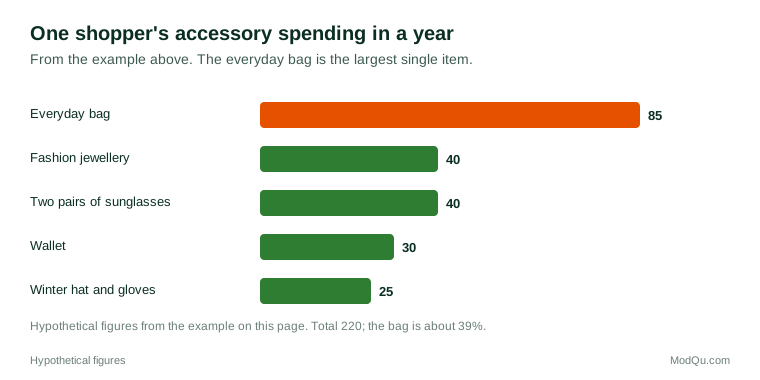
A shopper adds up their accessory spending for the year: one everyday bag for 85, a wallet for 30, two pairs of sunglasses for 20 each, a winter hat and gloves for 25, and fashion jewellery for 40. The total is 220, of which the bag is 85, or about 39%.
How many accessories people own and how often they buy
Ownership varies a great deal. Some people carry the same bag and wallet for years and own a single belt and pair of sunglasses. Others keep collections of bags, scarves or jewellery and change them with their outfits or the season. Accessories are often the first thing people buy when they want to update their look without replacing their clothes, and many people own items they rarely use, such as evening bags or hats bought for one event.
Buying patterns differ by item. Sunglasses are often lost or broken and replaced each summer. Wallets and everyday bags tend to be replaced when they wear out or when a person's routine changes, for example a new job or a baby. Jewellery and watches are bought less often and are more likely to be gifts.
Where people buy accessories
Accessories are sold almost everywhere clothes are sold, and in many places that do not sell clothes:
- clothing chains and department stores;
- specialist bag, luggage, jewellery and eyewear shops;
- supermarkets, pharmacies and petrol stations (sunglasses, reading glasses, hair accessories);
- markets, street stalls and craft fairs, often for handmade items;
- airports and tourist shops;
- brand websites, online marketplaces and social media sellers;
- second-hand shops and resale sites, which are especially popular for bags.
Handmade and local accessories are important in many countries. Woven bags, beaded jewellery, embroidered scarves and leatherwork are sold at local markets and to visitors, and often carry cultural meaning.
Gifts, occasions and culture
Accessories are among the most common gifts because they rarely need a size. Wallets, scarves, jewellery and watches are given for birthdays, graduations, weddings and religious festivals. In some cultures particular items carry special meaning, for example jewellery given at a wedding, or a headscarf or prayer cap given for a religious occasion.
Example
A grandparent buys a leather wallet for a grandchild who has started their first job. They choose a simple design with a coin pocket and card slots and ask the shop to emboss the grandchild's initials, which adds a small cost but makes the gift personal.
Care, repair and how long accessories last
Good care can make accessories last many years. Leather can be cleaned and conditioned, zips and straps can be replaced, and watch straps and batteries can be changed. Cobblers and leather repairers often fix bags as well as shoes. Cheaper items are more often replaced than repaired because the repair can cost as much as a new item.
Questions that businesses want answered include how often people replace their everyday bag, whether they repair accessories, and what makes them decide an item is worn out.
Trends and what people disagree about
- Practical bags. Backpacks, crossbody bags and belt bags have become common in settings where handbags or briefcases were once the norm.
- Phones replacing items. Mobile payments have led some people to stop carrying a wallet, while phone cases with card slots have become popular.
- Second-hand and vintage. Resale and vintage accessories are popular for both price and environmental reasons.
- Logos. Some buyers want visible branding; others prefer plain designs.
- Leather and alternatives. People disagree about whether leather or non-leather materials are better for the environment, since each has different impacts.
Key terms
- Crossbody bagA bag with a long strap worn across the body from one shoulder to the opposite hip.
- Tote bagA large open bag with two handles, usually without a closing flap.
- ClutchA small bag without a strap, carried in the hand, often for evening events.
- Small leather goodsWallets, card holders, key cases and similar small items made of leather.
- HardwareThe metal parts of a bag, such as zips, clasps, buckles and rings.
- Vegan leatherA material that looks like leather but is made without animal products.
- Fashion jewelleryLow-cost jewellery made from non-precious materials, also called costume jewellery.
- Carry-on sizeThe maximum bag size an airline allows in the cabin.
Full glossary: fashion merchandising terms on EditingTests.com.
Bags and accessories vocabulary test
How well do you know the language of this topic? Try 8 quick questions. Your score is shown straight away and is not saved.
What the bags and accessories survey asks
This survey is part of ModQu's Fashion and Style survey. The bags and accessories part takes about five minutes and covers:
- Which accessories you bought in the last year: bags, wallets, belts, hats, scarves, sunglasses or jewellery.
- How much you spent on accessories in total.
- Where you bought them: shops, markets, online or second-hand.
- What matters most when you choose a bag or wallet.
- Whether you buy accessories as gifts, and for which occasions.
- Whether you repair accessories or replace them.
After that you can choose to continue with other short parts of the Fashion and Style survey, such as footwear or sportswear and athleisure, or stop.
Ready to take part?
Your answers help show what people really think and do. Results are only ever reported as totals; no one can see your individual answers.
Start the surveyQuestions about this survey
Who can take part?
Adults.
Do I have to give my name?
No. You may be asked for your age group, region and similar details so results can be broken down, but not your name. ModQu never asks for passwords, card numbers or account numbers.
How are the results used?
Answers are combined into totals and percentages and published in ModQu reports. Individual answers are never shown.
Is the vocabulary test part of the survey?
No. It is optional and separate, and your score is not stored.