
Tell us about caregiving
Tell us whom you care for, how many hours you give and what support would help most. Your answers are combined with other people's and reported only as totals.
Start the caring for a family member surveyAbout 5 minutes. No account needed. You can stop at any time.
Who caregivers are
A family caregiver, sometimes called an unpaid or informal caregiver, is someone who regularly helps a family member or friend who has a long-term health condition, disability or problems related to ageing. Caregivers include:
- adult children caring for ageing parents;
- spouses and partners caring for each other;
- parents of children with disabilities or complex medical needs;
- young people caring for a parent or sibling;
- friends and neighbours.
Statistics Canada surveys have found that a large share of Canadians provide care at some point, and many do so while working full time. Women provide more hours of care on average, though many men are caregivers too.
What caregiving involves
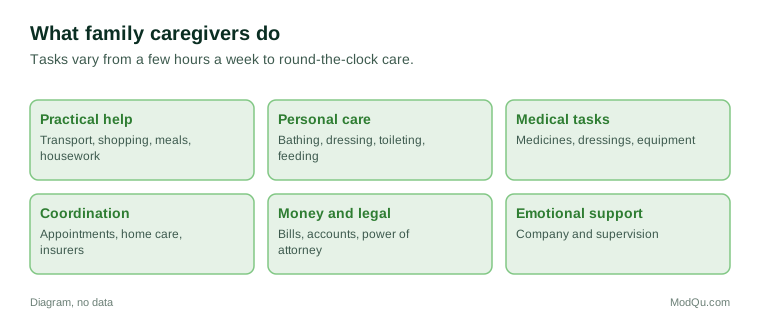
Caregiving tasks vary with the person's needs:
- practical help: transport, shopping, meals, housework and home maintenance;
- personal care: bathing, dressing, toileting and feeding;
- medical tasks: managing medicines, changing dressings, operating equipment;
- coordination: booking appointments, dealing with doctors, home care agencies and insurers;
- financial and legal tasks: paying bills, managing accounts, acting under power of attorney;
- emotional support and supervision, especially for people with dementia.
Some caregivers provide a few hours a week. Others provide round-the-clock care.
Example
A 52-year-old accountant visits her mother three times a week after work to sort medicines, bring groceries and check on her. She also takes her to medical appointments, which means using vacation days. She does not think of herself as a "caregiver" until a nurse uses the word.
Caregiving and work
Many caregivers are employed. Caregiving can lead to:
- missed work, late arrivals and interruptions;
- reduced hours or turning down promotions;
- using vacation and sick days for caregiving;
- leaving work altogether.
Some employers offer flexible hours, remote work, leave for family care and employee assistance programs. In Canada, Employment Insurance offers compassionate care benefits and family caregiver benefits for eligible workers caring for a critically ill or injured person or someone at risk of death, and federal and provincial employment standards provide some job-protected leave.
The financial cost
Caregivers often spend their own money on transport, medical supplies, home modifications, respite care and lost income. Some provinces and the federal government offer tax credits for caregivers, such as the Canada Caregiver Credit, but many caregivers do not claim them.
Example (hypothetical figures)
A son reduces his work week from five days to four to care for his father with Parkinson's disease. On a salary of $70,000, the change costs him about $14,000 a year before tax. He also spends about $250 a month on taxis, supplies and prepared meals for his father, about $3,000 a year.
Effects on health and wellbeing
Caregivers often report stress, fatigue, sleep problems, anxiety and depression, and some neglect their own health. Isolation is common when caregiving leaves little time for friends and activities. At the same time, many caregivers describe meaning, closeness and pride in the help they give.
Support for caregivers
Support may include:
- home care services, publicly funded or private, for personal care and nursing;
- respite care, short-term care that gives caregivers a break, in the home, in day programs or in short stays at care facilities;
- adult day programs for people with dementia or frailty;
- caregiver support groups, in person or online;
- caregiver organizations that offer information, counselling and training;
- care navigators who help families find services.
Many caregivers do not know what is available, find services hard to access, or face long waits.
Young caregivers
Children and young adults sometimes provide significant care for a parent or sibling with illness, disability or addiction. Young caregivers may miss school, feel isolated from friends and take on adult responsibilities early. Schools and youth organizations are increasingly aware of them, but many remain unrecognized.
Example
A 16-year-old helps care for her mother, who has multiple sclerosis, while her father works long hours. She cooks, helps her mother with stairs and looks after her younger brother. A teacher notices she is often tired and connects her with a young carers program at a local organization.
Caring from a distance
Some caregivers live far from the person they help. They coordinate care by phone, arrange services, manage finances online and travel when needed. Distance caregiving brings its own stress, including guilt and travel costs.
Planning ahead
Families who talk early about future care needs, legal documents such as powers of attorney, finances and preferences for where to live tend to cope better when a crisis comes. Many families avoid these conversations until a health emergency forces decisions.
Caring for someone with dementia
Dementia caregiving has particular challenges. Needs change gradually and then sometimes suddenly, and people with dementia may need supervision at all hours. Caregivers often describe grief for the person as they were, difficult decisions about safety and driving, and the eventual question of moving to long-term care. Alzheimer societies across Canada offer education, support groups and help navigating services.
Technology and caregiving
Caregivers increasingly use technology: medication reminder apps, shared calendars, video calls, medical alert devices, home monitoring sensors and online pharmacy refills. Some find technology saves time and gives peace of mind; others find it hard to set up or worry about privacy for the person they care for.
What service providers and employers want to know
Health systems, home care providers, employers, insurers and caregiver organizations want to understand who provides care, how many hours, what tasks, how it affects work and health, what support they use and what is missing.
Key terms
- Family caregiverSomeone who regularly helps a family member or friend without pay.
- Respite careShort-term care that gives caregivers a break.
- Home careHealth and support services provided in a person's home.
- Adult day programA daytime program offering activities and care for adults who need supervision.
- Compassionate care benefitsEmployment Insurance benefits for people caring for someone at risk of death.
- Care navigatorA person who helps families find and coordinate services.
- Power of attorneyA legal document allowing someone to act for another person.
- Caregiver burnoutPhysical and emotional exhaustion from caregiving.
Full glossary: caregiver services terms on EditingTests.com.
Caring for a family member vocabulary test
How well do you know the language of this topic? Try 8 quick questions. Your score is shown straight away and is not saved.
What the caring for a family member survey asks
This survey is part of ModQu's Health and Wellness survey. The caring for a family member part takes about five minutes and covers:
- Whom you care for, and their main needs.
- How many hours a week you spend on caregiving, and which tasks.
- How caregiving affects your work, finances and health.
- Which services or supports you use, such as home care or respite.
- What support you need but cannot get.
- Whether your employer offers anything that helps you combine work and care.
After that you can choose to continue with other short parts of the Health and Wellness survey, such as access to family doctors or virtual care and telehealth, or stop.
Ready to take part?
Your answers help show what people really think and do. Results are only ever reported as totals; no one can see your individual answers.
Start the surveyQuestions about this survey
Who can take part?
Unpaid caregivers.
Do I have to give my name?
No. You may be asked for your age group, region and similar details so results can be broken down, but not your name. ModQu never asks for passwords, card numbers or account numbers.
How are the results used?
Answers are combined into totals and percentages and published in ModQu reports. Individual answers are never shown.
Is the vocabulary test part of the survey?
No. It is optional and separate, and your score is not stored.
I do not call myself a caregiver. Is this survey for me?
Yes, if you regularly help someone with a health condition, disability or problems related to ageing, even for a few hours a week.