
Share which brands you know
Tell us which brands come to mind first for everyday products, where you first heard of them and which you have bought. Your answers are combined with other people's and reported only as totals.
Start the brand awareness surveyAbout 5 minutes. No account needed. You can stop at any time.
What brand awareness means
A brand is the name, logo, look and reputation that identify a product, service or company and set it apart from others. Brand awareness is how well people know a brand: whether they have heard of it, whether they can recognize it, and whether it comes to mind when they think of a type of product.
Awareness is usually described in levels:
- Unaware: the person has never heard of the brand.
- Recognition (aided awareness): the person recognizes the brand when shown its name or logo.
- Recall (unaided awareness): the person can name the brand without prompting when asked about a product type.
- Top of mind: the brand is the first one the person names.
Moving up these levels is harder at each step. Many people recognize dozens of brands in a category but can name only a few without help, and only one comes first.
How awareness is measured
Surveys measure awareness with a standard sequence of questions, usually asked in this order so earlier questions do not give away answers to later ones:
- Unaided: "When you think of breakfast cereals, which brands come to mind?" The first brand named is recorded as top of mind, the rest as unaided recall.
- Aided: "Which of these brands have you heard of?" with a list of names or logos.
- Usage: "Which have you bought in the last three months?" and "Which do you buy most often?"
Repeating the same questions over time, known as brand tracking, shows whether awareness is rising or falling, for example after an advertising campaign.
Example (hypothetical figures)
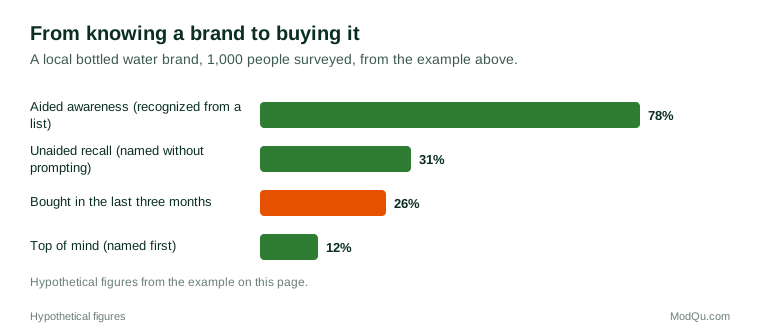
A survey asks 1,000 people about brands of bottled water. A local brand is named first by 120 people (12% top of mind), named at all without prompting by 310 (31% unaided), and recognized from a list by 780 (78% aided). Of those, 260 people (26%) have bought it in the last three months. The gap between 78% who know it and 26% who buy it is what the brand's marketing team wants to understand.
How people first hear of brands
People come to know brands in many ways:
- Seeing them in shops, on shelves, on vehicles and in the street.
- Advertising on television, radio, online, outdoors and in cinemas.
- Family: many people buy the brands their parents bought.
- Friends, colleagues and word of mouth.
- Social media and creators who show or mention products.
- Search results and online marketplaces.
- Sponsorship of sport, music and events.
- Using the product at someone else's home, work or school.
Example
A student moves into a shared flat and finds that her flatmates all use the same laundry detergent, a brand she had never noticed. She starts buying it because it is already in the cupboard, and two years later, living alone, she still buys it without thinking. She cannot remember ever seeing an advert for it.
The example shows that awareness is often built through everyday exposure rather than a single moment. People are frequently unable to say where they first heard of a brand they know well.
Why awareness matters
Awareness matters to brands because people usually choose from a small set of brands they already know, called the consideration set. A brand that does not come to mind at the moment of choice is less likely to be bought, especially when people shop quickly or online. Research in marketing has long found that brands with larger market shares tend to be known by more people, and that growing awareness among people who rarely buy the category is an important route to growth.
Awareness is not enough on its own. A brand can be well known but not liked, or known for the wrong reasons, such as a product recall or scandal. Surveys therefore often pair awareness questions with questions about opinion, trust and purchase.
Distinctive brand assets
Brands try to be recognized quickly through distinctive assets: colours, logos, shapes, characters, sounds, slogans and packaging that people link with one brand. A shopper scanning a shelf for a second may pick out a familiar colour before reading any words. Brands that change their logos or packaging too often can lose some of this recognition.
Example
A family-run tea company changes its long-standing red packaging to a modern white design. Sales fall for several months, and a survey shows that regular buyers could not find the product on the shelf. The company brings back a red band across the top of the new pack, and sales recover.
Awareness in different markets
Awareness differs between countries and groups. A brand that everyone knows in one country may be unknown in another. Local brands can have higher awareness than global ones in their home market. Younger people may know many brands only from social media and online shopping, while older people may know brands from television and shops. People in rural areas may know fewer brands because shops stock a narrower range.
Challenges in measuring awareness
Measuring awareness is not as simple as it sounds:
- Guessing: some people say they recognize a brand they have never heard of, especially if the name sounds familiar. Surveys sometimes include a made-up brand to check for this.
- Question order: showing a list of brands before asking for unaided recall makes recall higher.
- Category definition: asking about "soft drinks" or "fizzy drinks" can bring different brands to mind.
- Confusing similar names: people may mix up brands with similar names or colours.
What people disagree about
Marketers disagree about how much to spend on building awareness versus persuading people already aware, whether top-of-mind awareness predicts sales, how much awareness comes from advertising compared with simply being in shops, and how to measure awareness online. People also differ in how much they think they are influenced by brands they know; many say they are not influenced, while buying mainly familiar names.
Questions that brand owners, advertising agencies, media owners and retailers want answered include which brands people name first in a category, which they recognize, where they heard of them, and which they have bought.
Key terms
- BrandThe name, logo, look and reputation that identify a product or company.
- Brand awarenessHow well people know a brand.
- Unaided recallNaming a brand without any prompting.
- Aided awarenessRecognizing a brand when shown its name or logo.
- Top of mindThe first brand a person names in a category.
- Consideration setThe small group of brands a person would consider buying.
- Brand trackingMeasuring the same brand questions repeatedly over time.
- Distinctive assetA colour, logo, shape, sound or character that people link with one brand.
Full glossary: brand strategy terms on EditingTests.com.
Brand awareness vocabulary test
How well do you know the language of this topic? Try 8 quick questions. Your score is shown straight away and is not saved.
What the brand awareness survey asks
This survey is part of ModQu's Brands and Advertising survey. The brand awareness part takes about five minutes and covers:
- Which brands come to mind first when you think of everyday product types.
- Which brands you recognize from a list.
- Where you first heard of particular brands, if you remember.
- Which brands you have bought recently and which you buy most often.
- Whether you have ever chosen a brand mainly because it was familiar.
After that you can choose to continue with other short parts of the Brands and Advertising survey, such as brand loyalty or trust in brands, or stop.
Ready to take part?
Your answers help show what people really think and do. Results are only ever reported as totals; no one can see your individual answers.
Start the surveyQuestions about this survey
Who can take part?
Adults.
Do I have to give my name?
No. You may be asked for your age group, region and similar details so results can be broken down, but not your name. ModQu never asks for passwords, card numbers or account numbers.
How are the results used?
Answers are combined into totals and percentages and published in ModQu reports. Individual answers are never shown.
Is the vocabulary test part of the survey?
No. It is optional and separate, and your score is not stored.