
Share which adverts you remember
Tell us which advert you remember from the last week, where you saw it and whether it made you do anything. Your answers are combined with other people's and reported only as totals.
Start the advertising recall surveyAbout 5 minutes. No account needed. You can stop at any time.
What advertising recall means
Advertising recall is whether people remember an advert after seeing or hearing it, and what they remember about it. It is one of the oldest measures used to judge whether advertising works. Researchers distinguish:
- Unaided (spontaneous) recall: the person remembers an advert without being prompted, for example when asked "Which adverts do you remember seeing in the last week?"
- Aided (prompted) recall: the person remembers an advert when given a hint, such as the product category or brand name.
- Recognition: the person recognizes an advert when shown it again.
- Correct brand attribution: the person remembers not just the advert but which brand it was for.
The last point matters a great deal. Many people remember an advert's story, joke or music but cannot say which brand it was for, or name a competitor instead.
Why some adverts are remembered
Research and practice point to features that make adverts more memorable:
- Emotion: adverts that make people laugh, feel moved or feel surprised tend to be remembered better than plain information.
- Story and characters: a simple story or a recurring character.
- Distinctive brand cues: the brand's colours, logo, sound or character shown early and clearly.
- Music and jingles: a tune that stays in the head.
- Repetition: seeing an advert several times, though too much repetition annoys people.
- Relevance: people notice ads for things they are about to buy, such as a car or a holiday.
- Novelty: something unusual or unexpected.
- Context: where and when the advert is seen, such as during a big sports event.
Example
A woman remembers a television advert from her childhood in which a family dog steals a sandwich. She can describe it scene by scene and still hum the music, but she is not sure whether it was for bread, butter or a supermarket. A survey would count this as strong recall of the advert but weak brand attribution.
Where people see adverts
People see adverts across many channels: television, radio, print, outdoor posters and billboards, public transport, cinema, shop displays, websites, social media, search engines, video platforms, podcasts, games and email. Recall varies between channels. Television and cinema adverts with sound and moving pictures are often remembered well, while many online display ads are scrolled past in a second and barely noticed.
People are often unsure where they saw an advert. They may say "on TV" when they saw a clip of a TV advert on social media, or remember a billboard that was in fact an online ad. Surveys therefore ask about channels with care.
How recall is measured
Common methods include:
- Day-after recall: contacting people the day after a broadcast to ask what adverts they remember.
- Campaign tracking: asking a sample of people regularly, before, during and after a campaign, whether they remember advertising for a brand.
- Pre-testing: showing a new advert to a sample before it runs, then asking what they remember and how they feel.
- Recognition tests: showing stills or short clips and asking if people have seen them.
- Online brand lift studies: comparing people who were shown an online ad with similar people who were not.
Example (hypothetical figures)
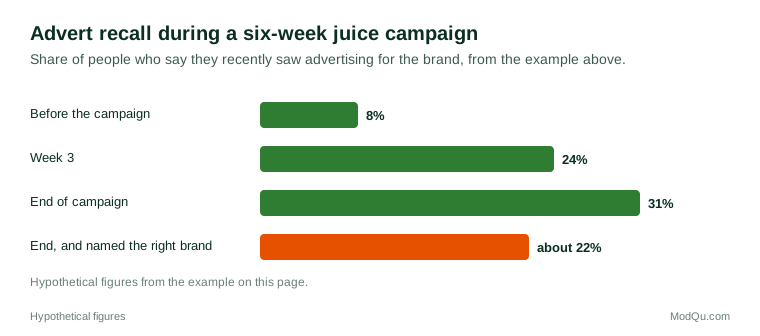
A juice brand runs a six-week campaign. Before it starts, 8% of people surveyed say they have seen advertising for the brand recently (some recall is always wrong or from older adverts). In week three this rises to 24% and at the end to 31%. Of those who recall the advert, 70% name the right brand, so correct branded recall at the end is about 22% of all people surveyed.
False memories and guessing
Memory for advertising is not perfect. People sometimes "remember" adverts they have never seen, especially for well-known brands that advertise often. They may mix up brands with similar colours or names. Questions about the past week are often answered with adverts seen weeks or months before. Researchers use control groups, made-up adverts and careful wording to measure how much of reported recall is real.
Does remembering an advert lead to action?
Recall is not the same as persuasion. An advert can be well remembered and still not lead anyone to buy, or be quickly forgotten and still influence choices later by keeping a brand familiar. Actions people report after seeing adverts include:
- searching online for the product or brand;
- visiting a website or shop;
- talking about the advert or product with others;
- buying the product, sometimes much later;
- signing up for an offer or newsletter.
Many people say adverts do not affect what they buy, while also reporting that they bought something after seeing an advert. Researchers often find a gap between what people say and what they do.
Example
A man sees an online advert for a new running shoe three times in a week. He does not click on it. A month later, when his old shoes wear out, he goes to a shop and finds himself picking up that model first. Asked why, he says it "looked familiar" and he had "heard it was good", though he cannot say where.
Ad clutter and attention
With so many adverts competing for attention, many are not noticed at all. "Ad clutter" describes the large number of ads in a single break, page or feed. People often look at their phones during TV ad breaks, scroll past online ads and skip video ads at the first chance. Some research now measures attention, for example how long an advert was actually on screen and in view, as well as recall.
What people disagree about
Marketers disagree about whether recall is a good measure of advertising success, whether memorable creative ideas matter more than how often an ad is seen, whether online ads are as memorable as TV ads, and whether advertising works mainly by persuading people or by keeping brands familiar. People also disagree about whether they are influenced by adverts they do not remember.
Questions that advertisers, agencies, media owners and researchers want answered include which adverts people remember, where they saw them, which brands they link them to, and whether the adverts led them to search, visit or buy.
Key terms
- Advertising recallWhether people remember an advert after seeing or hearing it.
- Unaided recallRemembering an advert without any prompt.
- Aided recallRemembering an advert when given a hint, such as the category.
- Brand attributionLinking a remembered advert to the correct brand.
- Pre-testingTesting a new advert on a sample of people before it runs.
- Campaign trackingMeasuring awareness and recall regularly during a campaign.
- Ad clutterA large number of ads competing for attention in one place.
- Brand liftThe increase in awareness or recall caused by a campaign, compared with people not exposed.
Full glossary: market research operations terms on EditingTests.com.
Advertising recall vocabulary test
How well do you know the language of this topic? Try 8 quick questions. Your score is shown straight away and is not saved.
What the advertising recall survey asks
This survey is part of ModQu's Brands and Advertising survey. The advertising recall part takes about five minutes and covers:
- Which advert you remember from the last week, and what it was for.
- Where you saw or heard it: TV, radio, online, social media, outdoors or elsewhere.
- What you remember about it, and how it made you feel.
- Whether it made you do anything, such as search, visit, talk about it or buy.
- How often you skip or ignore adverts.
After that you can choose to continue with other short parts of the Brands and Advertising survey, such as brand awareness or brand loyalty, or stop.
Ready to take part?
Your answers help show what people really think and do. Results are only ever reported as totals; no one can see your individual answers.
Start the surveyQuestions about this survey
Who can take part?
Adults.
Do I have to give my name?
No. You may be asked for your age group, region and similar details so results can be broken down, but not your name. ModQu never asks for passwords, card numbers or account numbers.
How are the results used?
Answers are combined into totals and percentages and published in ModQu reports. Individual answers are never shown.
Is the vocabulary test part of the survey?
No. It is optional and separate, and your score is not stored.