
Share your views on packaging
Tell us whether packaging has made you choose a product, what information you look for on packs and whether you prefer simple packaging. Your answers are combined with other people's and reported only as totals.
Start the packaging design surveyAbout 5 minutes. No account needed. You can stop at any time.
What packaging does
Packaging has several jobs at once:
- Protection: keeping products safe, clean and fresh during transport and storage.
- Information: telling people what the product is, what it contains, how to use it and any warnings.
- Identification: helping shoppers recognize the brand and find it on a shelf or screen.
- Persuasion: making the product look appealing and communicating its benefits.
- Convenience: making products easy to open, pour, reseal, store and carry.
- Legal requirements: showing information that laws require, such as ingredients, allergens and weight.
Pack design includes the material, shape, size, colours, images, typography and any special features such as windows, handles or resealable closures.
How packaging affects choice
Many shopping decisions are made quickly. In a supermarket, a shopper may look at a shelf for only a few seconds before picking a product. Packaging affects that moment in several ways:
- Standing out: a pack that is easy to spot gets noticed.
- Recognition: familiar colours and shapes help regular buyers find their usual brand.
- Signals of quality: heavier materials, matte finishes or glass can suggest a premium product.
- Signals of price: simple, plain packs can suggest value.
- Images: pictures of the product or ingredients make it look appealing.
- Claims: words such as "new", "natural", "high protein" or "family size".
Example
A shopper buying olive oil for the first time faces twenty bottles. She does not know the brands, so she chooses a dark glass bottle with a simple label showing the region where the olives were grown, guessing that it is better quality than the clear plastic bottles nearby. She later learns that dark glass protects oil from light, which supports her choice.
Information people look for
People look for different information depending on the product and their needs. Common items include:
- Price and size, including the price per unit (per kilogram or per litre) shown on shelf labels in many countries.
- Ingredients and allergens, especially for people with allergies or dietary needs.
- Nutrition information, sometimes shown as front-of-pack labels with colours or scores.
- Dates: "best before" and "use by" dates.
- Instructions for use, cooking or storage.
- Origin: where the product was made or grown.
- Certifications: organic, fair trade, halal, kosher, vegan and others.
- Recycling information: whether the pack can be recycled and how.
Many shoppers say labels are too small, too crowded or written in language that is hard to understand.
Labels and symbols
Packs carry many symbols, and people are often unsure what they mean. "Best before" usually refers to quality and "use by" to safety, but many people confuse the two, which contributes to food waste. Recycling symbols vary by country and are often misunderstood; a symbol showing a material type does not always mean the pack can be recycled locally.
Front-of-pack nutrition labels differ by country, for example traffic-light colours in the United Kingdom, letter-grade scores used in several European countries, and warning labels for high sugar, salt or fat in several Latin American countries such as Chile and Mexico. Governments have introduced these to help people make quicker, healthier choices.
Sustainability and over-packaging
Packaging waste, especially plastic, has become a strong public concern. People complain about:
- too much packaging for small products;
- packs that are hard to recycle, such as mixed materials;
- single-use plastics;
- large boxes for small online orders;
- "slack fill", where a pack is much larger than its contents.
Responses include lighter packaging, recycled materials, refill and reuse systems, paper instead of plastic, deposit schemes for bottles and cans, and laws that make producers pay for collecting and recycling packaging. People often say they want less packaging, but they also value protection, convenience and hygiene, which can involve trade-offs.
Example (hypothetical figures)
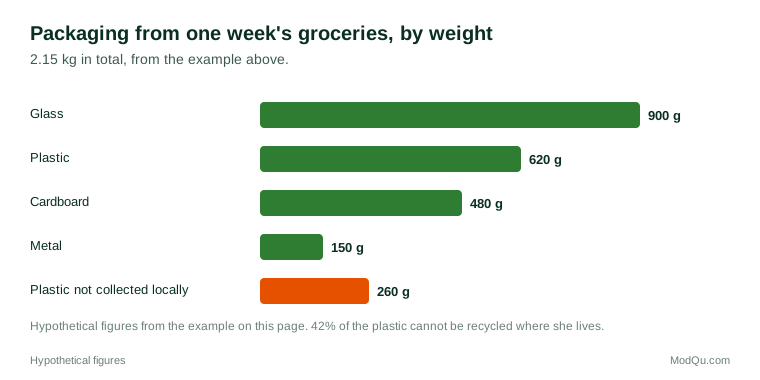
A shopper weighs the packaging from one week's groceries. Plastic comes to 620 g, cardboard to 480 g, glass to 900 g and metal to 150 g, a total of 2.15 kg. Of the plastic, 260 g is film and mixed material that her local service does not collect, so 42% of her plastic packaging cannot be recycled where she lives.
Convenience and accessibility
Packaging can be hard to open, especially for older people and people with arthritis or limited hand strength. Child-resistant packaging, needed for medicines and some household chemicals, can make this harder. Small print and low contrast make labels hard to read for people with poor sight. Designers increasingly test packs with a range of users, and some brands add features such as easy-open tabs, larger print and braille.
Example
An older man with arthritis stops buying a brand of jam because he cannot open the jar without help. He switches to a brand in a squeezable plastic bottle. The original brand later introduces an easier-to-open lid after customer complaints.
Packaging changes and shrinkflation
When brands change packaging, regular buyers sometimes cannot find the product or think the recipe has changed. A new pack size can also hide a price increase, for example a smaller pack at the same price. Some countries require shops to show unit prices so people can compare packs of different sizes.
Packaging online
Online shopping has changed the role of packaging. Shoppers first see a product as a small image on a screen, so brands design packs that are easy to recognize at small sizes and add clear product photos and details to listings. Products shipped to homes need packaging that survives delivery, and some brands now design simpler, "frustration-free" packs for online orders that are easier to open and use less material. Many people say they are frustrated by large boxes with lots of filling for small items.
What people disagree about
People disagree about whether plastic should be replaced with other materials that may have their own environmental costs, whether front-of-pack nutrition labels help or confuse, whether brands should be required to use plain packaging for products such as tobacco (as several countries require), and how much responsibility lies with producers versus shoppers for packaging waste.
Questions that brand owners, packaging designers, retailers, regulators and environmental groups want answered include whether packaging has influenced people's choices, what information they look for, whether they understand labels and symbols, and how they feel about packaging waste.
Key terms
- PackagingThe materials that contain, protect and present a product.
- Front-of-pack labelA simple summary of key information, such as nutrition, on the front of a pack.
- Best beforeA date after which quality may decline, though the product may still be safe.
- Use byA date after which a product should not be used, for safety reasons.
- Unit priceThe price per standard amount, such as per kilogram or litre.
- Slack fillEmpty space in a pack beyond what is needed.
- Deposit return schemeA system where buyers pay a small deposit on a container and get it back when they return it.
- Plain packagingRules requiring packs with no logos or brand designs, used for tobacco in several countries.
Full glossary: packaging design terms on EditingTests.com.
Packaging design vocabulary test
How well do you know the language of this topic? Try 8 quick questions. Your score is shown straight away and is not saved.
What the packaging design survey asks
This survey is part of ModQu's Brands and Advertising survey. The packaging design part takes about five minutes and covers:
- Whether packaging has ever made you choose or avoid a product.
- What information you look for on packs, and what is hard to find or read.
- Whether you understand date labels, nutrition labels and recycling symbols.
- Whether you prefer simple packaging, and how you feel about packaging waste.
- Whether you have had trouble opening packaging.
After that you can choose to continue with other short parts of the Brands and Advertising survey, such as brand awareness or brand loyalty, or stop.
Ready to take part?
Your answers help show what people really think and do. Results are only ever reported as totals; no one can see your individual answers.
Start the surveyQuestions about this survey
Who can take part?
Adults.
Do I have to give my name?
No. You may be asked for your age group, region and similar details so results can be broken down, but not your name. ModQu never asks for passwords, card numbers or account numbers.
How are the results used?
Answers are combined into totals and percentages and published in ModQu reports. Individual answers are never shown.
Is the vocabulary test part of the survey?
No. It is optional and separate, and your score is not stored.