
Share whether you prefer local or global brands
Tell us whether you prefer local or global brands, in which products, and why. Your answers are combined with other people's and reported only as totals.
Start the local versus global brands surveyAbout 5 minutes. No account needed. You can stop at any time.
What local and global brands are
A local brand is sold mainly in one country or region, often owned by a company based there and closely tied to local tastes, culture and history. A global brand is sold in many countries under the same name and look, usually by a large international company.
In between are:
- National brands that are big in one country but little known abroad.
- Regional brands sold across a group of neighbouring countries.
- Global brands that adapt, changing recipes, sizes, names or advertising for each market.
- Local brands owned by global companies, which keep their local name and image after a takeover.
People are often unsure which brands are local and which are global. Some brands that seem local are owned by international companies, and some brands that seem international are from the buyer's own country.
Why people choose local brands
Reasons people give for preferring local brands include:
- Supporting the local economy and jobs.
- Taste and familiarity: products made for local preferences, such as particular flavours, spice levels or textures.
- Tradition and nostalgia: brands their parents used.
- National or regional pride.
- Trust: knowing the company and its reputation locally.
- Price: local brands are sometimes cheaper.
- Freshness and shorter supply chains, especially for food.
Example
A family in a South-East Asian country buys a local brand of instant noodles that has been sold there for fifty years. A global brand is on the same shelf at a similar price, but the family says the local one "tastes like home" and is the flavour their children grew up with. They buy the global brand only when the local one is out of stock.
Why people choose global brands
Reasons people give for preferring global brands include:
- Perceived quality and consistency: the product is the same everywhere.
- Status and modernity: global brands can signal success or a connection to the wider world.
- Innovation: new technology and features.
- Wide availability and after-sales service.
- Safety and standards, especially where people distrust local product safety.
- Familiarity from travel, media and the internet.
Preferences vary by product. In many markets people prefer global brands for technology, cars and luxury goods, and local brands for food, drink, household products and services such as banking and telecoms.
Example (hypothetical figures)
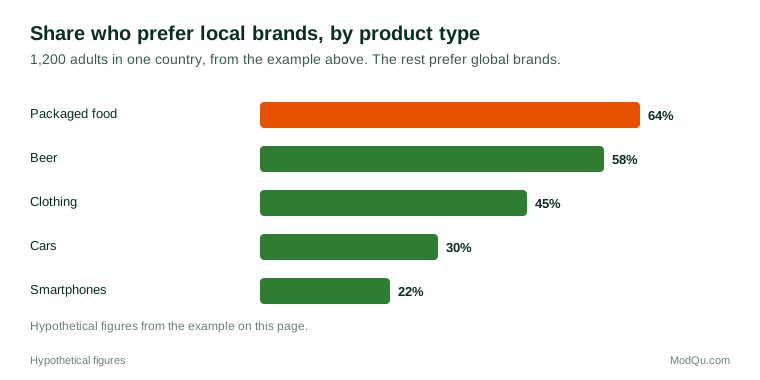
A survey asks 1,200 adults in one country whether they prefer local or global brands in five categories. For packaged food, 64% prefer local. For beer, 58% prefer local. For clothing, the split is 45% local and 55% global. For smartphones, 22% prefer local. For cars, 30% prefer local. People who say they "always buy local" still choose global brands for at least one category in most cases.
How global brands adapt
Many global brands change what they sell to suit local markets. Common adaptations include:
- different recipes and flavours, such as spicier or sweeter versions;
- menu items based on local dishes in restaurant chains;
- smaller, cheaper pack sizes in markets where people buy daily;
- local names, scripts or packaging;
- advertising with local celebrities, holidays and humour;
- products that meet religious or dietary rules, such as halal or vegetarian versions.
Some companies describe this as "think global, act local". Others keep a single global product and image everywhere, relying on its consistency.
Ownership and the blurred line
Many brands that people think of as local are owned by international companies, and many international brands started as small local businesses. When a global company buys a local brand, it often keeps the name and recipe to keep local loyalty. Some people feel misled when they learn a "local" brand is foreign-owned; others say it does not matter as long as the product and jobs stay local.
Example
A man has bought the same brand of crisps for years, believing it is a small family firm from his region. He reads that the brand was bought by an international food company a decade ago. He is annoyed at first, but after checking that the crisps are still made in the same factory with the same staff, he keeps buying them.
Differences between countries
Preferences differ between countries. In some fast-growing markets, global brands were long seen as more modern and higher quality, but local brands have gained ground as their quality has improved and as national pride has grown. In some countries, consumers favour domestic brands strongly during economic or political tensions. Younger people often see global brands as normal rather than special, and some actively seek out local, independent and small brands.
Online shopping and new brands
Online shopping and social media have made it easier for small local brands to reach customers and for brands from other countries to sell directly. Some brands sold online are hard to place: they may have an English-sounding name, be owned in one country and made in another. Many shoppers say they are unsure where online brands come from.
Price and value
Price can push people in either direction. In some markets, local brands are cheaper than global ones because they have lower costs and do not pay for global advertising, and people on tight budgets choose them for that reason. In others, global brands use their scale to offer lower prices than small local producers. Store brands sold by supermarkets, which are often made by local manufacturers, add another option. Many shoppers say they would buy local more often if the price difference were smaller.
What people disagree about
People disagree about whether buying local brands helps the economy as much as people think, whether global brands push out local culture and businesses, whether local brands are better quality or only more familiar, and whether ownership matters if production stays local. Views often differ between older and younger people and between cities and rural areas.
Questions that brand owners, retailers, investors and trade bodies want answered include whether people prefer local or global brands, in which product categories, for what reasons, and whether knowing a brand's ownership changes their choice.
Key terms
- Local brandA brand sold mainly in one country or region, closely tied to local tastes.
- Global brandA brand sold in many countries under the same name and look.
- National brandA brand that is large in one country but little known abroad.
- LocalizationAdapting a product, name or advert to suit a local market.
- Brand ownershipThe company that owns a brand, which may differ from where it seems to be from.
- AcquisitionOne company buying another company or brand.
- Consumer ethnocentrismA preference for products from one's own country, sometimes as a matter of principle.
- Think global, act localA strategy of global scale with local adaptation.
Full glossary: brand strategy terms on EditingTests.com.
Local versus global brands vocabulary test
How well do you know the language of this topic? Try 8 quick questions. Your score is shown straight away and is not saved.
What the local versus global brands survey asks
This survey is part of ModQu's Brands and Advertising survey. The local versus global brands part takes about five minutes and covers:
- Whether you generally prefer local or global brands.
- In which products you prefer each, such as food, drink, clothing, technology or cars.
- Why you prefer them: taste, quality, price, trust, supporting the economy or status.
- Whether knowing who owns a brand would change your choice.
- Whether you actively look for small or independent local brands.
After that you can choose to continue with other short parts of the Brands and Advertising survey, such as brand awareness or brand loyalty, or stop.
Ready to take part?
Your answers help show what people really think and do. Results are only ever reported as totals; no one can see your individual answers.
Start the surveyQuestions about this survey
Who can take part?
Adults.
Do I have to give my name?
No. You may be asked for your age group, region and similar details so results can be broken down, but not your name. ModQu never asks for passwords, card numbers or account numbers.
How are the results used?
Answers are combined into totals and percentages and published in ModQu reports. Individual answers are never shown.
Is the vocabulary test part of the survey?
No. It is optional and separate, and your score is not stored.