
Share how you feel about adverts
Tell us how you feel about online ads, whether you use an ad blocker and which kinds of ads annoy you most. Your answers are combined with other people's and reported only as totals.
Start the attitudes to advertising surveyAbout 5 minutes. No account needed. You can stop at any time.
What this topic covers
Advertising is paid communication that tries to make people aware of a product, service, idea or organization, or persuade them to act. This topic is about how people feel about it. It covers:
- general attitudes to advertising;
- views on different channels: television, radio, print, outdoor, cinema, websites, apps, social media, search, video and podcasts;
- which formats people accept and which annoy them;
- ad blocking and paying to avoid ads;
- personalized and targeted advertising;
- concerns about misleading ads and advertising to children.
Mixed feelings
Most people have mixed feelings about advertising. Surveys in many countries find that people often say they dislike ads in general, while also remembering and enjoying particular adverts, finding some useful and accepting ads as the price of free content.
Reasons people give for liking some advertising:
- it tells them about new products, offers and events;
- some ads are funny, moving or creative;
- it pays for free television, websites, apps and news.
Reasons people give for disliking advertising:
- there is too much of it;
- it interrupts what they are doing;
- it can be repetitive, loud or irrelevant;
- some ads are misleading;
- online ads can feel like they are following them around;
- it encourages people to buy things they do not need.
Example
A man says he "hates adverts" and skips them whenever he can. In the same conversation he quotes a slogan from a car advert he saw as a child, describes a funny beer advert from the previous week in detail, and admits he found his current phone plan through an advert on a bus shelter.
Which formats annoy people most
People's views differ by format. Formats commonly described as most annoying include:
- Pop-ups that cover what a person is reading.
- Auto-playing video with sound.
- Unskippable video ads, especially long ones before short videos.
- Ads that follow people around the web after they looked at a product.
- Ads that slow pages down or make them jump as they load.
- Repetitive ads seen many times a day.
- Ads disguised as content, where it is not clear something is an advert.
Formats people tend to accept more readily include short skippable ads, ads related to what they are searching for, sponsorship messages, outdoor posters and cinema ads that people expect.
Example (hypothetical figures)
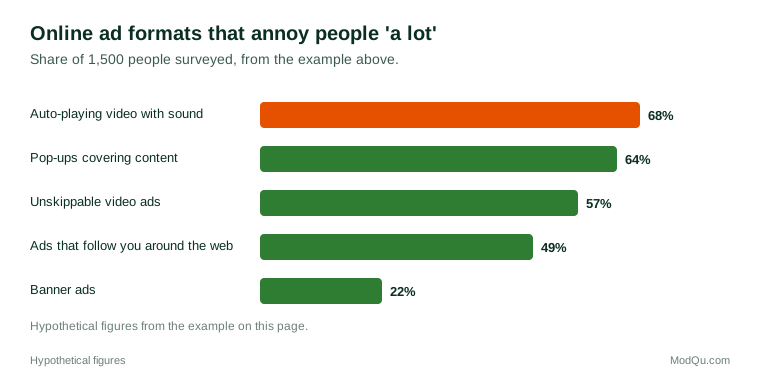
A survey asks 1,500 people which online ad formats annoy them "a lot". Auto-playing video with sound is chosen by 68%, pop-ups that cover content by 64%, unskippable video ads by 57%, ads that follow people around the web by 49%, and banner ads by 22%. Banner ads are the least disliked but also the least noticed.
Ad blocking
An ad blocker is software that stops many adverts from appearing on websites and sometimes in apps. People use them to avoid annoying ads, speed up pages, use less mobile data, and protect their privacy from tracking. Ad blocker use varies a great deal between countries and age groups, and is higher on computers than on phones.
Ad blocking has led to a long-running dispute. Websites that depend on advertising say blockers threaten free content and journalism, and some ask users to turn off blockers or pay. Users say the ad experience became so poor that blocking was the only option. Some industry groups have published standards for less intrusive ads.
Paying to avoid ads
Many services now offer a choice between a free version with ads and a paid version without them, for example in streaming video and music, apps, games and news. Some streaming services have added cheaper plans with adverts. People's choices depend on how much they use the service, how annoying they find the ads and how much they can afford.
Example
A student uses a free music streaming plan with ads. When she starts using it on long commutes, the frequent ads become annoying enough that she pays for the ad-free plan. She keeps the free version of a video app because she uses it only a few minutes a day.
Personalized advertising
Personalized or targeted advertising uses data about people, such as browsing history, location, purchases and interests, to choose which ads they see. People are divided about it:
- Some prefer ads that are relevant to them over random ones.
- Many feel uncomfortable about how much companies know, and describe some ads as "creepy".
- Many do not understand how their data is collected and used.
Privacy laws in many places, such as the European Union's General Data Protection Regulation, require consent for some kinds of tracking, which is why many websites show cookie consent banners. Browsers and phone systems have also added tools that limit tracking. People often click "accept" on banners without reading them, which raises questions about how meaningful consent is.
Children and advertising
Many countries restrict advertising to children, for example banning ads for unhealthy food during children's television or limiting ads in children's apps. Parents raise concerns about ads in games, influencer content aimed at children, and children being unable to tell adverts from content.
Misleading advertising
Most countries have rules that ban false or misleading advertising, enforced by regulators or industry bodies. People can usually complain about an advert they think is misleading, offensive or harmful. Common complaints include exaggerated claims, hidden conditions on offers, and environmental claims that cannot be backed up.
What people disagree about
People disagree about whether advertising is a fair price for free content, how much tracking is acceptable, whether ad blocking is fair to publishers, how strictly to limit advertising for unhealthy food, alcohol, gambling and fossil fuels, and whether advertising mainly informs or manipulates. Views often differ between age groups and between people who work in or around advertising and those who do not.
Questions that advertisers, agencies, media owners and regulators want answered include how people feel about advertising in each channel, which formats annoy them most, whether they use ad blockers, whether they would pay to avoid ads and how they feel about personalized ads.
Key terms
- AdvertisingPaid communication that aims to inform or persuade people.
- Ad blockerSoftware that stops many adverts from appearing.
- Pop-upAn advert that appears over the content a person is viewing.
- Skippable adA video ad that can be skipped after a few seconds.
- Targeted advertisingChoosing ads for people based on data about them.
- RetargetingShowing ads for a product to people who have already looked at it.
- Cookie bannerA notice asking website visitors to accept or reject tracking.
- Native advertisingAds designed to look like the content around them.
Full glossary: online advertising platforms terms on EditingTests.com.
Attitudes to advertising vocabulary test
How well do you know the language of this topic? Try 8 quick questions. Your score is shown straight away and is not saved.
What the attitudes to advertising survey asks
This survey is part of ModQu's Brands and Advertising survey. The attitudes to advertising part takes about five minutes and covers:
- How you feel about advertising in general and in each channel, from TV to social media.
- Whether you use an ad blocker, and on which devices.
- Which kinds of ads annoy you most and which you find acceptable or useful.
- Whether you pay for any ad-free plans, and why.
- How you feel about ads chosen using data about you.
- Whether you have ever complained about an advert.
After that you can choose to continue with other short parts of the Brands and Advertising survey, such as brand awareness or brand loyalty, or stop.
Ready to take part?
Your answers help show what people really think and do. Results are only ever reported as totals; no one can see your individual answers.
Start the surveyQuestions about this survey
Who can take part?
Adults.
Do I have to give my name?
No. You may be asked for your age group, region and similar details so results can be broken down, but not your name. ModQu never asks for passwords, card numbers or account numbers.
How are the results used?
Answers are combined into totals and percentages and published in ModQu reports. Individual answers are never shown.
Is the vocabulary test part of the survey?
No. It is optional and separate, and your score is not stored.