
Share how your family celebrates
Tell us how much you spent on your last family celebration, where it was held and whether you hired any services. Your answers are combined with other people's and reported only as totals.
Start the birthdays and family occasions surveyAbout 5 minutes. No account needed. You can stop at any time.
What family occasions cover
Family occasions include a wide range of events:
- Birthdays, from children's parties to milestone ages such as 18, 21, 30, 40, 50, 60 and beyond.
- Coming-of-age and religious ceremonies, such as baptisms and christenings, first communions, bar and bat mitzvahs, quinceañeras, naming ceremonies and confirmations.
- Anniversaries, especially milestone anniversaries such as 25 or 50 years.
- Graduations and school leaving celebrations.
- Engagements and baby showers.
- Religious and cultural festivals, such as Christmas, Eid, Diwali, Lunar New Year, Hanukkah and national holidays.
- Family reunions and gatherings for visiting relatives.
- Retirements and other life milestones.
Weddings and funerals are covered on separate pages. This page focuses on the smaller and more frequent celebrations that fill most family calendars.
How celebrations differ
Customs differ greatly between cultures and families. Some cultures mark particular ages with large celebrations, such as a girl's fifteenth birthday in many Latin American communities or a sixtieth birthday in parts of East Asia. In some families, birthdays are quiet and religious festivals are the main gatherings; in others, every birthday is a party.
Common elements include food, cake, decorations, music, games, gifts, photos and, for children, party bags. Many families combine traditions from different backgrounds.
Where celebrations are held
Families choose between:
- home, the most common and usually cheapest option;
- gardens, parks and beaches, especially in warm weather;
- restaurants, often for adult birthdays and family meals;
- community halls, religious buildings and clubs, for larger gatherings;
- activity venues, such as soft play centres, trampoline parks, bowling alleys, swimming pools and escape rooms, popular for children's parties;
- hotels and event venues for large or formal celebrations;
- holiday destinations, where families travel together for a milestone.
Example
A parent plans a seventh birthday party. A soft play centre offers a package for 15 children with food and a party host. Holding the party at home would be cheaper but means cleaning up and entertaining 15 children in a small flat. They choose the venue and say the convenience was worth it, though they would hold a smaller party next year.
Services people hire
Larger celebrations often involve paid services:
- caterers, bakers and cake makers;
- entertainers, such as magicians, face painters, bands and DJs;
- photographers and videographers;
- decorators, balloon artists and equipment hire such as tables, chairs and marquees;
- venue hire;
- party planners for large events.
Many families mix paid services with help from relatives, such as an aunt who bakes the cake or a cousin who plays music.
What celebrations cost
Spending varies hugely. A child's birthday may cost little more than a cake, while a milestone birthday or coming-of-age ceremony can cost as much as a small wedding.
Example (hypothetical figures)
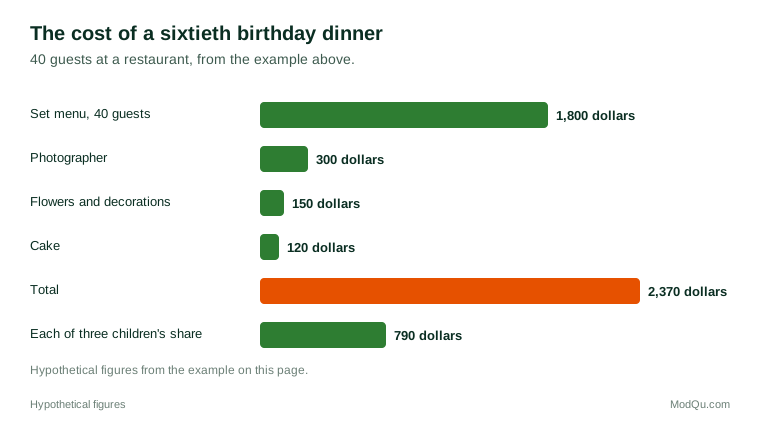
A family holds a sixtieth birthday dinner for 40 guests at a restaurant. The set menu costs 45 dollars a head, 1,800 dollars in total. A cake costs 120 dollars, flowers and decorations 150 dollars, and a photographer 300 dollars. The total is 2,370 dollars. Three adult children split the cost equally, 790 dollars each.
Common pressures on spending include:
- comparison with other families' parties, often seen on social media;
- children's expectations, especially when classmates have large parties;
- guest lists that grow;
- cultural or family expectations for certain occasions;
- rising prices for venues and food.
Keeping celebrations affordable
Many families look for ways to keep celebrations affordable without losing what matters to them. Common approaches include:
- holding parties at home, in a park or in a relative's garden;
- shared or joint parties, such as two children with nearby birthdays celebrating together;
- potluck meals where each guest brings a dish;
- homemade cakes and decorations;
- smaller guest lists;
- setting a budget early and sticking to it;
- choosing an experience, such as a family day out, instead of a party.
Example
Two families whose children share a birthday week hold a joint party in a park. Each family brings food, one parent organizes games and another bakes a cake. They say it cost less than half of a venue party and the children enjoyed having more friends there.
Gifts and money
Gifts are a large part of many occasions. Practices include:
- presents chosen by the giver;
- gift lists and wish lists;
- cash or money transfers, common in many cultures and increasingly in others;
- red envelopes at Lunar New Year and other occasions in East and Southeast Asian cultures;
- group gifts where several people share the cost;
- "no gifts" parties or requests to give to charity instead.
Some families set spending limits for children's parties or agree that classmates bring a small amount of money towards one larger present.
Example
A class of parents agrees that for children's birthday parties, each guest brings 5 dollars in a card instead of a present. The birthday child buys one item they want. Parents say it saves time and reduces the number of unwanted toys.
Planning and stress
Family occasions can be enjoyable and stressful at once. Common sources of stress include cost, planning time, disagreements about guest lists and arrangements, travel for relatives, and the effort of hosting. Many people say smaller, simpler celebrations were the ones they enjoyed most.
Planning tools have changed: invitations are often sent by message or online, guests reply in group chats, and decorations and supplies are ordered online.
What people disagree about
Celebrations raise a few common debates:
- how much is reasonable to spend on a child's birthday party;
- whether to invite the whole class to children's parties;
- whether giving cash is acceptable;
- how to share costs and hosting between family members;
- whether social media has raised expectations.
Questions venues, caterers, party suppliers and family brands want answered include how families celebrate, what they spend, where they hold events and which services they hire.
Key terms
- Milestone birthdayA birthday at an age seen as especially significant, such as 18, 50 or 60.
- Coming-of-age ceremonyA ceremony marking a young person's move towards adulthood.
- Party packageA venue's set price for a party, often including food and activities.
- CatererA business that prepares and serves food for events.
- Party bagA small bag of gifts given to children leaving a party.
- Red envelopeMoney given in a red envelope at Lunar New Year and other occasions.
- Gift listA list of items a person would like to receive.
- Venue hirePaying to use a hall, room or space for an event.
Full glossary: live events production terms on EditingTests.com.
Birthdays and family occasions vocabulary test
How well do you know the language of this topic? Try 8 quick questions. Your score is shown straight away and is not saved.
What the birthdays and family occasions survey asks
This survey is part of ModQu's Life Stages and Family survey. The birthdays and family occasions part takes about five minutes and covers:
- Your last family celebration: what it was for and how many people came.
- Where it was held.
- How much it cost, as a range, and who paid.
- Which services you hired, if any.
- How you handle gifts, including cash.
- What you would do differently next time.
After that you can choose to continue with other short parts of the Life Stages and Family survey, such as ageing and senior living or weddings and celebrations, or stop.
Ready to take part?
Your answers help show what people really think and do. Results are only ever reported as totals; no one can see your individual answers.
Start the surveyQuestions about this survey
Who can take part?
Adults.
Do I have to give my name?
No. You may be asked for your age group, region and similar details so results can be broken down, but not your name. ModQu never asks for passwords, card numbers or account numbers.
How are the results used?
Answers are combined into totals and percentages and published in ModQu reports. Individual answers are never shown.
Is the vocabulary test part of the survey?
No. It is optional and separate, and your score is not stored.
Does the survey cover weddings and funerals?
Those have their own survey pages. This one covers birthdays, anniversaries, festivals and other family occasions.
Can I answer if my family does not celebrate birthdays?
Yes. The survey covers all kinds of family occasions, including religious and cultural ones.