
Share your life as a basketball fan
Tell us which leagues you follow, how you watch games and whether you have bought team merchandise. Your answers are combined with other people's and reported only as totals.
Start the basketball fans surveyAbout 5 minutes. No account needed. You can stop at any time.
What this topic covers
Basketball was invented in the United States in 1891 and is now one of the most widely played and watched sports in the world. It is governed internationally by FIBA (the International Basketball Federation), and it is an Olympic sport for men and women in both five-on-five and three-on-three formats.
This topic is about fans. It covers:
- which leagues and teams people follow, at home and abroad;
- how they watch: live at arenas, on television, by streaming, or through clips and highlights;
- what they spend on tickets, subscriptions and merchandise;
- following individual players;
- fantasy basketball, video games and online fan culture.
Leagues fans follow
Fans follow basketball at several levels:
- The main North American men's professional league, the best-known basketball league in the world, followed by fans in many countries through broadcasts and social media.
- The North American women's professional league, whose audiences and attendance have grown in recent years.
- National leagues in countries such as Spain, Türkiye, Greece, Lithuania, China, the Philippines, Australia, Argentina and many others.
- European club competitions, in which top clubs from different countries play each other.
- International competitions, including the FIBA Basketball World Cup, continental championships and the Olympics.
- College and university basketball, which is a major spectator sport in the United States.
Many fans outside North America follow both a local team and a North American team, often because of a favourite player.
Example
A student in Manila plays basketball every evening on a neighbourhood court. He follows his country's professional league and supports a team in the main North American league because of a guard he has admired since childhood. He watches North American games in the morning before school, because of the time difference, usually as highlights on his phone.
Following players
Basketball has five players per team on court, so individual stars are very visible. Many fans follow players more than teams, switching support when a favourite player moves. Star players have large social media followings and signature shoes, which ties basketball closely to fashion and sportswear. International players have also helped the sport grow in their home countries, where fans follow their careers abroad closely.
How fans watch
Fans watch basketball in many ways:
- At the arena, where games come with music, entertainment and food.
- On television, through national broadcasters or pay services.
- By streaming, including league-run services that show out-of-market or international games.
- Through highlights and short clips on social media, which many younger fans prefer to full games.
- On outdoor screens and in bars for big games.
Time zones affect international fans: games in North America often air in the early morning in Asia and late at night or overnight in Europe, so many international fans watch replays or highlights.
Merchandise
Basketball merchandise is a large market. Fans buy:
- replica and authentic jerseys of teams and players;
- caps, hoodies and other team clothing;
- basketball shoes, including player signature models;
- trading cards, which have become a serious hobby and investment for some collectors;
- basketballs and hoops for playing at home.
Example (hypothetical figures)
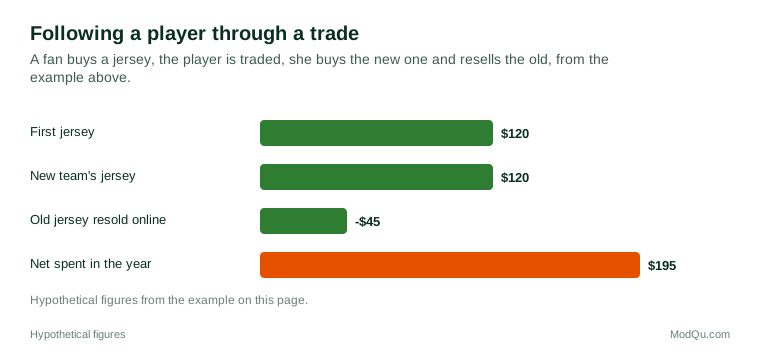
A fan buys a replica jersey of her favourite player for $120. Six months later the player is traded to another team. She buys the new team's jersey for $120 and sells the old one online for $45. Her net spending on jerseys for that player in one year is $195.
Jerseys and shoes are often worn as everyday fashion by people who do not follow the sport closely, which spreads the visibility of teams and players.
Fantasy, games and online fan culture
Many fans play fantasy basketball, picking a team of real players and scoring points based on their statistics. Basketball video games are popular and introduce many young people to players and teams. Online, fans discuss trades, statistics, contracts and debates over who is the greatest player of all time, sometimes in very large communities. Detailed statistics are central to how many fans talk about the game.
Playing and watching
Basketball is easy to play informally: a ball and a hoop are enough, and a court fits in small urban spaces. Many fans play as well as watch. The three-on-three format, played on half a court, has grown quickly, including in cities in Asia and Europe.
Example
A youth worker in an African city organizes a weekend three-on-three tournament on a newly painted public court. Forty teams sign up. Local businesses donate water and prizes, and several players are later invited to trials with a regional club.
Issues fans care about
Fans often raise concerns about:
- the cost of tickets and of watching on television or streaming;
- star players resting or missing games, which disappoints fans who bought tickets;
- the length of seasons and the number of games;
- trades that move favourite players;
- the growth and coverage of women's basketball;
- access to games in their country and time zone.
Attending games
Going to a professional or college game is a big outing for many fans. Ticket prices vary greatly: seats close to the court at top-level games can be very expensive, while lower-division, college and international club games are often affordable. Arenas offer food, music, half-time shows and giveaways, and many fans say the atmosphere is the main reason to go.
Fans who live far from a top-level team may attend only once in a lifetime, sometimes as part of a trip abroad. Local leagues, college games and national team matches give others a chance to see live basketball closer to home. Questions about attendance help leagues understand who comes, how far they travel and what would bring them back.
What fans disagree about
Fans disagree about whether the modern game relies too much on three-point shooting, whether star players have too much power to choose their teams, whether the regular season matters when many teams reach the playoffs, and whether national leagues or international competitions deserve more attention. Long-time fans and newer fans who follow mainly through social media often have different views of what makes the game exciting.
Questions that leagues, clubs, broadcasters, sportswear brands and sponsors want answered include which leagues people follow, how they watch, whether they buy merchandise, which players they follow and what would make them attend or watch more.
Key terms
- FIBAThe International Basketball Federation, which governs the sport internationally.
- Three-on-threeA half-court version of basketball with three players per side.
- Replica jerseyA lower-priced copy of a team's game jersey sold to fans.
- Signature shoeA basketball shoe designed with and named after a player.
- TradeA deal in which teams exchange players.
- PlayoffsThe knockout stage after the regular season.
- Fantasy basketballA game in which fans pick real players and score points from their statistics.
- Out-of-marketGames not shown on local television in a fan's area.
Full glossary: sports management terms on EditingTests.com.
Basketball fans vocabulary test
How well do you know the language of this topic? Try 8 quick questions. Your score is shown straight away and is not saved.
What the basketball fans survey asks
This survey is part of ModQu's Sports survey. The basketball fans part takes about five minutes and covers:
- Which basketball leagues and teams you follow, at home and abroad.
- Which players you follow, and whether you follow players more than teams.
- How you watch games: arena, TV, streaming, highlights or social media.
- Whether you have bought team merchandise, and what.
- Whether you play basketball yourself, and where.
- What would make you watch or attend more.
After that you can choose to continue with other short parts of the Sports survey, such as football (soccer) fans or playing team sports, or stop.
Ready to take part?
Your answers help show what people really think and do. Results are only ever reported as totals; no one can see your individual answers.
Start the surveyQuestions about this survey
Who can take part?
Adults who follow basketball.
Do I have to give my name?
No. You may be asked for your age group, region and similar details so results can be broken down, but not your name. ModQu never asks for passwords, card numbers or account numbers.
How are the results used?
Answers are combined into totals and percentages and published in ModQu reports. Individual answers are never shown.
Is the vocabulary test part of the survey?
No. It is optional and separate, and your score is not stored.