
Share your experience of adult learning
Tell us why you took your last course, whether it was online or in person and who paid for it. Your answers are combined with other people's and reported only as totals.
Start the adult education and night school surveyAbout 5 minutes. No account needed. You can stop at any time.
What adult education covers
Adult education is organized learning by adults, outside the path from school straight to college or university. It goes by many names, including continuing education, lifelong learning, adult learning and, for evening classes, night school.
The main kinds are:
- Adult basic education and high school completion: courses that let adults earn a high school diploma or upgrade marks in subjects such as English and mathematics to enter college or a trade.
- Literacy and numeracy programs, for adults who want to improve reading, writing or basic mathematics.
- Language classes, including English and French for newcomers. In Canada, the federal government funds free language training for eligible permanent residents through Language Instruction for Newcomers to Canada (LINC), and Québec runs its own French courses for immigrants.
- Continuing education at colleges and universities: part-time certificate and diploma programs, single courses and professional development.
- Workplace-related courses in areas such as first aid, food safety, project management, accounting and software.
- Apprenticeship classroom training for people working in trades.
- Personal interest courses: cooking, art, music, photography, languages, history, fitness and many others, often offered by school boards, community centres, libraries and colleges.
- Older adult learning, such as programs offered through seniors' centres and university-affiliated learning-in-retirement groups.
Why adults go back to learning
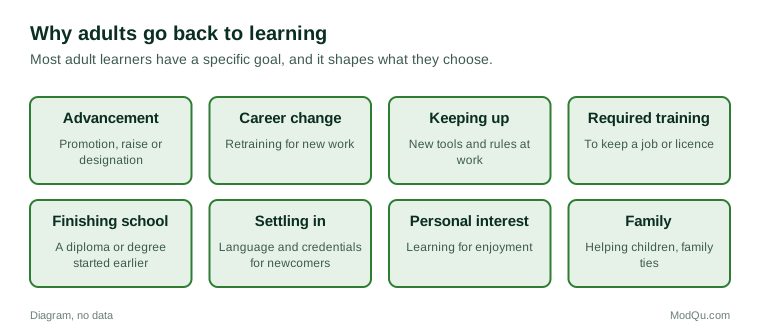
Adults usually have a specific reason for returning to learning, and that reason shapes what they choose. Common motivations include:
- Career advancement: qualifying for a promotion, a raise or a professional designation.
- Career change: retraining after a layoff, an injury or a desire for different work.
- Keeping up: learning new software, rules or methods in a current job.
- Required training: certifications needed to keep a job or licence.
- Completing unfinished education: finishing high school or a degree started years ago.
- Settling in a new country: learning the language and getting foreign credentials recognized.
- Personal growth and interest: learning for enjoyment, to meet people or to stay mentally active.
- Supporting family: for example learning a language to help children with homework.
Example
A 42-year-old retail supervisor left high school without finishing. Their children are now in high school, and they want to apply for a management training program that requires a diploma. They enrol in an adult high school completion program run by their school board, taking two evening courses a term, and graduate in a year and a half.
How courses are offered
Adult education has to fit around work and family, so it is offered in many formats:
- Evening and weekend classes, the classic night school model;
- Online courses, self-paced or with live sessions;
- Hybrid courses combining online work with some in-person sessions;
- Intensive courses over a few days or weeks;
- Part-time programs spread over months or years;
- Workplace training delivered during work hours;
- Prior learning assessment and recognition (PLAR), through which some colleges and universities give credit for skills learned through work and life experience.
Online and hybrid options have grown a lot, making it easier for people in rural areas and people with busy schedules to take part. Some learners still prefer in-person classes for the structure, contact with instructors and other learners, and hands-on practice.
Costs and who pays
Costs vary widely. Many adult high school completion and literacy programs are free or low-cost, funded by provinces. Language classes for eligible newcomers are often free. Personal interest courses through community centres and school boards usually charge modest fees. College and university continuing education courses often charge per course.
Adults pay for learning in several ways:
- their own money;
- employer support, such as paying fees directly or reimbursing them after the course is passed, sometimes with a requirement to stay for a period;
- government programs, such as provincial training grants for unemployed workers, and the federal Canada Training Credit, which lets eligible workers claim part of their training costs on their tax return;
- tax measures, such as the tuition tax credit for eligible courses at recognized institutions, and the Lifelong Learning Plan, which allows people to withdraw from their RRSP for full-time education under set rules;
- unions and industry training funds.
Example (hypothetical figures)
A worker takes a three-course evening certificate in human resources at a college. Each course costs $780, for $2,340 in total. Their employer reimburses 75% of the fees once each course is passed, which is $1,755. The worker's own cost is $585, part of which they can claim through the tuition tax credit.
Questions that businesses and schools want answered here include why adults take courses, which formats they prefer, and how much employer support affects whether they enrol.
Barriers to adult learning
When adults are asked what stops them taking courses, or what made a course hard to finish, common answers include:
- Time: work, family and caregiving leave little time for study.
- Cost, especially for longer programs.
- Scheduling: classes at times that do not fit shifts or childcare.
- Confidence: worry about going back to school after many years, or bad memories of school.
- Distance and transportation, especially outside cities.
- Technology: lack of a reliable computer or internet for online courses.
- Information: not knowing what courses are available or which would help.
- Recognition: doubt that a course will lead to a job or a raise.
Adults with lower levels of formal education are often less likely to take part in adult learning, even though they may benefit greatly. This pattern has been found in many countries.
Example
A warehouse worker on night shifts wants to take a forklift and supervisor course, but the college offers it only on weekday evenings, when they are at work. They find an online version with a weekend in-person practical session, and their manager adjusts their schedule for that weekend.
What adult learners say helps
Adult learners often describe what made their learning work:
- courses that fit their schedule, including online or evening options;
- instructors who treat them as adults and draw on their experience;
- practical content they can use right away;
- support from family and employers;
- flexible deadlines;
- recognition for what they already know;
- a clear link to a goal, such as a job or a credential.
Example
A retired engineer joins a university-affiliated learning group for older adults that runs peer-led study groups on history and literature. There are no exams or grades. They say the weekly sessions give them structure, new friends and something to read and argue about.
What people disagree about
There are debates about adult education. Who should pay: individuals, employers or governments? Should funding focus on training for jobs, or include learning for personal interest and community life? How should credits from prior learning and foreign qualifications be recognized? And with more courses online, how can adults who lack digital skills or internet access avoid being left behind?
Key terms
- Continuing educationPart-time courses and programs for adults offered by colleges, universities and others.
- Lifelong learningLearning throughout life, for work and personal reasons.
- Adult basic educationPrograms that help adults build literacy, numeracy and high school credits.
- UpgradingTaking courses to improve marks or meet entry requirements.
- Prior learning assessmentA process that gives credit for skills learned through work and life.
- Tuition tax creditA tax credit for eligible tuition fees paid to recognized institutions.
- LINCFree federally funded language classes for eligible newcomers to Canada.
- Credit courseA course that counts toward a diploma, degree or certificate.
Full glossary: e learning content terms on EditingTests.com.
Adult education and night school vocabulary test
How well do you know the language of this topic? Try 8 quick questions. Your score is shown straight away and is not saved.
What the adult education and night school survey asks
This survey is part of ModQu's Education and Learning survey. The adult education and night school part takes about five minutes and covers:
- Why you took your most recent course, and what kind of course it was.
- Whether it was online, in person or a mix, and which you prefer.
- Who paid for it, and whether your employer supported you.
- How the course fitted around work and family.
- What has stopped you taking courses, if anything.
- Whether the course helped you reach your goal.
After that you can choose to continue with other short parts of the Education and Learning survey, such as choosing a college or university or online learning, or stop.
Ready to take part?
Your answers help show what people really think and do. Results are only ever reported as totals; no one can see your individual answers.
Start the surveyQuestions about this survey
Who can take part?
Adults who took a course in the last two years.
Do I have to give my name?
No. You may be asked for your age group, region and similar details so results can be broken down, but not your name. ModQu never asks for passwords, card numbers or account numbers.
How are the results used?
Answers are combined into totals and percentages and published in ModQu reports. Individual answers are never shown.
Is the vocabulary test part of the survey?
No. It is optional and separate, and your score is not stored.
Do personal interest classes count?
Yes. Any organized course you took as an adult counts, including hobby, fitness and language classes.