
Share your experience of inclusion at work
Tell us whether you feel included at work and how fairly people are treated. Your answers are combined with other people's and reported only as totals.
Start the workplace diversity and inclusion surveyAbout 5 minutes. No account needed. You can stop at any time.
What diversity and inclusion mean
Diversity describes the mix of people in a workplace. It can include age, sex and gender, ethnicity, nationality, language, religion, disability, sexual orientation, social background, education and caring responsibilities. A workplace is diverse when its staff come from many of these groups rather than mostly one.
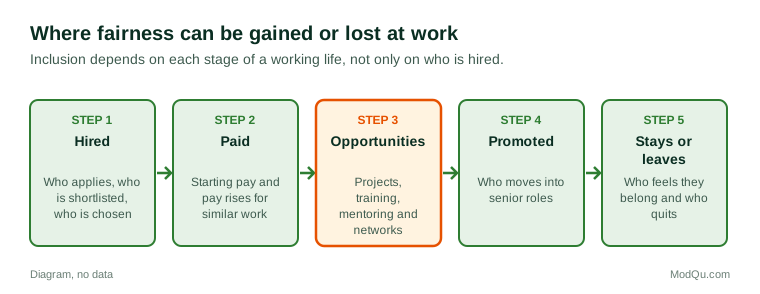
Inclusion describes how people are treated once they are there: whether they are respected, heard, given fair chances and able to do their best work without hiding parts of who they are. A workplace can be diverse without being inclusive, for example if people from some groups are hired but rarely promoted, or leave quickly.
Related terms often used alongside them are equity, meaning fair access to opportunities given that people start from different places, and belonging, meaning a person's sense that they are accepted as part of the group.
Why the subject matters to workers and employers
For workers, inclusion affects daily experience: who gets interesting assignments, whose ideas are taken seriously, who is invited to meetings and social events, and who is paid and promoted. People who feel excluded report lower job satisfaction and are more likely to leave.
For employers, the reasons given usually include:
- following equality and anti-discrimination law;
- hiring from a wider pool of talent;
- keeping staff and reducing turnover;
- serving customers from many backgrounds;
- bringing different views into decisions.
Laws differ greatly between countries. Many countries prohibit discrimination at work on grounds such as sex, race, religion, disability and age, and some include sexual orientation and other grounds. The International Labour Organization's Discrimination (Employment and Occupation) Convention of 1958 is one of its core conventions and has been ratified by most member states. What is legally protected, and how laws are enforced, still varies widely.
How unfair treatment happens
Unfair treatment at work is not always open or deliberate. It can take several forms:
- Direct discrimination: treating someone worse because of a protected characteristic, for example refusing to hire a qualified older applicant because of their age.
- Indirect discrimination: a rule that applies to everyone but disadvantages one group, such as a requirement that is not needed for the job.
- Harassment: unwanted behaviour that makes someone feel intimidated or degraded.
- Unconscious bias: judgements people make without realizing, for example about who "fits" a team.
- Microaggressions: small remarks or actions, often unintended, that signal someone is an outsider.
- Exclusion from networks: informal meetings, social events or mentoring that some groups are left out of.
Example
A team regularly holds planning talks at an after-work social event. One member does not drink alcohol for religious reasons and another must leave at 5 p.m. to collect a child. Neither is formally excluded, but both often find decisions have been made without them.
What employers commonly do
Organizations take a wide range of steps, from small changes to large programs:
- written equality and anti-harassment policies, with ways to report problems;
- removing names or photos from job applications at the first stage;
- structured interviews with the same questions for every candidate;
- training on bias, harassment and respectful behaviour;
- employee networks or resource groups for staff who share a background or experience;
- mentoring and sponsorship programs;
- workplace adjustments for disability, such as equipment or changed hours;
- prayer or quiet rooms, flexible holidays for different faiths, and parental and carer leave;
- pay audits that compare pay across groups doing similar work.
Some employers publish figures on the make-up of their workforce or pay gaps, in some countries because the law requires it for larger firms.
Example
A hospital notices that nurses with qualifications from other countries are rarely promoted to senior roles. It sets up a mentoring program and changes promotion interviews so each candidate is asked the same questions and scored by a panel instead of one manager.
Measuring inclusion
Diversity can be counted, with consent, by asking staff to describe themselves in confidential surveys. Inclusion is harder to measure, because it is about experience. Employers and researchers use survey questions such as whether people feel respected, whether they can speak up without fear, and whether promotion is fair.
Example (hypothetical figures)
In an anonymous survey of 500 staff, 420 answer. Of these, 330 say they feel included. When the results are broken down, 85% of staff in head office agree, compared with 65% of staff in regional depots. The employer decides to look at depot conditions first.
Because some groups are small, results must be reported carefully so individuals cannot be identified. Many people also choose not to answer personal questions, which affects what can be learned.
What people disagree about
Diversity and inclusion programs are debated in many countries. Supporters say they correct unfair treatment and help organizations work better. Critics argue that some programs are box-ticking, that training does not change behaviour, or that targets can lead to unfairness of a different kind. Others question how far employers should go beyond what the law requires. There is also debate about which groups should be counted, and whether to focus on diversity numbers or on the daily experience of inclusion.
Questions that employers and HR teams want answered include whether staff feel included, whether they have seen unfair treatment, whether they would feel safe reporting it, and whether their employer has done enough.
Key terms
- DiversityThe mix of different kinds of people in a workplace.
- InclusionWhether people are treated fairly and feel able to take full part.
- EquityFair access to opportunities, allowing for different starting points.
- Indirect discriminationA rule for everyone that disadvantages one group without good reason.
- Unconscious biasA judgement made about people without being aware of it.
- MicroaggressionA small remark or act, often unintended, that signals someone does not belong.
- Reasonable adjustmentA change to a job or workplace that removes a barrier for a disabled worker.
- Pay gapThe difference in average pay between two groups of workers.
Full glossary: diversity equity inclusion consulting terms on EditingTests.com.
Workplace diversity and inclusion vocabulary test
How well do you know the language of this topic? Try 8 quick questions. Your score is shown straight away and is not saved.
What the workplace diversity and inclusion survey asks
This survey is part of ModQu's Work and Careers survey. The workplace diversity and inclusion part takes about five minutes and covers:
- Whether you feel included and respected at work.
- Whether you have seen or experienced unfair treatment, and what kind.
- Whether you would feel safe reporting a problem.
- Which inclusion programs your employer runs, if any.
- How fair you think hiring, pay and promotion are.
- Whether you think your employer has done enough, too much or too little.
After that you can choose to continue with other short parts of the Work and Careers survey, such as job satisfaction or remote and hybrid work, or stop.
Ready to take part?
Your answers help show what people really think and do. Results are only ever reported as totals; no one can see your individual answers.
Start the surveyQuestions about this survey
Who can take part?
Employees.
Do I have to give my name?
No. You may be asked for your age group, region and similar details so results can be broken down, but not your name. ModQu never asks for passwords, card numbers or account numbers.
How are the results used?
Answers are combined into totals and percentages and published in ModQu reports. Individual answers are never shown.
Is the vocabulary test part of the survey?
No. It is optional and separate, and your score is not stored.
Is diversity the same as inclusion?
No. Diversity is about who is in the workplace. Inclusion is about how people are treated and whether they feel able to take full part once they are there.
Do I have to describe my background to answer?
No. Personal questions such as ethnicity, religion or disability are optional, and you can choose not to answer any of them.
Why do employers ask staff about inclusion?
Because inclusion is about experience, it cannot be counted from records alone. Confidential surveys are one of the few ways to learn how staff feel.
What counts as unfair treatment at work?
It can range from open discrimination and harassment to being left out of meetings, training or promotion chances. Legal definitions differ by country.