
Share your experience as a victim of crime
Tell us whether you have experienced crime, whether you reported it and what support you received. Your answers are combined with other people's and reported only as totals.
Start the victims of crime surveyAbout 5 minutes. No account needed. You can stop at any time.
Who is a victim of crime
A victim of crime is a person who has suffered harm because of a criminal act. The harm can be physical, emotional or financial. Many legal systems also treat close family members of someone killed by a crime as victims, and some recognize businesses and organizations as victims of offences such as theft or fraud.
Most people who experience crime suffer relatively common offences rather than the serious violent crimes that receive the most news coverage. The experience can still be upsetting, costly and time-consuming.
Common kinds of crime
Crimes against individuals and households are often grouped like this:
- Property crime: theft of personal items, bicycle and vehicle theft, burglary and vandalism.
- Fraud and online crime: card fraud, scams, identity theft, account takeovers and online shopping fraud.
- Violent crime: assault, robbery and threats.
- Sexual offences, including sexual assault and image-based abuse.
- Domestic abuse: physical, emotional, sexual, financial or controlling behaviour by a partner or family member.
- Hate crime: an offence motivated by hostility towards a person's race, religion, disability, sexual orientation or other characteristic.
- Harassment and stalking, in person or online.
In many countries fraud and online crime have become among the most commonly experienced offences, as more shopping, banking and communication moves online.
Example
A student's bicycle is taken from outside a library, even though it was locked. They report it online to the police to get a crime reference number, which their insurer asks for before processing a claim.
Why many crimes are not reported
Crime surveys in many countries, such as those run by national statistics offices, consistently find that a large share of crimes are never reported to the police. Researchers sometimes call the unreported part the dark figure of crime. Common reasons people give include:
- The incident seemed too minor or nothing was lost.
- They believed the police could not or would not do anything.
- They dealt with it themselves or reported it to someone else, such as a bank.
- They feared retaliation or did not want the offender, often someone they knew, to get into trouble.
- They felt embarrassed or worried they would not be believed.
- They did not trust the police or had a bad experience before.
- Language barriers or concern about immigration status.
Reporting rates tend to differ by type of crime. Vehicle theft and burglary are often reported because insurers require a report. Sexual offences, domestic abuse and fraud are more often unreported.
What usually happens after a report
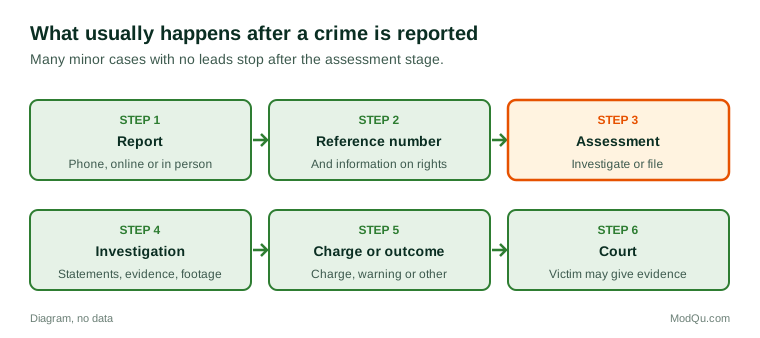
The details vary, but in many countries the steps look similar:
- The report is recorded, by phone, online, at a police station or by an officer who attends.
- The victim receives a reference number and, in some places, a written record of their rights.
- The police assess the report and decide whether to investigate further. Many minor crimes with no leads are filed without further action.
- An investigation may include statements, forensic evidence and checking footage from cameras.
- A suspect may be charged, warned or given an alternative outcome, such as a community resolution.
- A prosecution goes to court, where the victim may be asked to give evidence.
- Sentencing and after, including information about release dates in some systems.
Example (hypothetical figures)
A shopper loses 600 in their local currency to an online purchase that never arrives. Their bank refunds 400 under its fraud rules, leaving them 200 out of pocket. They also report the fraud to the national reporting service so that the seller's account can be linked to other complaints.
Victims' rights
Many countries have set out the rights of victims in law or in official codes. The European Union, for example, has a directive setting minimum standards for victims' rights in its member states, and many other countries have victims' charters or bills of rights. A United Nations declaration of 1985 sets out basic principles of justice for victims of crime.
Rights commonly include:
- Information about the progress of the case and decisions made.
- Respect and recognition, and being treated with dignity.
- Support services, including emotional and practical help.
- Protection from intimidation and repeat harm, such as protective orders.
- Taking part in proceedings, for example by giving a victim personal statement or impact statement.
- Interpretation and translation where needed.
- Compensation, from the offender or from a state scheme in some countries.
Support for victims
Support may be offered by the police, courts, health services and charities. It can include:
- Emotional support and counselling.
- Practical help, such as changing locks or replacing documents.
- Help understanding the court process and visiting a court before a trial.
- Specialist services for domestic abuse, sexual violence and hate crime.
- Safe accommodation, such as refuges.
- Help with claims for compensation.
Some people need support even if they do not report the crime to the police, and many services accept people directly.
Example
A woman who was threatened by a former partner calls a domestic abuse helpline. A support worker helps her think through her safety, explains how protective orders work where she lives, and tells her about local refuge places, without asking her to make a police report first.
Effects of crime on victims
The impact of crime varies widely. Some people move on quickly, while others experience lasting effects. These can include fear of going out, anxiety, sleep problems, anger, loss of trust in others, money worries, time off work and physical injuries. Repeat victimization, where the same person or household is targeted again, can increase these effects. How a victim is treated by the police and courts can also affect how they feel about the experience.
What people and businesses want to know
Questions public bodies, insurers and support organizations want answered include how many people experience crime, which kinds, how many report it, why some do not, how satisfied victims are with the police and courts, what support they received, and how much the crime cost them.
Key terms
- VictimA person who has suffered harm because of a criminal act.
- Crime reference numberThe number given when a crime is recorded by the police.
- Dark figure of crimeCrime that happens but is never reported or recorded.
- Victim impact statementA statement in which a victim describes how a crime has affected them.
- Protective orderA court order that restricts contact by a person who poses a risk.
- Hate crimeAn offence motivated by hostility towards a characteristic such as race or religion.
- Repeat victimizationWhen the same person or place is targeted more than once.
- Crime surveyA survey that asks people directly about crimes they have experienced.
Full glossary: crime analysis terms on EditingTests.com.
Victims of crime vocabulary test
How well do you know the language of this topic? Try 8 quick questions. Your score is shown straight away and is not saved.
What the victims of crime survey asks
This survey is part of ModQu's Law and Rights survey. The victims of crime part takes about five minutes and covers:
- Whether you or your household have experienced crime in the last three years, and what kind.
- Whether you reported it to the police or another body, and if not, why not.
- How you were treated after reporting it, and how satisfied you were.
- What support you were offered or received, and from whom.
- How the crime affected you, including any money lost or time off work.
- How safe you feel in your area now.
After that you can choose to continue with other short parts of the Law and Rights survey, such as using a lawyer or consumer rights and complaints, or stop.
Ready to take part?
Your answers help show what people really think and do. Results are only ever reported as totals; no one can see your individual answers.
Start the surveyQuestions about this survey
Who can take part?
Adults.
Do I have to give my name?
No. You may be asked for your age group, region and similar details so results can be broken down, but not your name. ModQu never asks for passwords, card numbers or account numbers.
How are the results used?
Answers are combined into totals and percentages and published in ModQu reports. Individual answers are never shown.
Is the vocabulary test part of the survey?
No. It is optional and separate, and your score is not stored.