
Share your experience of separation
Tell us whether you used a lawyer or a mediator, how long it took and what it cost. Your answers are combined with other people's and reported only as totals.
Start the family law and separation surveyAbout 5 minutes. No account needed. You can stop at any time.
What this topic covers
This topic is about the process of separating, for married and unmarried couples, and the legal help people use along the way. It covers parenting arrangements, child and spousal support, dividing property and debts, the family home, and the different routes to an agreement: negotiation between the couple, mediation, collaborative law, arbitration and court.
In Canada, divorce for married couples is governed by the federal Divorce Act, while property division, the rights of unmarried couples and many parenting and support questions fall under provincial and territorial law. Rules for common-law and unmarried partners differ considerably between provinces, especially for property. In the United States, family law is set mainly by each state.
The main issues to settle
Separating couples usually need to decide on several matters:
- Parenting: where children will live, how time is shared, and how decisions about health, education and religion will be made. The Divorce Act uses the terms "parenting time" and "decision-making responsibility", and the best interests of the child are the main consideration.
- Child support: payments to help support children, usually calculated using the Federal Child Support Guidelines or provincial guidelines based on income and the parenting arrangement.
- Spousal support: payments from one partner to the other in some situations, which may be informed by the Spousal Support Advisory Guidelines.
- Property and debts: the home, pensions, savings, vehicles, businesses and debts.
- The family home: whether one partner keeps it, it is sold, or both stay for a time.
Example
A married couple with two school-age children agree to separate. They decide the children will spend alternate weeks with each parent, that both will share decisions about school and health, and that the parent with the higher income will pay child support set by the guidelines. The house is sold, and the proceeds are divided after the mortgage is paid off.
Ways to reach agreement
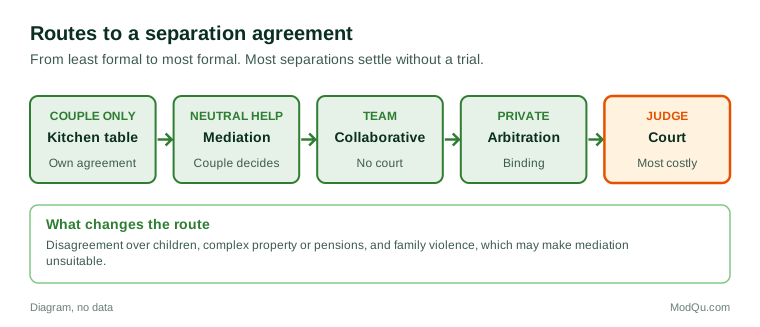
Couples can settle their separation in several ways, from least to most formal:
- Kitchen-table agreements, where the couple works things out themselves, sometimes using templates, and often has each side's lawyer review the result.
- Mediation, where a neutral mediator helps the couple discuss issues and reach an agreement. Mediators do not decide the outcome. Some are lawyers; others come from social work, psychology or other fields.
- Collaborative family law, where each partner has a lawyer trained in collaborative practice, and everyone signs an agreement to settle without going to court. Financial and family professionals may join the team.
- Negotiation through lawyers, by letters, meetings and settlement conferences.
- Arbitration, where a private arbitrator hears both sides and makes a binding decision.
- Court, where a judge decides any issues the couple cannot settle.
Most separations in Canada are settled without a trial. A written separation agreement or a court order records what was agreed or decided. A divorce itself is granted by a court, but many uncontested divorces are handled through paperwork without a hearing.
Lawyers and mediators
People's choices about legal help vary widely. Some hire a lawyer for every step; others use a mediator and have a lawyer review the final agreement; some represent themselves entirely. Common reasons for using a lawyer include complex property or pensions, a business, disagreement over children, a history of family violence, or a partner who already has a lawyer.
Family violence changes the process. Mediation may not be suitable where one partner fears the other, and courts and mediators screen for this. Provincial legal aid programs often give priority to family cases involving violence.
Example
A couple married for 22 years choose mediation to save cost. They attend five two-hour sessions, then each takes the draft agreement to their own lawyer for independent legal advice. One lawyer suggests a change to how a workplace pension is valued, which the couple settles in a final session.
What separation costs
Costs depend mostly on how much the couple agrees on and which route they use. Common costs include:
- lawyers' fees, usually hourly, with a retainer;
- mediator fees, often split between the couple;
- court filing fees;
- valuations of pensions, businesses or property;
- parenting assessments, in some disputed cases;
- the cost of setting up a second home.
Contested cases that go to court and trial cost far more than agreed separations, and can take years.
Example (hypothetical figures)
A couple pays a mediator $250 an hour, split equally, for five two-hour sessions. Ten hours cost $2,500, so each pays $1,250. Each then pays a lawyer $350 an hour for three hours of independent legal advice, $1,050 each. Court filing fees for an uncontested divorce are $400 in total, split equally. Each partner's total is $1,250 plus $1,050 plus $200, which is $2,500.
How long it takes
Timelines range from a few months for simple, agreed separations to several years for contested cases. In Canada, the most common ground for divorce is living separate and apart for at least one year, so many couples settle parenting, support and property while they wait to apply for the divorce itself. Court delays, valuations, disagreements over children and changes in circumstances can all extend the process.
Support services and changes
Many services exist alongside legal help: family justice centres, parenting-after-separation courses (required in some provinces before a court case), counselling, support groups, financial advisors who work with separating couples, and child support services that calculate or enforce payments. Provinces run maintenance enforcement programs that collect and pass on support payments when a payor does not pay.
Trends include more online tools for drafting agreements and calculating support, video mediation and court hearings, unbundled legal services, and changes to the Divorce Act in 2021 that put more emphasis on the best interests of the child and on family violence. Debates include the cost of family justice, the number of self-represented people in family court, and how to protect children from conflict. Questions businesses and public bodies want answered include whether people used lawyers or mediators, how long separation took, what it cost and how satisfied people were.
Key terms
- Separation agreementA written contract setting out how separating partners will handle children, support and property.
- MediationA process where a neutral person helps a couple reach their own agreement.
- Collaborative lawA process where each partner has a lawyer and all agree to settle without court.
- Child supportPayments to help support children after separation, usually set by guidelines.
- Spousal supportPayments from one partner to the other in some situations after separation.
- Parenting timeThe time a child spends in each parent's care.
- Decision-making responsibilityThe authority to make major decisions about a child's health, education and other matters.
- Independent legal adviceAdvice from a lawyer acting only for one partner before signing an agreement.
Full glossary: mediation services terms on EditingTests.com.
Family law and separation vocabulary test
How well do you know the language of this topic? Try 8 quick questions. Your score is shown straight away and is not saved.
What the family law and separation survey asks
This survey is part of ModQu's Law and Rights survey. The family law and separation part takes about five minutes and covers:
- When you separated or divorced, and whether children were involved.
- Whether you used a lawyer, a mediator, collaborative law, arbitration or court.
- How long the process took from separation to final agreement.
- What it cost, roughly, including all professional fees.
- How satisfied you were with the process and the result.
- What would have made the process easier.
After that you can choose to continue with other short parts of the Law and Rights survey, such as using a lawyer or consumer rights and complaints, or stop.
Ready to take part?
Your answers help show what people really think and do. Results are only ever reported as totals; no one can see your individual answers.
Start the surveyQuestions about this survey
Who can take part?
Adults who separated or divorced in the last five years.
Do I have to give my name?
No. You may be asked for your age group, region and similar details so results can be broken down, but not your name. ModQu never asks for passwords, card numbers or account numbers.
How are the results used?
Answers are combined into totals and percentages and published in ModQu reports. Individual answers are never shown.
Is the vocabulary test part of the survey?
No. It is optional and separate, and your score is not stored.