
Share your experience of legal help
Tell us why you needed legal help, how you found your lawyer and whether the cost matched what you expected. Your answers are combined with other people's and reported only as totals.
Start the using a lawyer surveyAbout 5 minutes. No account needed. You can stop at any time.
Why people need legal help
People seek legal help for many reasons. Some are planned and routine; others come with stress and deadlines. Common reasons include:
- Buying or selling a home, and mortgages.
- Wills, estates and powers of attorney.
- Separation, divorce, child custody and support.
- Disputes with landlords, neighbours, contractors, employers or businesses.
- Employment issues, such as dismissal or workplace harassment.
- Personal injury, after a car crash or fall.
- Criminal charges, including impaired driving.
- Immigration and citizenship.
- Starting or running a business, contracts and leases.
- Debt and bankruptcy.
Studies of everyday legal problems in Canada, such as those by the Canadian Forum on Civil Justice and the federal Department of Justice, have found that many adults experience at least one serious legal problem over a few years, and that many of them never get formal legal help.
Who provides legal help
Legal help comes from several kinds of providers, each regulated differently:
- Lawyers, licensed by a provincial or territorial law society, who can give legal advice and represent clients in court.
- Notaries in Quebec, who are legal professionals handling real estate, wills, marriage contracts and other non-court matters.
- Notaries public in British Columbia, who can handle some real estate, wills and other documents.
- Licensed paralegals in Ontario, who can represent people in small claims court, some tribunals and some minor offences.
- Legal aid clinics and legal aid plans, which help people with low incomes in certain types of cases.
- Law school clinics and pro bono programs, where students or volunteer lawyers give free help.
- Court and tribunal information services and public legal education websites.
Because rules differ by province, the type of help available for the same problem can vary from place to place.
How people find a lawyer
People find lawyers through:
- recommendations from family, friends or co-workers;
- a lawyer they used before for a different matter;
- referrals from another professional, such as a real estate agent, accountant or doctor;
- law society lawyer referral services, which in several provinces offer a short free first consultation;
- online searches, reviews and directories;
- legal insurance plans, sometimes offered through employers or unions;
- advertising, especially for personal injury and traffic cases.
Example
After being let go from a job, a worker asks friends whether anyone knows an employment lawyer. One suggests the provincial law society's referral service. The worker gets a free 30-minute consultation, learns what questions to ask, and then compares quotes from two lawyers before choosing one who offers a fixed fee to review the severance offer.
How lawyers charge
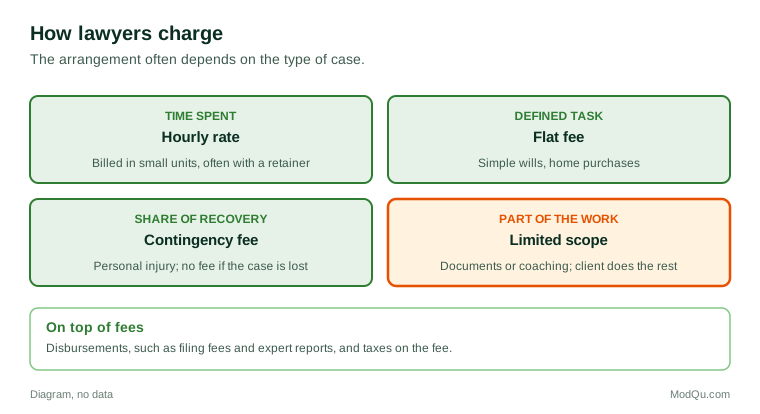
Lawyers use several fee arrangements, and the choice often depends on the type of case:
- Hourly rates, billed in small time units, often with a retainer paid in advance.
- Flat or fixed fees for defined tasks, such as a simple will or a home purchase.
- Contingency fees, common in personal injury, where the lawyer is paid a percentage of any money recovered and nothing if the case is lost. Law societies and some provincial laws set rules on these.
- Limited scope or unbundled services, where the lawyer helps with part of a matter, such as preparing documents or coaching, while the client does the rest.
- Disbursements, which are costs the lawyer pays on the client's behalf, such as court filing fees, searches or expert reports, billed on top of fees.
Example (hypothetical figures)
A client signs a contingency agreement for a personal injury claim at 30% of any settlement, plus disbursements. The case settles for $90,000. The lawyer's fee is $27,000, plus tax on the fee, and disbursements of $4,500 for medical reports and filing fees are repaid. Before tax, the client receives $90,000 minus $27,000 minus $4,500, which is $58,500.
The first meeting and working together
At a first meeting, a lawyer usually asks about the problem, checks for conflicts of interest, explains possible options and outlines fees. Many lawyers then send a retainer agreement or engagement letter setting out the scope of the work and how billing will work. People commonly bring documents, a timeline of events and a list of questions.
Communication is one of the most common sources of dissatisfaction. Clients say they want to understand what is happening, be told about costs as they build up, and get replies within a reasonable time. Lawyers point out that cases can be slow for reasons beyond their control, such as court backlogs or the other side's delays.
Cost and access to justice
Cost is the main reason many people do not hire a lawyer. Legal aid covers some criminal, family and immigration cases for people below income limits that vary by province, and many people earn too much to qualify but too little to pay for a full case. As a result, a growing number of people represent themselves in court and tribunals, especially in family law and small claims.
Example
A tenant facing an eviction hearing earns slightly too much for legal aid. They use a free community legal clinic's information session, read the tribunal's guides and pay a lawyer for one hour of coaching before the hearing. They say this cost far less than full representation and helped them prepare their evidence.
Satisfaction and complaints
People's satisfaction with lawyers often depends on the outcome, but also on whether they felt informed, respected and fairly billed. A client who is unhappy with a bill can ask the lawyer to explain it and, in most provinces, ask for a review or assessment of the account through the courts or the law society. Complaints about a lawyer's conduct go to the provincial or territorial law society, which regulates lawyers and can discipline them.
Trends and debates
Trends include online legal services and document tools, video meetings, unbundled services, more fixed-fee offers and growing use of technology in law firms. Debates include whether non-lawyers should be allowed to provide more legal services, how to make legal help affordable, how to fund legal aid, and how far online tools can safely replace advice from a lawyer. Questions businesses and public bodies want answered include why people needed help, how they found a lawyer, what they paid and whether they were satisfied.
Key terms
- Law societyThe body that licenses and regulates lawyers in a province or territory.
- RetainerMoney paid in advance to a lawyer, held in trust and drawn on as work is done.
- Contingency feeA fee paid as a share of money recovered, with no fee if the case is lost.
- DisbursementsCosts a lawyer pays for a client, such as filing fees, billed on top of fees.
- ParalegalA legal professional who, in Ontario, is licensed to handle certain matters.
- Legal aidPublicly funded legal help for people with low incomes in certain cases.
- Pro bonoLegal work done for free for the public good.
- Self-represented litigantA person who goes to court without a lawyer.
Full glossary: legal advisory terms on EditingTests.com.
Using a lawyer vocabulary test
How well do you know the language of this topic? Try 8 quick questions. Your score is shown straight away and is not saved.
What the using a lawyer survey asks
This survey is part of ModQu's Law and Rights survey. The using a lawyer part takes about five minutes and covers:
- Why you needed legal help, and when.
- How you found your lawyer or other legal help.
- How you were charged: hourly, fixed fee, contingency or other.
- Whether the cost was what you expected.
- How satisfied you were with the help and the result.
- What stopped you, if anything, from getting legal help.
After that you can choose to continue with other short parts of the Law and Rights survey, such as consumer rights and complaints or online privacy rights, or stop.
Ready to take part?
Your answers help show what people really think and do. Results are only ever reported as totals; no one can see your individual answers.
Start the surveyQuestions about this survey
Who can take part?
Adults who needed legal help in the last three years.
Do I have to give my name?
No. You may be asked for your age group, region and similar details so results can be broken down, but not your name. ModQu never asks for passwords, card numbers or account numbers.
How are the results used?
Answers are combined into totals and percentages and published in ModQu reports. Individual answers are never shown.
Is the vocabulary test part of the survey?
No. It is optional and separate, and your score is not stored.