
Share your experience of a rental dispute
Tell us whether you have had a dispute with a landlord or tenant, what it was about and how it was resolved. Your answers are combined with other people's and reported only as totals.
Start the tenant and landlord disputes surveyAbout 5 minutes. No account needed. You can stop at any time.
What this topic covers
This topic is about disagreements between residential tenants and landlords: people renting apartments, houses, basement suites, rooms and condominiums, and the individuals and companies who rent them out. It covers what disputes are about, the laws that govern renting, how disputes are resolved informally, through mediation or at a tribunal, and how people feel about the outcome.
In Canada, residential tenancies are governed by provincial and territorial law. Each province has its own act and a dispute body, such as the Landlord and Tenant Board in Ontario, the Residential Tenancy Branch in British Columbia, the Tribunal administratif du logement in Quebec and the Residential Tenancy Dispute Resolution Service in Alberta, which works alongside the courts. Rules differ significantly between provinces, so the same problem may be handled differently in Halifax, Toronto and Vancouver. In the United States, rules vary by state and often by city.
Common kinds of dispute
Disputes tend to fall into a few groups:
- Repairs and maintenance: heating, leaks, mould, pests, broken appliances and slow responses.
- Rent and rent increases: how much, how often, and how much notice is required, including rules on rent control where it exists.
- Unpaid rent, the most common reason landlords apply to a tribunal.
- Deposits: whether a security or damage deposit is returned, and deductions for damage or cleaning. Some provinces, such as Ontario, do not allow damage deposits but allow a last month's rent deposit.
- Evictions: for unpaid rent, behaviour, the landlord or a family member moving in, renovations or sale.
- Noise and neighbours, including complaints between tenants in the same building.
- Entry and privacy: when and how a landlord may enter the unit.
- Guests, roommates, subletting and pets.
- Discrimination in renting, which is handled under human rights laws.
Example
A tenant reports a broken furnace in January. The landlord sends a technician after four days, who orders a part that takes two weeks. The tenant buys space heaters and asks for a rent reduction for the cold weeks. The landlord says the delay was the supplier's fault. They agree on a partial rent credit after the tenant shows receipts for the heaters and a higher electricity bill.
How disputes are usually handled
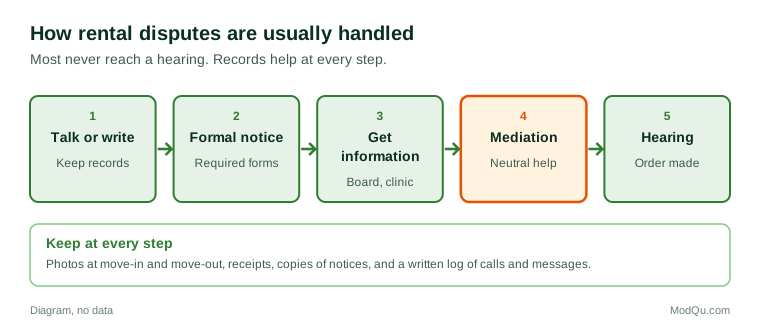
Most disputes never reach a tribunal. The usual steps are:
- Talking or writing to the other party, ideally keeping records.
- Formal written notice, such as a repair request, a notice of rent increase or a notice to end a tenancy, using forms required in many provinces.
- Getting information, from the provincial tenancy body, tenant advocacy groups, landlord associations or legal clinics.
- Mediation, offered by several tribunals, where a neutral person helps both sides reach an agreement.
- An application to the tribunal or board, which holds a hearing and makes an order.
- Enforcement, which may involve the courts or a sheriff for evictions or unpaid money.
Keeping written records, photos, receipts and copies of notices is commonly recommended by tenancy bodies for both tenants and landlords.
Hearings and outcomes
At a hearing, often held by phone or video, each side presents evidence and the adjudicator or member makes a decision. Possible orders include paying rent owed, returning a deposit, a rent reduction, carrying out repairs, compensation, or ending a tenancy and setting a date to move out. Decisions can usually be reviewed or appealed only on limited grounds.
Waiting times for hearings vary by province and over time. Long backlogs have been reported in some provinces, which affects both tenants waiting for repairs and landlords waiting for unpaid rent.
Example (hypothetical figures)
A tenant moves out of a unit with a $1,100 security deposit. The landlord keeps $600, saying the carpet was damaged. The tenant applies to the tenancy body with move-in and move-out photos. The adjudicator finds that the carpet was 12 years old and near the end of its useful life, and orders the landlord to return $450 of the $600, leaving a $150 deduction for a burn mark. The tenant receives $500 at move-out plus $450 after the hearing, $950 in total.
Evictions
Evictions are the most serious kind of dispute because a tenant can lose their home. Provincial laws set out the reasons a landlord may end a tenancy, the notice required and, in some cases, compensation owed to the tenant, for example when a landlord or family member moves in. Tenants generally cannot be removed without the proper process, and in most provinces only a sheriff or court officer can carry out an eviction order.
Some evictions have drawn wide attention, such as "renovictions", in which tenants are evicted for renovations and the unit is then re-rented at a much higher rent. Several provinces and cities have changed rules to address this.
Landlords' perspective
Many landlords are small owners renting out one or two units, sometimes a basement suite in their own home. Their common concerns include unpaid rent, damage beyond normal wear and tear, delays in hearings, and the cost of repairs and insurance. Larger landlords and property managers deal with many tenancies and often use standard processes and software for repairs and rent collection.
Example
A couple rent out the basement of their house. Their tenant stops paying rent after losing a job. The couple apply to the tribunal and wait several months for a hearing. In the meantime they agree with the tenant on a payment plan, which the tenant keeps to, and they withdraw the application.
Trends and debates
Trends include high rents and low vacancy in many cities, more renters at all ages, more units in purpose-built rental buildings and in investor-owned condos, and online hearings. Debates include rent control, how to balance tenant protection with landlords' rights, the length of tribunal waits, rules on short-term rentals, and the treatment of renovictions. Questions businesses and public bodies want answered include how many renters and landlords have had disputes, what they were about, whether tribunals were used and how disputes ended.
Key terms
- Residential tenancyThe legal relationship between a landlord and a tenant renting a home.
- Security depositMoney paid at the start of a tenancy, held against damage or unpaid rent.
- Rent controlLimits on how much rent can be raised for a sitting tenant.
- Notice to end a tenancyA formal written notice that a tenancy will end, using required forms in many provinces.
- AdjudicatorThe person who hears a dispute and makes a decision at a tribunal.
- MediationA process where a neutral person helps both sides reach an agreement.
- RenovictionEviction for renovations, followed by re-renting at a higher rent.
- Normal wear and tearExpected deterioration from ordinary use, not counted as damage.
Full glossary: alternative dispute resolution terms on EditingTests.com.
Tenant and landlord disputes vocabulary test
How well do you know the language of this topic? Try 8 quick questions. Your score is shown straight away and is not saved.
What the tenant and landlord disputes survey asks
This survey is part of ModQu's Law and Rights survey. The tenant and landlord disputes part takes about five minutes and covers:
- Whether you rent or are a landlord, and for how long.
- Whether you have had a dispute with a landlord or tenant, and what it was about.
- How you tried to resolve it, and whether you used a tribunal or mediation.
- How long it took and how it ended.
- How fair you felt the process and the outcome were.
- What would have helped you resolve it sooner.
After that you can choose to continue with other short parts of the Law and Rights survey, such as using a lawyer or consumer rights and complaints, or stop.
Ready to take part?
Your answers help show what people really think and do. Results are only ever reported as totals; no one can see your individual answers.
Start the surveyQuestions about this survey
Who can take part?
Renters and landlords.
Do I have to give my name?
No. You may be asked for your age group, region and similar details so results can be broken down, but not your name. ModQu never asks for passwords, card numbers or account numbers.
How are the results used?
Answers are combined into totals and percentages and published in ModQu reports. Individual answers are never shown.
Is the vocabulary test part of the survey?
No. It is optional and separate, and your score is not stored.