
Share your experience of rights at work
Tell us how well you know your rights at work, whether you have had a dispute and how it was handled. Your answers are combined with other people's and reported only as totals.
Start the employment rights surveyAbout 5 minutes. No account needed. You can stop at any time.
What employment rights cover
Employment rights are the rules that set minimum standards for how workers are treated. They come from several sources: national or regional laws, collective agreements negotiated by unions, the individual employment contract, and, in many countries, international standards such as the conventions of the International Labour Organization.
The details vary a great deal between countries, but most systems deal with the same broad areas:
- Pay: being paid on time, receiving at least any legal minimum wage, and receiving a written record of pay and deductions.
- Working time: limits on weekly hours, rest breaks, rest between shifts and, in many places, pay for overtime.
- Leave: paid annual holidays, public holidays, sick leave, and leave for pregnancy, birth, adoption and caring.
- Health and safety: a safe workplace, training and protective equipment.
- Fair treatment: protection from discrimination and harassment.
- Job security: notice periods, rules on dismissal and redundancy, and in some countries severance pay.
- Representation: the right to join a union and, in many countries, to take part in collective bargaining.
- Privacy: rules on how employers collect and use workers' personal information.
Rights are usually strongest for people with an employment contract. People who are self-employed, on short contracts or working through platforms may have fewer rights, and the boundary between these groups is one of the most disputed questions in employment law.
Employees, workers and the self-employed
Many legal systems sort working people into categories, and each category carries different rights. A common split is between employees, who work under the direction of an employer and usually receive the fullest protection, and independent contractors, who run their own business and agree terms with clients. Some countries add a middle category with some but not all rights.
Courts and tribunals often look beyond the label in a contract. They ask practical questions, such as who sets the hours, who supplies the tools, whether the person can send someone else to do the work, and whether they can work for others. Debates about delivery riders, drivers and other platform workers in many countries turn on these questions.
Example
A courier delivers parcels six days a week for one company, wears its uniform, uses its app to receive routes and cannot refuse jobs without losing work. The contract calls them self-employed. They begin to question whether they should be entitled to paid holidays and the minimum wage.
How well people know their rights
Many workers have only a general idea of their rights. People often learn about them only when something goes wrong, for example when they are dismissed, are injured, or need time off for a family reason. Knowledge tends to vary by age, sector, length of service, union membership and whether the person is working in their home country.
Sources of information include employers' handbooks, union representatives, government websites and labour inspectorates, legal advice services, colleagues, and friends and family. Migrant workers may face extra barriers, such as language, uncertainty about their visa status, or dependence on an employer for housing.
Common workplace disputes
The disagreements that most often reach advisers, unions and tribunals include:
- Unpaid or underpaid wages, including unpaid overtime, unlawful deductions and unpaid final pay after leaving.
- Holiday pay and leave, such as being refused leave or not being paid for it.
- Dismissal, when a worker believes they were dismissed without a fair reason or a fair process.
- Redundancy, including how people were selected and what they were paid.
- Discrimination and harassment, linked to characteristics such as sex, race, age, disability or religion.
- Changes to contracts, such as cuts to hours or a move to a different site.
- Health and safety, including retaliation against someone who raised a concern.
- Pregnancy and family leave, including treatment on return to work.
Example (hypothetical figures)
A shop worker is paid 12 an hour in their local currency and regularly works 4 extra hours each week that are not recorded. Over 26 weeks that is 104 unpaid hours, worth 1,248 at their normal rate. They raise it with their manager, who agrees to check the time records.
How disputes are usually handled
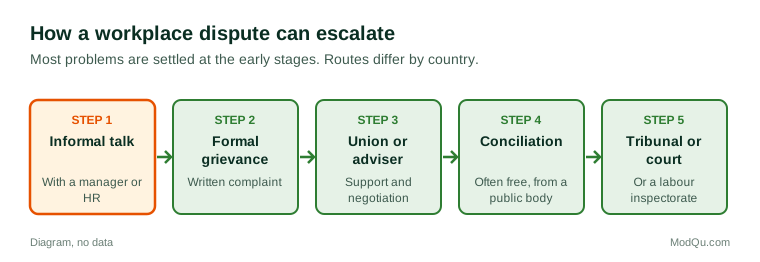
Most workplace problems are settled inside the workplace, but there are several stages a dispute can pass through.
- Informal discussion with a manager or human resources.
- A formal grievance, a written complaint that the employer is expected to investigate and answer.
- Help from a union representative or adviser, who may attend meetings and negotiate.
- Conciliation or mediation, often provided free by a public body in countries such as the United Kingdom, Ireland and Australia.
- A claim to an employment tribunal, labour court or labour inspectorate, depending on the country.
- A settlement agreement, in which the worker usually receives a payment and agrees not to pursue the claim.
Labour inspectorates, found in many countries, can visit workplaces and enforce minimum standards on matters such as pay and safety. Specialist courts or tribunals hear individual claims. Time limits for bringing a claim can be short, sometimes only a few months from the event.
Unions and collective bargaining
A trade union is an organization of workers that negotiates with employers on pay and conditions and supports members with problems at work. Union membership rates vary widely between countries and sectors, and they are usually higher in the public sector than in private services.
Collective bargaining can set pay scales, hours and leave for a whole workplace or sector, and in some countries agreements are extended to cover workers who are not members. Unions also provide individual help, such as representation at disciplinary meetings and legal support for claims. The right to strike, and the rules around it, differ between countries.
Example
A hospital cleaner is told that her shifts will change from days to nights with one week's notice. She contacts her union representative, who points out that the collective agreement requires four weeks' notice and consultation. The change is postponed while the union and employer talk.
Trends and debates
Several issues come up again and again in public discussion of employment rights:
- Platform and gig work, and whether app-based workers should be treated as employees.
- Remote and hybrid work, including the right to request flexible work and the right to disconnect outside working hours, which some countries have written into law.
- Monitoring and data, as employers use software to track productivity and location.
- Zero-hours and on-call contracts, which offer flexibility but uncertain income.
- Pay transparency, including rules requiring employers to publish pay ranges or pay gaps.
- Enforcement, and whether workers who know their rights can afford or dare to use them.
People disagree about the balance between flexibility for businesses and security for workers. Employers often stress the cost of new obligations; worker groups stress the risk of low pay and insecurity.
What people and businesses want to know
Questions employers, advisers and public bodies want answered include how confident workers are about their rights, which rights they know least about, how many have had a dispute, what it was about, whether they raised it, and how it ended. They also want to know who workers turn to first, how many belong to a union, and what stops people from taking action.
Key terms
- Employment contractThe agreement, written or not, that sets the terms of a person's job.
- Minimum wageThe lowest hourly or monthly pay allowed by law.
- GrievanceA formal complaint by a worker to their employer.
- Unfair dismissalEnding someone's employment without a fair reason or a fair process.
- RedundancyDismissal because the job is no longer needed.
- Collective bargainingNegotiation between unions and employers over pay and conditions.
- Labour inspectorateA public body that checks and enforces minimum standards at work.
- Settlement agreementAn agreement in which a worker usually receives a payment and gives up a claim.
Full glossary: labor relations terms on EditingTests.com.
Employment rights vocabulary test
How well do you know the language of this topic? Try 8 quick questions. Your score is shown straight away and is not saved.
What the employment rights survey asks
This survey is part of ModQu's Law and Rights survey. The employment rights part takes about five minutes and covers:
- How well you feel you know your rights at work, and where you learned about them.
- Whether you have had a dispute or problem with an employer in the last three years, and what it was about.
- Whether you raised it, who you went to for help, and how it ended.
- Whether you are a union member, and why or why not.
- How secure and fairly treated you feel in your current job.
- Which rights you think matter most, or are most often ignored.
After that you can choose to continue with other short parts of the Law and Rights survey, such as using a lawyer or consumer rights and complaints, or stop.
Ready to take part?
Your answers help show what people really think and do. Results are only ever reported as totals; no one can see your individual answers.
Start the surveyQuestions about this survey
Who can take part?
Employees.
Do I have to give my name?
No. You may be asked for your age group, region and similar details so results can be broken down, but not your name. ModQu never asks for passwords, card numbers or account numbers.
How are the results used?
Answers are combined into totals and percentages and published in ModQu reports. Individual answers are never shown.
Is the vocabulary test part of the survey?
No. It is optional and separate, and your score is not stored.