
Share your experience of getting legal help
Tell us whether you have needed legal help, whether you got it and what stood in the way. Your answers are combined with other people's and reported only as totals.
Start the access to justice and legal costs surveyAbout 5 minutes. No account needed. You can stop at any time.
What access to justice means
Access to justice means that people can understand their rights, get help with legal problems, and use courts or other bodies to resolve disputes fairly. It is not only about courts. Most legal problems that people face, such as a debt, a dispute with a landlord or a problem at work, never reach a court. Access to justice includes knowing a problem has a legal side, finding information, getting advice, and having a fair way to settle the matter.
The United Nations includes access to justice for all in its Sustainable Development Goals, under Goal 16 on peace, justice and strong institutions.
Everyday legal problems
Legal needs surveys, carried out in many countries, ask people about problems they have had that have a legal side, whether or not they thought of them as legal. Commonly reported problems include:
- Consumer problems, such as faulty goods, poor services or unfair charges.
- Money and debt, including debt collection and disputes with lenders.
- Housing, such as repairs, deposits, rent increases and eviction.
- Employment, including unpaid wages and dismissal.
- Family matters, such as separation, child arrangements and support payments.
- Neighbours, over noise, boundaries or damage.
- Public services and benefits, such as decisions about welfare payments.
- Land and property, including ownership documents, a major issue in many countries.
- Injury and accidents.
These problems can lead to further problems. A job loss can lead to debt, which can lead to a housing problem, and stress can affect health.
How legal help is paid for
There are several main ways people pay for, or receive, legal help:
- Private fees, charged by the hour, as a fixed fee for a task, or as a mix.
- Contingency or conditional fees, where the lawyer is paid only if the case succeeds, often as a share of the money recovered. These are allowed in some countries, such as the United States, and limited or banned in others.
- Legal expenses insurance, sold on its own or included with home, car or bank account policies. It is common in some European countries, such as Germany.
- Legal aid, paid for by the state.
- Free advice from charities, law school clinics, community legal centres and lawyers working without a fee, often called pro bono work.
- Union legal services for members with problems at work.
Example (hypothetical figures)
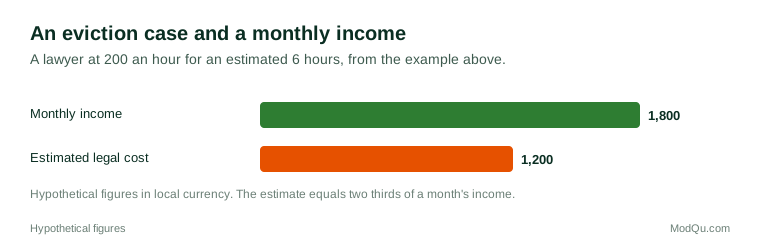
A tenant needs help with an eviction notice. A local lawyer charges 200 an hour in their local currency and estimates 6 hours of work, or 1,200 in total. The tenant's monthly income is 1,800, so the estimate equals two thirds of a month's income. They look for a free advice service instead.
Legal aid
Legal aid is help with legal costs provided by the state, usually for people with low incomes or in certain types of case. Its form differs a great deal between countries:
- Some countries provide a lawyer free of charge for people accused of serious crimes who cannot afford one; this is a right in many international human rights agreements.
- For civil and family cases, many countries apply a means test, looking at income and savings, and a merits test, looking at whether the case has a reasonable chance of success.
- Some countries pay private lawyers to take legal aid cases; others employ public defenders or lawyers in public legal aid offices.
- The range of matters covered changes over time. Several countries have reduced civil legal aid in recent decades, while others have expanded it.
Many people do not know whether they qualify for legal aid, or do not know it exists.
Why people do not get help
Research on legal needs in many countries has found that a large share of people with legal problems do not get professional help. Reasons include:
- Cost, or fear of unknown costs.
- Not knowing the problem is legal, or not knowing their rights.
- Not knowing where to go.
- Distance, especially in rural areas with few lawyers.
- Language barriers and disability.
- Distrust of lawyers or courts.
- Time pressure and stress.
- Belief that nothing can be done, or that the problem is not serious enough.
Some people manage well on their own or with help from friends and family. Others give up, and the problem continues or gets worse.
Example
A worker is not paid for their last month after the business closes. They do not know that a public scheme may cover some unpaid wages when an employer becomes insolvent. A friend mentions an advice centre, where an adviser helps them apply.
Representing yourself
When people cannot get or afford a lawyer, many represent themselves in court or tribunal. Such people are called self-represented litigants or litigants in person. Courts in many countries have produced plain-language guides, online forms and help desks for them. Self-representation can work for simpler matters, but it can be stressful and difficult in complex cases or where the other side has a lawyer.
Other routes to help
People use a growing range of routes beyond traditional lawyers:
- Government, court and charity websites with plain-language guides.
- Telephone and online advice lines.
- Ombudsman schemes and other free complaint bodies.
- Mediation services.
- Online courts and dispute resolution platforms.
- Paralegals and community advisers, who in some countries are trained to help with common problems.
- Limited-scope services, where a lawyer helps with only part of a case for a lower fee, sometimes called unbundled services.
Example
A parent separating from a partner cannot afford a lawyer for the whole process. They pay a lawyer for one meeting to explain the options and check a draft agreement, and handle the rest of the paperwork themselves using the court's online forms.
What people and businesses want to know
Questions law firms, legal technology companies, insurers and public bodies want answered include how many people had a legal problem recently, what kind, whether they got help and from where, what it cost, why some did not get help, and how many know about legal aid or legal expenses insurance.
Key terms
- Access to justiceBeing able to understand rights, get help and resolve legal problems fairly.
- Legal aidHelp with legal costs paid for by the state.
- Means testA check of income and savings to decide eligibility for help.
- Pro bonoLegal work done without a fee for the public good.
- Contingency feeA fee paid only if a case succeeds, often a share of the money recovered.
- Legal expenses insuranceInsurance that pays legal costs for certain types of dispute.
- Self-represented litigantA person who takes part in a court case without a lawyer.
- Unbundled servicesLegal help with only part of a case, for a lower fee.
Full glossary: legal services terms on EditingTests.com.
Access to justice and legal costs vocabulary test
How well do you know the language of this topic? Try 8 quick questions. Your score is shown straight away and is not saved.
What the access to justice and legal costs survey asks
This survey is part of ModQu's Law and Rights survey. The access to justice and legal costs part takes about five minutes and covers:
- Whether you have had a problem with a legal side in the last three years, and what kind.
- Whether you got help, and from whom: a lawyer, an adviser, a website, friends or no one.
- If you did not get help, the main reasons why.
- What any legal help cost you, and how you paid for it.
- Whether you know about legal aid, free advice services or legal expenses insurance where you live.
- How the problem ended, and how it affected you.
After that you can choose to continue with other short parts of the Law and Rights survey, such as using a lawyer or consumer rights and complaints, or stop.
Ready to take part?
Your answers help show what people really think and do. Results are only ever reported as totals; no one can see your individual answers.
Start the surveyQuestions about this survey
Who can take part?
Adults.
Do I have to give my name?
No. You may be asked for your age group, region and similar details so results can be broken down, but not your name. ModQu never asks for passwords, card numbers or account numbers.
How are the results used?
Answers are combined into totals and percentages and published in ModQu reports. Individual answers are never shown.
Is the vocabulary test part of the survey?
No. It is optional and separate, and your score is not stored.