
Share your experience of copyright
Tell us how you share and use creative work online, and whether your own work has been copied. Your answers are combined with other people's and reported only as totals.
Start the intellectual property and copyright surveyAbout 5 minutes. No account needed. You can stop at any time.
What intellectual property is
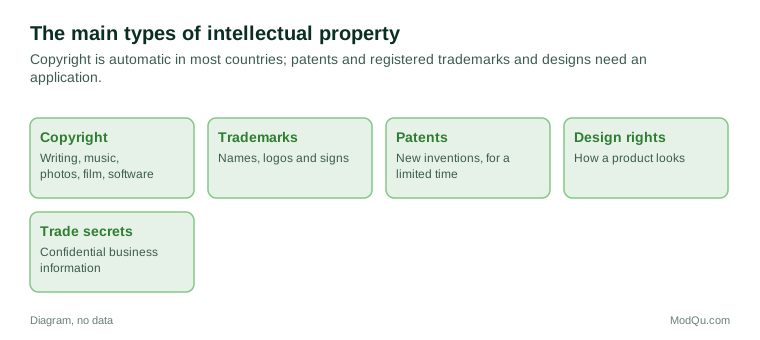
Intellectual property, often shortened to IP, is a set of legal rights over creations of the mind. Instead of protecting a physical object, IP protects ideas expressed in certain forms, inventions, names and designs. The main types are:
- Copyright: protects original creative works, such as writing, music, photographs, films, artwork and software.
- Trademarks: protect names, logos and other signs that identify the source of goods or services.
- Patents: protect new inventions for a limited time, in exchange for publishing how they work.
- Design rights: protect the appearance of a product, such as its shape or pattern.
- Trade secrets: protect confidential business information, such as a recipe or process.
Ordinary people meet copyright most often, because they create and share copyright works every day, from holiday photos to short videos.
How copyright works
Copyright has a few features that are similar in most countries, partly because over 180 countries belong to the Berne Convention, an international agreement on copyright managed by the World Intellectual Property Organization.
- It is automatic. In most countries there is no need to register a work or add a symbol; protection starts when the work is created and fixed, for example written down or recorded. Some countries, such as the United States, offer optional registration that brings extra benefits.
- It protects expression, not ideas. The idea of a story about a detective is free to use; a particular novel is protected.
- It lasts a long time. In many countries the term is the author's life plus 70 years; under the Berne Convention the minimum is generally life plus 50 years.
- It gives the owner control over copying, sharing, adapting and performing the work.
- It can be licensed or transferred, for example to a publisher or employer.
Example
An amateur photographer takes a picture of a sunset and posts it online. Without registering it or adding any notice, they own the copyright in the photo. A week later they see it on a holiday rental website without their permission.
Who owns what you post
Many people are unsure who owns the photos and videos they share. In general:
- The creator usually owns the copyright, for example the person who took the photo, not the person in it.
- Posting on a social platform does not usually transfer ownership. Platform terms normally give the platform a licence to show, store and distribute the content, sometimes widely.
- Work made as part of a job is often owned by the employer, depending on the country and the contract.
- Commissioned work, such as wedding photos, may stay with the photographer unless the contract says otherwise.
- People in photos may have separate rights, such as privacy or image rights, which vary greatly between countries.
Reading the terms of a platform, or a contract with a client, is often the only way to know exactly what rights have been given.
Using other people's work
Using someone else's copyright work usually needs permission, unless an exception applies or the work is out of copyright. Common situations include:
- Sharing a link to content is usually treated differently from copying it.
- Reposting images or videos without permission can infringe copyright, even with credit given.
- Using music in videos often requires a licence. Some platforms have licences for music in certain uses.
- Memes and remixes are common online, but their legal status depends on the country and the use.
- Public domain works, whose copyright has expired or never existed, can be used freely.
Many countries allow some uses without permission. The United States has a broad doctrine of fair use, decided case by case. Countries such as Canada, the United Kingdom, Australia and India have fair dealing rules that list specific purposes, such as research, criticism, review, news reporting or parody. Countries in the European Union have a list of exceptions set by EU law and national law. These rules are not the same, so a use allowed in one country may not be allowed in another.
Licences and open content
A licence is permission to use a work on certain conditions. Creators can choose to give broad permission in advance. Open content licences, such as Creative Commons licences, let anyone use a work as long as they follow the conditions, such as giving credit, not using it commercially or sharing changes under the same terms. Stock image and music libraries sell licences for set uses, and the conditions of the licence matter: a licence for a website may not cover printed advertising.
Example (hypothetical figures)
A small café uses a photo it found online on its menu. The photographer contacts the café and offers a licence for 150 in their local currency for one year, or asks for the photo to be removed. Licensing a similar stock photo in advance would have cost 40, so the café pays 110 more than if it had licensed first.
Protecting your own work
Creators use several methods to protect their work and show ownership:
- Keeping original files, drafts and dated records.
- Adding their name, a copyright notice or a watermark.
- Choosing what licence, if any, to give.
- Registering the work where the country offers registration.
- Using platforms' tools to report copying.
- Sending a takedown notice to a website or host.
- Asking a lawyer to write to the person copying the work.
Many countries have takedown systems that require online hosts to remove infringing content when they are properly notified. Court action is less common for individual creators, because of cost, but some countries have lower-cost routes for small copyright claims.
Example
A craft maker finds their knitting pattern being sold as a download by another seller. They send the marketplace a takedown request with a link to their original pattern and its publication date. The marketplace removes the listing.
Trends and debates
Copyright is changing as technology changes. Current debates include:
- Automated content generation, and whether works made with computer tools are protected and who owns them.
- Training data, and whether copying works to train software needs permission.
- Platform responsibility for what users upload.
- The length of copyright terms, and whether they are too long.
- Fair pay for creators on streaming and sharing platforms.
- Piracy, and access to content in countries where it is expensive or unavailable.
Questions businesses and public bodies want answered include how well people understand copyright, how often they check before sharing, whether they have had their own work copied, what they did about it, and how they feel about current rules.
Key terms
- Intellectual propertyLegal rights over creations of the mind, such as works, inventions and brands.
- CopyrightRights over original creative works, such as writing, music, photos and software.
- TrademarkA protected name, logo or sign that identifies the source of goods or services.
- Public domainWorks not protected by copyright, which anyone may use.
- LicencePermission to use a work on stated conditions.
- Fair useA United States doctrine that allows some uses of copyright works without permission.
- Fair dealingRules in some countries that allow use of works for listed purposes, such as review.
- Takedown noticeA request to an online host to remove content that infringes copyright.
Full glossary: intellectual property terms on EditingTests.com.
Intellectual property and copyright vocabulary test
How well do you know the language of this topic? Try 8 quick questions. Your score is shown straight away and is not saved.
What the intellectual property and copyright survey asks
This survey is part of ModQu's Law and Rights survey. The intellectual property and copyright part takes about five minutes and covers:
- How often you create and share photos, videos, writing or other creative work.
- Whether you know who owns the content you post on social platforms.
- Whether you check copyright or licences before using or sharing others' work.
- Whether your own work has been copied, and what you did about it.
- How you protect your work, for example with watermarks or licences.
- How fair you think copyright rules are for creators and users.
After that you can choose to continue with other short parts of the Law and Rights survey, such as using a lawyer or consumer rights and complaints, or stop.
Ready to take part?
Your answers help show what people really think and do. Results are only ever reported as totals; no one can see your individual answers.
Start the surveyQuestions about this survey
Who can take part?
Adults who create or share content.
Do I have to give my name?
No. You may be asked for your age group, region and similar details so results can be broken down, but not your name. ModQu never asks for passwords, card numbers or account numbers.
How are the results used?
Answers are combined into totals and percentages and published in ModQu reports. Individual answers are never shown.
Is the vocabulary test part of the survey?
No. It is optional and separate, and your score is not stored.