
Intelligence · Concepts and history
Intelligence Support to Law Enforcement Investigations
Police services increasingly use intelligence to decide where to focus and how to investigate. This article explains how criminal intelligence supports investigations, the model of intelligence-led policing, the main analytic techniques and the obstacles that limit their use.
Police work has always depended on information: witness statements, informants, records of past offences. What changed from the 1990s onwards was the idea that information should be systematically collected, analysed and used to decide where to focus police effort, rather than simply to solve crimes after they were reported. This approach, known as intelligence-led policing, now shapes how many police services in Canada, the United Kingdom, Australia and the United States organise their work (Ratcliffe, 2016). This article explains how intelligence supports law enforcement and what makes that support effective.
From reaction to targeting
Traditional policing was largely reactive: officers responded to calls and investigated reported crimes one at a time. Intelligence-led policing reverses the emphasis. Analysts study patterns of crime and the people and places involved, and managers use that analysis to target prolific offenders, criminal networks and problem locations. Innes and Sheptycki (2004) describe this as a shift from detection, solving individual cases, to disruption, reducing the capacity of offenders and networks to commit crime.
Peterson (2005) set out how American agencies could build an intelligence capability: clear requirements, trained analysts, secure information systems and links between agencies. Carter and Carter (2009) emphasise that intelligence-led policing is a management philosophy, not just a unit: it works only if intelligence actually drives decisions about priorities and resources.
The 3-i model
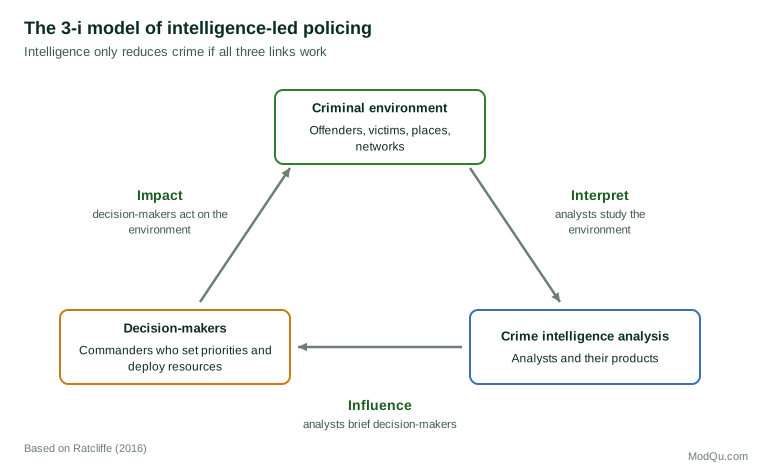
Ratcliffe (2016) summarises intelligence-led policing in the 3-i model (Figure 1). Analysts must interpret the criminal environment; they must influence decision-makers with their analysis; and decision-makers must impact the criminal environment through their actions. If any link fails, intelligence does not reduce crime: analysts may misread the environment, their work may not reach or persuade commanders, or commanders may lack the resources or will to act.
Analytic techniques
Several techniques give criminal intelligence its practical value.
Hot-spot analysis maps where crime concentrates. Sherman et al. (1989) found that about half of all calls to police in Minneapolis came from just 3% of addresses. Braga et al. (2014), in a systematic review and meta-analysis, found that focusing patrols and problem-solving on such hot spots reduces crime without simply displacing it to nearby areas.
Network analysis maps relationships among offenders. Sparrow (1991) argued that the tools of social network analysis could identify central figures, brokers and vulnerabilities in criminal organisations, helping investigators decide whom to target for the greatest disruption.
Geographic profiling estimates where a serial offender is likely to live from the locations of linked crimes. Rossmo (2000) developed the method from the observation that offenders tend to commit crimes neither too close to nor too far from their home base, and it has been used to prioritise suspects in major investigations.
Case support applies analysis to a single investigation: building timelines, linking telephone and financial records, and testing alternative explanations of the evidence. Analysts can help investigators avoid fixing too early on one suspect by setting out what each explanation predicts and checking which evidence fits, a discipline that also strengthens the case if it later goes to court.
Obstacles in practice
Putting intelligence-led policing into practice has proved harder than advocating it. Ratcliffe (2002) found that the rhetoric often ran ahead of the reality: analysts were few, poorly integrated and asked mainly for statistics rather than analysis. Cope (2004) showed that analysts' work was frequently shaped by what officers already believed, a pattern Cope called "policing-led intelligence" rather than intelligence-led policing. Sheptycki (2004) identified a set of organisational pathologies, including information hoarding between units, duplication, and "noise" from large volumes of low-quality intelligence reports.
These problems are familiar from other intelligence settings. Analysts without status are ignored; information that is not shared cannot be analysed; and collection that is not driven by clear requirements produces volume rather than insight.
An illustration
Suppose a city sees a sharp rise in vehicle thefts over three months. Treated in the traditional way, each theft is a separate case, investigated if there is a lead and otherwise filed. An intelligence-led response starts differently. An analyst maps the thefts and finds that most occurred in four car parks near a transit station, mostly in the evening. Linking the cases shows that several of the stolen vehicles were later found near the same industrial estate, and arrest records reveal that two known offenders recently released from custody live nearby. Telephone and vehicle-movement data connect them to a third person who operates a vehicle repair business.
The analyst's report sets out these findings, states the confidence attached to each link and suggests options: targeted patrols and better lighting at the car parks, surveillance of the suspected network and inspection of the repair business. The commander chooses a combination, and the analyst tracks theft levels afterwards to judge whether the response worked. The case shows the 3-i model in action: interpretation of the pattern, influence on the commander and impact on the problem, followed by evaluation.
Safeguards
Law enforcement intelligence touches citizens directly, so it carries particular responsibilities. Information about individuals must be collected lawfully, recorded with an assessment of its reliability and reviewed regularly. Analysis that concentrates attention on certain places or groups can reinforce existing biases if the underlying data reflect past patterns of enforcement rather than actual offending. Good practice therefore includes clear grading of sources, periodic purging of outdated records and independent oversight.
Conclusion
Intelligence supports law enforcement by helping police decide where to look, whom to target and how to connect evidence. The research shows that focused, intelligence-driven strategies can reduce crime, but only when analysis is accurate, reaches the people who decide and leads to action. Building that chain, and keeping it lawful and fair, is the central task of criminal intelligence.
References
Braga, A. A., Papachristos, A. V., & Hureau, D. M. (2014). The effects of hot spots policing on crime: An updated systematic review and meta-analysis. Justice Quarterly, 31(4), 633–663. https://doi.org/10.1080/07418825.2012.673632
Carter, D. L., & Carter, J. G. (2009). Intelligence-led policing: Conceptual and functional considerations for public policy. Criminal Justice Policy Review, 20(3), 310–325. https://doi.org/10.1177/0887403408327381
Cope, N. (2004). 'Intelligence led policing or policing led intelligence?' Integrating volume crime analysis into policing. British Journal of Criminology, 44(2), 188–203. https://doi.org/10.1093/bjc/44.2.188
Innes, M., & Sheptycki, J. W. E. (2004). From detection to disruption: Intelligence and the changing logic of police crime control in the United Kingdom. International Criminal Justice Review, 14(1), 1–24. https://doi.org/10.1177/105756770401400101
Peterson, M. (2005). Intelligence-led policing: The new intelligence architecture (NCJ 210681). Bureau of Justice Assistance, U.S. Department of Justice.
Ratcliffe, J. (2002). Intelligence-led policing and the problems of turning rhetoric into practice. Policing and Society, 12(1), 53–66. https://doi.org/10.1080/10439460290006673
Ratcliffe, J. H. (2016). Intelligence-led policing (2nd ed.). Routledge.
Rossmo, D. K. (2000). Geographic profiling. CRC Press.
Sheptycki, J. (2004). Organizational pathologies in police intelligence systems: Some contributions to the lexicon of intelligence-led policing. European Journal of Criminology, 1(3), 307–332. https://doi.org/10.1177/1477370804044005
Sherman, L. W., Gartin, P. R., & Buerger, M. E. (1989). Hot spots of predatory crime: Routine activities and the criminology of place. Criminology, 27(1), 27–56. https://doi.org/10.1111/j.1745-9125.1989.tb00862.x
Sparrow, M. K. (1991). The application of network analysis to criminal intelligence: An assessment of the prospects. Social Networks, 13(3), 251–274. https://doi.org/10.1016/0378-8733(91)90008-H