
Intelligence · Concepts and history
Measurement and Signature Intelligence Contributions to Technical Knowledge
Measurement and signature intelligence (MASINT) identifies objects and events by the physical traces they leave: seismic waves, radiation, spectra and radar returns. This article explains what MASINT is, how it works, what it has contributed and what its methods teach about technical knowledge.
Most intelligence disciplines deal with what people say or what cameras see. Measurement and signature intelligence, usually shortened to MASINT, deals with something less obvious: the physical traces that objects and events leave behind. An underground explosion sends seismic waves through the Earth. A nuclear reactor releases particular gases. A missile engine emits a characteristic heat pattern, and every material reflects light in its own way. By measuring these traces precisely and comparing them with known signatures, analysts can detect, identify and describe things that their owners would prefer to keep hidden. This article explains what MASINT is, how it works, what it has contributed and what its methods teach about producing technical knowledge.
What MASINT is
Lowenthal and Clark (2016) describe MASINT as the most technically demanding and least understood of the main collection disciplines. Unlike imagery, which produces a picture a person can interpret, or signals intelligence, which produces messages to be read, MASINT produces measurements: wavelengths, frequencies, particle counts, waveforms. Its products only make sense when compared with a library of known signatures, much as a fingerprint only identifies someone when it can be matched against a record.
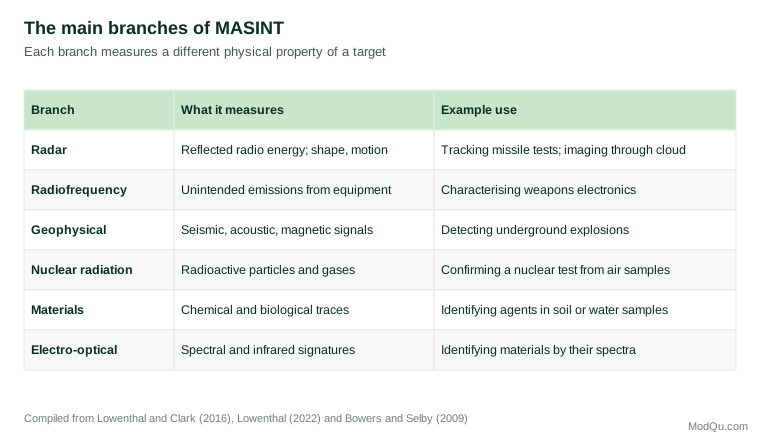
The discipline groups together several technical branches that share this logic of measurement and matching (Lowenthal, 2022). Figure 1 summarises the main ones.
How a signature becomes knowledge
The process behind MASINT has four steps. First, a sensor records a physical quantity: a seismometer records ground motion, a spectrometer records the intensity of light at many wavelengths, a radar records the echo of its own pulse. Second, the raw measurement is processed to remove noise and correct for distance, weather and instrument effects. Third, the cleaned measurement is compared with a library of reference signatures gathered from known objects and events. Fourth, analysts interpret the match, judging how confident they can be and what else could explain it.
The quality of the library is therefore as important as the quality of the sensor. A spectral signature can identify a material only if that material's spectrum has been measured before. A seismic waveform can be classified as an explosion rather than an earthquake only because thousands of events of both kinds have been recorded and studied. Building and maintaining these reference libraries is slow, scientific work, and it is a large part of what makes MASINT expensive.
Herman (1996) observes that technical collection generally produces evidence that is precise and hard to fake, but narrow: it shows what happened physically, not why. MASINT illustrates this well. A measurement may establish with high confidence that a nuclear explosion occurred, its approximate size and location, without saying anything about the intentions of the government that conducted it.
Monitoring nuclear tests
The clearest example of MASINT's contribution is the monitoring of nuclear explosions. Richelson (2006) traces how the United States detected the first Soviet atomic test in 1949 by collecting radioactive debris carried by the wind and analysing it, a classic MASINT method: the particles carried a signature that only a nuclear explosion could produce, and their composition revealed details of the device's design.
Seismic monitoring grew in importance as testing moved underground. Bowers and Selby (2009) explain how seismologists distinguish explosions from earthquakes. Explosions are compact and sudden, and they generate relatively strong compressional waves and weaker surface waves than an earthquake of similar size. Explosions are also usually shallow, while many earthquakes are deep. By combining several such measurements, analysts can classify most events with considerable confidence.
These methods became the basis of an international verification system. Dahlman et al. (2009) describe how the Comprehensive Nuclear-Test-Ban Treaty created a global network of seismic, hydroacoustic, infrasound and radionuclide stations, whose data are shared among member states. The system turned techniques developed for national intelligence into a shared, scientific means of verification. Hafemeister (2007) reviewed its progress and concluded that detection capabilities had improved substantially, with small explosions detectable at far lower yields than when the treaty was negotiated. A later review by the National Research Council (2012) reached a similar conclusion, while noting the remaining difficulty of detecting very small or deliberately muffled tests.
The case shows how MASINT can support not only secret intelligence but public, verifiable knowledge. When North Korea conducted nuclear tests in the 2000s and 2010s, seismic stations around the world detected them within minutes, and independent scientists could estimate their location and size from openly available data.
Imaging beyond the visible
Other branches of MASINT extend imaging beyond what the human eye can see. Day et al. (1998) describe how the early Corona reconnaissance satellites returned film that revolutionised knowledge of Soviet forces in the 1960s; Brugioni (1991) recounts how photo-interpreters identified Soviet missiles in Cuba in 1962 by matching objects in aerial photographs with known patterns of equipment and site layout. That habit of matching observations with known signatures is the core of MASINT.
Modern sensors go further. Imaging spectrometry, also called hyperspectral imaging, measures reflected light in hundreds of narrow wavelength bands. Goetz et al. (1985) showed that such measurements could identify minerals and vegetation types from the air by their spectral signatures. The same principle allows analysts to distinguish a painted decoy from a real vehicle, or to detect disturbed soil or particular chemical compounds.
Synthetic aperture radar produces images by sending radio pulses and measuring their echoes, so it works at night and through cloud. Moreira et al. (2013) explain how the technique achieves fine resolution by combining echoes recorded as the sensor moves, and how comparing radar images taken at different times can detect changes of a few centimetres in the ground surface. Such change detection can reveal construction, excavation or the movement of heavy equipment.
From secret to commercial
Many MASINT techniques have spread far beyond intelligence agencies. Commercial satellites now offer radar, multispectral and hyperspectral imagery; seismic networks are run by universities; and environmental agencies use spectral and radiation sensors routinely. Zhu et al. (2017) review how deep learning is used to analyse such remote-sensing data at scale, automating the detection of objects and changes that once required trained interpreters.
For businesses, this means that measurement-based intelligence is increasingly accessible. Insurers use radar imagery to assess flood damage, commodity traders estimate crop yields from spectral data, and environmental investigators detect methane leaks from satellites. The underlying logic is the same as in national MASINT: measure a physical quantity, compare it with known signatures and interpret the result with care.
Limits and pitfalls
MASINT is powerful but not infallible. Its limits follow from its method:
- Signatures can be ambiguous. Different objects or events can produce similar measurements, and the same object can produce different measurements under different conditions.
- Libraries can be incomplete. A new material, weapon or technique may have no reference signature, so the sensor records something that cannot be identified.
- Adversaries can adapt. Knowing what sensors measure, a target can try to suppress or disguise its signature, for example by conducting a test in a large cavity to muffle seismic waves (National Research Council, 2012).
- Precision can mislead. Measurements carry an air of objectivity, but their interpretation still requires judgement. Clark (2020) warns that analysts must place technical evidence within a wider model of the target rather than treating it as self-explanatory.
- Specialists can become isolated. Because MASINT requires deep scientific expertise, its practitioners may be separated from all-source analysts, and its findings may be poorly understood by users (Lowenthal & Clark, 2016).
Lessons for technical knowledge
MASINT offers several lessons for anyone who produces knowledge from measurements, whether in intelligence, science or business.
- Invest in reference data. A measurement is only as useful as the library it can be compared with. Organisations that collect sensor data should also build and maintain good baselines.
- Combine independent measurements. Classification of nuclear tests is reliable because several independent signals point the same way. A single measurement is rarely conclusive.
- State confidence and alternatives. Precise numbers should still come with explicit statements of uncertainty and of other possible explanations.
- Connect the technical to the human. Measurements show what happened physically; other sources are needed to explain why. Integrating them is the task of all-source analysis.
- Share where possible. The international test-ban monitoring system shows that shared measurement networks can build trust and knowledge that no single party could achieve alone (Dahlman et al., 2009).
Conclusion
Measurement and signature intelligence turns physical traces into knowledge by careful measurement and comparison with known signatures. It has made fundamental contributions, above all to the detection and verification of nuclear tests, and its techniques now underpin much of commercial remote sensing. Its strength is precision; its weakness is that precision can hide ambiguity. Used well, combined with other sources and stated with honest confidence, it is one of the most reliable ways intelligence has found to know what is physically happening in the world.
References
Bowers, D., & Selby, N. D. (2009). Forensic seismology and the Comprehensive Nuclear-Test-Ban Treaty. Annual Review of Earth and Planetary Sciences, 37, 209–236. https://doi.org/10.1146/annurev.earth.36.031207.124143
Brugioni, D. A. (1991). Eyeball to eyeball: The inside story of the Cuban missile crisis. Random House.
Clark, R. M. (2020). Intelligence analysis: A target-centric approach (6th ed.). CQ Press.
Dahlman, O., Mykkeltveit, S., & Haak, H. (2009). Nuclear test ban: Converting political visions to reality. Springer. https://doi.org/10.1007/978-1-4020-6885-0
Day, D. A., Logsdon, J. M., & Latell, B. (Eds.). (1998). Eye in the sky: The story of the Corona spy satellites. Smithsonian Institution Press.
Goetz, A. F. H., Vane, G., Solomon, J. E., & Rock, B. N. (1985). Imaging spectrometry for Earth remote sensing. Science, 228(4704), 1147–1153. https://doi.org/10.1126/science.228.4704.1147
Hafemeister, D. (2007). Progress in CTBT monitoring since its 1999 Senate defeat. Science & Global Security, 15(3), 151–183.
Herman, M. (1996). Intelligence power in peace and war. Cambridge University Press.
Lowenthal, M. M., & Clark, R. M. (Eds.). (2016). The five disciplines of intelligence collection. CQ Press.
Lowenthal, M. M. (2022). Intelligence: From secrets to policy (9th ed.). CQ Press.
Moreira, A., Prats-Iraola, P., Younis, M., Krieger, G., Hajnsek, I., & Papathanassiou, K. P. (2013). A tutorial on synthetic aperture radar. IEEE Geoscience and Remote Sensing Magazine, 1(1), 6–43. https://doi.org/10.1109/MGRS.2013.2248301
National Research Council. (2012). The Comprehensive Nuclear Test Ban Treaty: Technical issues for the United States. National Academies Press. https://doi.org/10.17226/12849
Richelson, J. T. (2006). Spying on the bomb: American nuclear intelligence from Nazi Germany to Iran and North Korea. W. W. Norton.
Zhu, X. X., Tuia, D., Mou, L., Xia, G.-S., Zhang, L., Xu, F., & Fraundorfer, F. (2017). Deep learning in remote sensing: A comprehensive review and list of resources. IEEE Geoscience and Remote Sensing Magazine, 5(4), 8–36. https://doi.org/10.1109/MGRS.2017.2762307