
Intelligence · Concepts and history
Cultural and Linguistic Intelligence for Contextual Knowledge Depth
Information about other people is only as good as our understanding of their culture and language. This article explains cultural and linguistic intelligence, the research behind it, the analytic errors it prevents, and practical methods for building contextual depth into intelligence and market research.
Facts do not interpret themselves. The same statement, gesture, price change or military movement can mean very different things depending on who makes it, in what language and within what set of shared assumptions. Intelligence that ignores this context can be accurate in every detail and still wrong in its conclusions. Cultural and linguistic intelligence is the capacity to understand other people on their own terms: to grasp the values, norms, ways of reasoning and language that shape what they say and do. This article explains what the concept means, summarises research on culture and cognition, describes the analytic errors that a lack of cultural understanding produces, and sets out practical methods for adding contextual depth to intelligence and market research.
Two meanings of cultural intelligence
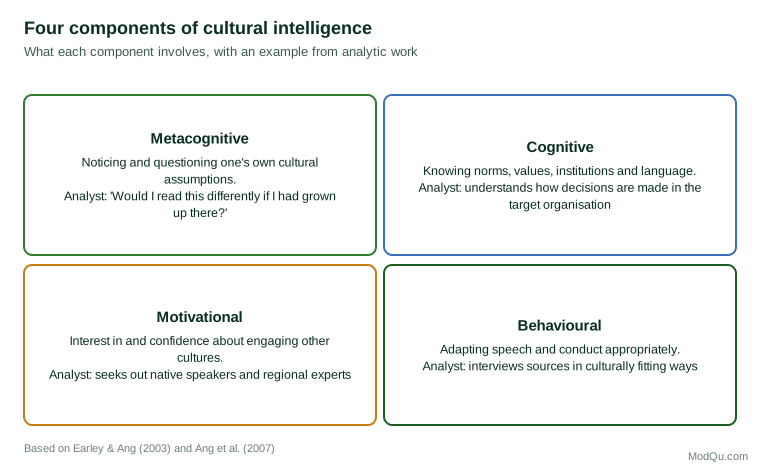
The phrase is used in two related senses. In organisational psychology, cultural intelligence (often abbreviated CQ) refers to an individual's capability to function effectively in culturally diverse settings. Earley and Ang (2003) introduced the concept and described it as having four parts: metacognitive (awareness of one's own cultural assumptions and the ability to adjust them), cognitive (knowledge of norms and practices in different cultures), motivational (interest in and confidence about engaging with other cultures) and behavioural (the ability to adapt speech and actions appropriately). Ang et al. (2007) developed a twenty-item scale to measure these four facets and found that they predicted cultural judgement and decision-making, adjustment to living abroad and task performance in multicultural settings.
In intelligence and security practice, cultural intelligence also refers to a product: knowledge about the culture of a population, organisation or adversary, gathered and analysed to support decisions. McFate (2005) argued that Western military operations in Iraq and Afghanistan had suffered from a lack of such knowledge and that anthropology, long distrusted by the military, had much to offer. Both senses matter. Organisations need people with the capability, and they need products that capture the knowledge.
What research says about culture and cognition
Values and dimensions
Large comparative surveys have mapped systematic differences in values across countries. Hofstede (2001), drawing initially on surveys of employees of a multinational company in dozens of countries, described dimensions such as power distance (acceptance of unequal power), uncertainty avoidance (discomfort with ambiguity), individualism versus collectivism, masculinity versus femininity and long-term orientation. The GLOBE project studied middle managers in 62 societies and measured nine cultural dimensions, distinguishing what people reported as current practices from what they believed should be the case (House et al., 2004). Gelfand et al. (2011), in a 33-nation study, distinguished tight cultures, with strong norms and low tolerance of deviance, from loose ones, and linked tightness to histories of threat such as war, disease and scarcity.
These frameworks are useful starting points, but they describe national averages. Individuals and organisations within any country vary widely, and treating a dimension score as a description of every person is a form of stereotyping.
Communication styles
Hall (1976) distinguished high-context cultures, in which much meaning is carried by shared background, relationships and what is left unsaid, from low-context cultures, in which meaning is expected to be stated explicitly in words. A message that seems vague to a reader from a low-context culture may be perfectly clear to its intended audience; conversely, directness that is normal in one setting may signal hostility in another. Misreading the context can lead analysts to overlook signals that were meant to be understood or to find signals where none were intended.
Ways of thinking
Nisbett (2003) summarised experiments suggesting that people raised in East Asian cultures tend to reason more holistically, attending to context and relationships, while people raised in Western cultures tend to reason more analytically, focusing on objects and categories. Henrich et al. (2010) warned that much of psychology rests on studies of people from Western, educated, industrialised, rich and democratic societies, whom they abbreviated as WEIRD, and that these people are often unusual rather than typical on measures such as fairness, visual perception and reasoning. Theories of how "people" think may therefore describe a narrow slice of humanity.
Language and thought
Whether language shapes thought has been debated for a century. Kay and Kempton (1984), studying colour categories, found that the words a language provides can influence judgements of similarity, but that the effect is modest and depends on the task. Boroditsky (2001) reported that Mandarin and English speakers differed in how they thought about time, which Mandarin often describes vertically. Later attempts to reproduce some of these findings have produced mixed results, and most researchers now accept a moderate position: language does not imprison thought, but it makes some distinctions easier to notice and express than others.
For intelligence and research, the practical importance of language is less about cognition than about meaning. Words carry connotations, idioms and political associations that do not translate directly, and a translation that is accurate word for word can still mislead.
Analytic errors that cultural intelligence prevents
Mirror imaging
The most frequently cited error is mirror imaging: assuming that others will think and act as we would in their position. Heuer (1999) described it as one of the most common traps in intelligence analysis, noting that analysts fill gaps in their knowledge by imagining how they themselves would behave. Allison (1969) showed how explanations of Soviet behaviour in the Cuban missile crisis depended on assumptions about how the Soviet government made decisions, assumptions often borrowed from Western experience.
Ethnocentrism
Booth (1979) argued that strategic thinking is pervaded by ethnocentrism: the tendency to see the world through the lens of one's own culture, to judge others by its standards and to assume its values are universal. Booth showed how this led strategists to misjudge adversaries' goals, fears and willingness to accept costs. Jervis (2010), examining the failure of American intelligence to anticipate the Iranian revolution of 1979, found that analysts underestimated the role of religion in Iranian politics partly because it did not fit their assumptions about modernisation.
Misreading strategic culture
Snyder (1977) introduced the concept of strategic culture, arguing that Soviet leaders' thinking about nuclear war was shaped by distinct historical experiences and institutional traditions, and that American assumptions about how they would behave in a limited nuclear conflict might therefore be wrong. The concept has since been applied to many states and organisations: the beliefs, habits and preferred ways of acting that make some choices seem natural and others unthinkable.
Losing meaning in translation
Treverton (2003) notes that much of the information intelligence agencies need is in languages their analysts do not read, and that shortages of linguists repeatedly limited what could be learned from collected material. Lowenthal (2022) emphasises that translation is not a mechanical step: translators make interpretive choices that shape what analysts see.
Building contextual depth
How can organisations build cultural and linguistic understanding into their intelligence and research? Several methods have proved useful.
Recruit and develop the right people
Native speakers and people with deep experience of a region bring knowledge that cannot easily be taught. Analysts without that background can develop it through language training, time in the region and structured study. Ang et al. (2007) found that cultural intelligence can be measured, which allows organisations to identify development needs. Johnston (2005), studying analytic culture in the American intelligence community, found that expertise built over years in a region was among the most valued and least protected assets of analytic organisations.
Use thick description
The anthropologist Clifford Geertz argued that understanding a culture requires thick description: interpreting actions in terms of the meanings they have for the people involved, rather than simply recording behaviour (Geertz, 1973). Geertz's famous example was the difference between a twitch and a wink, physically identical but socially distinct. For analysts, thick description means asking not only what happened but what it meant to the actors and their audiences.
Translate carefully and check
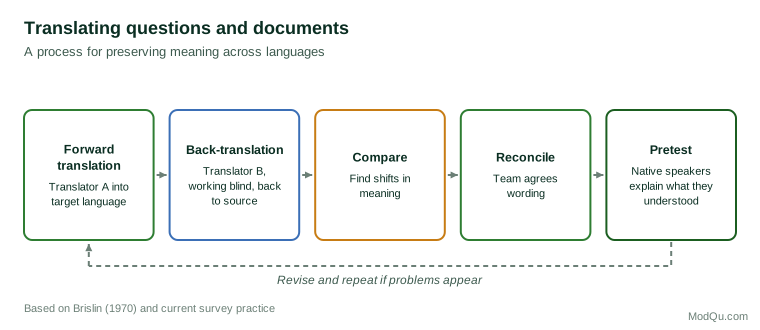
For surveys and documents, careful translation is essential. Brislin (1970) described back-translation, in which one translator renders a text into the target language and a second, working independently, translates it back into the original, so that discrepancies reveal problems of meaning. Modern practice adds team review, pretesting with native speakers and attention to concepts that do not exist in the same form in both languages.
Test assumptions about others explicitly
Structured techniques help. Analysts can list the assumptions they are making about how another group thinks and ask what evidence supports each one. They can ask colleagues with different backgrounds to review judgements. And they can construct alternative explanations of behaviour based on the other group's own stated beliefs and history rather than on what would be rational for an outsider.
Avoid stereotypes
Cultural knowledge must be held lightly. National dimensions describe tendencies, not individuals, and cultures change. Kent (1949) insisted that intelligence about foreign states must be grounded in deep and current knowledge of their history, institutions and people, not in received images. The aim of cultural intelligence is to widen the range of interpretations an analyst considers, not to replace one simplification with another.
Culture in interviews and source evaluation
Cultural understanding matters at the point of collection as well as in analysis. People from different backgrounds differ in how readily they disclose information to strangers, how they express disagreement, how they show respect and how they respond to direct questions. A source who answers "perhaps" or "it may be difficult" may, in a high-context setting, be giving a clear refusal; an interviewer from a low-context culture may record it as uncertainty. Silence, indirectness and deference to authority can be misread as evasion or agreement.
Source evaluation is affected too. Analysts judge credibility partly by cues such as confidence, consistency and directness, which are themselves culturally shaped. A source who speaks with elaborate politeness or tells a story in a non-linear way may be judged less reliable by an analyst who expects a crisp, chronological account. Being aware of these effects, and relying on corroboration rather than on impressions of demeanour, reduces the risk of discounting good information or crediting poor information because of style rather than substance.
Language skills shape what is collected in the first place. An organisation that monitors only English-language media about a foreign market will see the market through the eyes of international journalists and analysts rather than through the local press, trade associations and social media where many early signals appear. Even basic monitoring of local-language sources, supported by translation tools and checked by fluent speakers, can reveal issues that never reach international coverage.
Organisational culture as a subject of intelligence
Culture operates within organisations as well as nations. Every company, agency and armed force has its own habits of decision-making, appetite for risk, attitudes to hierarchy and preferred ways of doing things. These organisational cultures can be as important as national ones in predicting behaviour. A competitor whose culture prizes engineering excellence may respond to a price war by launching a better product rather than cutting prices; a government ministry with a cautious culture may delay a decision that its political leaders have announced.
The concept of strategic culture, introduced by Snyder (1977) to describe national security thinking, can be applied to these organisations too. Analysts can ask: what has this organisation done in similar situations before? What does it celebrate and what does it punish? Who has influence, and how do they reach decisions? Answers drawn from history, public statements, former employees and the organisation's own documents often predict behaviour better than general assumptions about rational action.
A business illustration
A consumer goods company plans to launch a premium product in a new Asian market. Its home-market research had shown that customers responded well to advertising that emphasised individual achievement and personal choice. Local focus groups, conducted through interpreters, appear to confirm interest in the product. After launch, sales are weak.
A review finds several cultural and linguistic problems. The survey translation rendered "premium" with a word that suggested "expensive" rather than "high quality", lowering scores. Participants in the focus groups had been reluctant to criticise the product in front of a foreign moderator, so apparent enthusiasm overstated real interest. And the advertising's emphasis on standing out from others did not resonate in a market where products were often bought as gifts and judged by how they reflected on relationships. Each problem could have been detected with back-translation, local moderators and a deliberate check on assumptions carried over from the home market.
Applications in business and research
For businesses, cultural and linguistic intelligence affects market entry, product design, advertising, negotiation and partnerships. Survey research across countries faces particular challenges: response styles differ (some populations avoid extreme answers, others favour agreement), concepts such as "satisfaction" or "trust" may not have exact equivalents, and the same question can be heard differently. Back-translation, cognitive pretesting in each language and careful interpretation of cross-national differences are standard safeguards. A finding that customers in one country rate a product lower than customers in another may reflect different scale use rather than different opinions.
In competitive intelligence, understanding a foreign competitor's business culture, including how decisions are made, how long-term its planning is, and how it relates to government, helps predict its behaviour more accurately than assuming it will act like a domestic rival.
Conclusion
Cultural and linguistic intelligence supplies the context without which information is easily misread. Research on values, communication styles, reasoning and language shows that differences between cultures are real, though often smaller and more variable than stereotypes suggest. The errors that follow from ignoring them, mirror imaging, ethnocentrism and loss of meaning in translation, have contributed to some of the best-known intelligence failures. The remedies are within reach of any organisation: people with deep regional and language expertise, careful translation, explicit testing of assumptions about others and descriptions rich enough to capture what actions mean to those who take them.
References
Allison, G. T. (1969). Conceptual models and the Cuban missile crisis. American Political Science Review, 63(3), 689–718. https://doi.org/10.2307/1954423
Ang, S., Van Dyne, L., Koh, C., Ng, K. Y., Templer, K. J., Tay, C., & Chandrasekar, N. A. (2007). Cultural intelligence: Its measurement and effects on cultural judgment and decision making, cultural adaptation and task performance. Management and Organization Review, 3(3), 335–371. https://doi.org/10.1111/j.1740-8784.2007.00082.x
Booth, K. (1979). Strategy and ethnocentrism. Croom Helm.
Boroditsky, L. (2001). Does language shape thought? Mandarin and English speakers' conceptions of time. Cognitive Psychology, 43(1), 1–22. https://doi.org/10.1006/cogp.2001.0748
Brislin, R. W. (1970). Back-translation for cross-cultural research. Journal of Cross-Cultural Psychology, 1(3), 185–216. https://doi.org/10.1177/135910457000100301
Earley, P. C., & Ang, S. (2003). Cultural intelligence: Individual interactions across cultures. Stanford University Press.
Geertz, C. (1973). The interpretation of cultures. Basic Books.
Gelfand, M. J., Raver, J. L., Nishii, L., Leslie, L. M., Lun, J., Lim, B. C., Duan, L., Almaliach, A., Ang, S., Arnadottir, J., Aycan, Z., Boehnke, K., Boski, P., Cabecinhas, R., Chan, D., Chhokar, J., D'Amato, A., Ferrer, M., Fischlmayr, I. C., ... Yamaguchi, S. (2011). Differences between tight and loose cultures: A 33-nation study. Science, 332(6033), 1100–1104. https://doi.org/10.1126/science.1197754
Hall, E. T. (1976). Beyond culture. Anchor Books.
Henrich, J., Heine, S. J., & Norenzayan, A. (2010). The weirdest people in the world? Behavioral and Brain Sciences, 33(2–3), 61–83. https://doi.org/10.1017/S0140525X0999152X
Heuer, R. J., Jr. (1999). Psychology of intelligence analysis. Center for the Study of Intelligence, Central Intelligence Agency.
Hofstede, G. (2001). Culture's consequences: Comparing values, behaviors, institutions, and organizations across nations (2nd ed.). Sage.
House, R. J., Hanges, P. J., Javidan, M., Dorfman, P. W., & Gupta, V. (Eds.). (2004). Culture, leadership, and organizations: The GLOBE study of 62 societies. Sage.
Jervis, R. (2010). Why intelligence fails: Lessons from the Iranian Revolution and the Iraq War. Cornell University Press.
Johnston, R. (2005). Analytic culture in the US intelligence community: An ethnographic study. Center for the Study of Intelligence, Central Intelligence Agency.
Kay, P., & Kempton, W. (1984). What is the Sapir-Whorf hypothesis? American Anthropologist, 86(1), 65–79. https://doi.org/10.1525/aa.1984.86.1.02a00050
Kent, S. (1949). Strategic intelligence for American world policy. Princeton University Press.
Lowenthal, M. M. (2022). Intelligence: From secrets to policy (9th ed.). CQ Press.
McFate, M. (2005). Anthropology and counterinsurgency: The strange story of their curious relationship. Military Review, 85(2), 24–38.
Nisbett, R. E. (2003). The geography of thought: How Asians and Westerners think differently . . . and why. Free Press.
Snyder, J. L. (1977). The Soviet strategic culture: Implications for limited nuclear operations (R-2154-AF). RAND Corporation.
Treverton, G. F. (2003). Reshaping national intelligence for an age of information. Cambridge University Press.