
Intelligence · Concepts and history
The Distinction Between Current Intelligence and Estimative Knowledge
Intelligence organisations report what is happening now and estimate what is likely to happen next. This article explains the difference between current intelligence and estimative knowledge, why the first tends to crowd out the second, and how to keep a healthy balance.
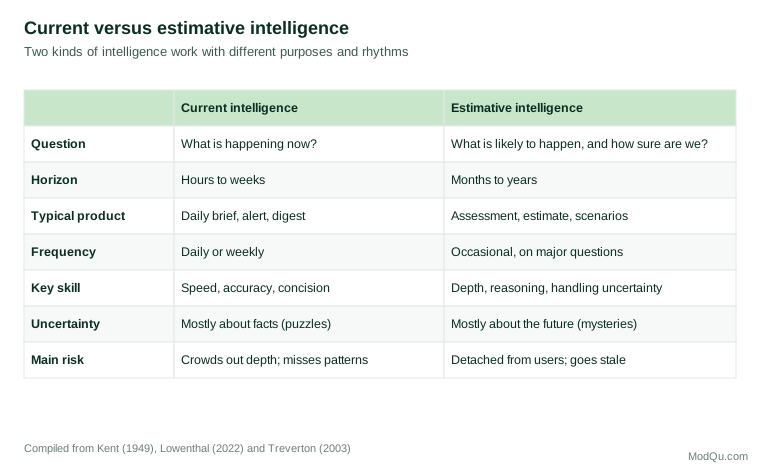
Every intelligence function, in government or business, does two different kinds of work. It reports on what is happening: yesterday's events, this morning's market movements, a competitor's announcement. And it estimates what is likely to happen: whether a conflict will escalate, whether demand will recover, how a rival will respond to a price cut. The first is current intelligence; the second is estimative intelligence. They rely on different skills, serve different decisions and are judged by different standards. Confusing them, or letting one crowd out the other, is one of the most common weaknesses of intelligence organisations.
Kent's three kinds of knowledge
Sherman Kent, in a foundational book on strategic intelligence, divided the knowledge a state needs about others into three types (Kent, 1949). Basic descriptive intelligence describes relatively stable facts: geography, economic structure, institutions, military forces. Current reportorial intelligence keeps that picture up to date by tracking events as they happen. Speculative–evaluative intelligence, the estimative kind, looks forward: it judges what others are likely to do and what situations are likely to develop.
Kent regarded the estimative function as the most important and the most difficult. Later, as director of the American Office of National Estimates, Kent described estimating as the work of going beyond the available facts to reasoned judgements about matters that cannot be known for certain (Steury, 1994).
Current intelligence
Current intelligence answers the questions: what is happening, and what does it mean right now? Its products are daily briefs, situation reports, alerts and short notes. The best-known example is the daily intelligence briefing prepared for a head of government, but every organisation has equivalents: a morning summary of overnight news for executives, a weekly competitor digest, a dashboard of sales and market indicators.
Current intelligence is valuable. Decision-makers need to know about events quickly, and short, frequent products keep intelligence visible to its users. Lowenthal (2022) notes that current intelligence is often the product senior officials read most closely, which gives it influence beyond its depth. It also helps analysts maintain contact with their users and learn what they care about.
Estimative intelligence
Estimative intelligence answers different questions: what is likely to happen, how probable is each outcome, and what would change the judgement? Its products are assessments and estimates, typically longer, produced less often and drawing on years of accumulated knowledge. They deal explicitly with uncertainty.
Treverton (2003) distinguishes puzzles, which have answers that more information could reveal, from mysteries, which depend on future choices and have no answer yet. Current intelligence mostly addresses puzzles about the present: what happened, where, who was involved. Estimative intelligence mostly addresses mysteries about the future. It cannot remove uncertainty, but it can structure it: identifying the forces at work, estimating probabilities and naming the indicators that will show which way events are moving.
Friedman and Zeckhauser (2012) argue that the value of estimative intelligence depends on how clearly it conveys uncertainty. Kent (1964) had already shown that probability words such as "likely" are read very differently by different people, and recommended linking them to numerical ranges.
The tyranny of the current
Many observers have noted that current intelligence tends to crowd out estimative work. Lowenthal (2022) describes a persistent bias towards current intelligence in American agencies, driven by the demand for daily products and the attention they receive. Johnston (2005), in an ethnographic study of analysts, found that many spent most of their time on current reporting and had little opportunity for the long-term research that builds expertise and supports estimates.
The reasons are easy to understand. Current products are requested constantly, take little time to produce and receive immediate attention. Estimative products are requested rarely, take weeks or months, and their value may not be apparent for years. Analysts are rewarded for visibility. Over time, an organisation can lose the deep expertise that estimates require, so that when a major strategic question arises there is no one with the knowledge to answer it well.
Grabo (2002), writing about strategic warning, makes a related point. Warning of a major threat depends on recognising a pattern that develops over weeks or months. Analysts focused on reporting each day's events may describe every piece of the pattern without ever stepping back to see it as a whole. Current reporting can therefore create an illusion of awareness while warning fails.
The opposite risk
The opposite imbalance also occurs. Estimates produced at a distance from current events can become stale, detached from what users need or overtaken by developments. Davis (2006) stresses that analysts need close contact with policymakers to know which questions matter, and current intelligence is often the channel through which that contact happens. Kerbel and Olcott (2010) argue that the most useful analysis emerges from continuing interaction with users rather than from finished products delivered from afar.
Estimates also face political pressures. Pillar (2011) describes how estimates on high-profile questions can become entangled in policy debates, with users selecting the judgements that support their positions. Fingar (2011), who led the American National Intelligence Council in the mid-2000s, describes efforts to make estimates more rigorous and transparent, including clearer statements of confidence and of the evidence underlying key judgements.
Getting the balance right
Betts (2007) reminds us that no organisational design can eliminate the uncertainty at the heart of estimates. But some practices help keep current and estimative work in productive balance:
- Protect time for depth. Assign some analysts to longer-term questions, or rotate analysts so that each spends part of the year on estimative work.
- Connect current reports to estimates. Ask, in each current product, what the new event means for existing estimates. Does it make an outcome more or less likely? Is it an indicator previously identified?
- Track indicators. For each important estimate, list the developments that would signal change, and monitor them in current reporting.
- Revisit estimates on a schedule. Re-examine key judgements regularly, and record how they changed and why.
- Score estimates against outcomes. Agrell and Treverton (2015) argue that intelligence should borrow from science the habit of testing judgements; Marrin (2012) calls for an evidence base about which analytic practices work. Recording probability estimates and checking them later provides both.
Writing each kind of product
The two products also call for different writing. A current report should lead with the event, then state in one or two sentences why it matters to the reader and what, if anything, it changes. Its value lies in speed and clarity, so it should be short, dated and specific about sources. An estimate should lead with its key judgements, attach a probability and a confidence level to each, and set out the main assumptions on which they rest. It should also say what would change the judgement: the indicators that, if observed, would make an outcome more or less likely. Davis (2006) stresses that readers of estimates need to see the reasoning, not only the conclusion, so that they can judge for themselves how much weight to give it. Kent (1964) warned that vague wording in estimates lets every reader find the meaning they prefer.
A business illustration
A retailer's intelligence team produces a weekly digest of competitor news: price changes, store openings, advertising campaigns. This is current intelligence, and it is widely read. But when the board asks whether a major online competitor is likely to enter its market within two years, the team struggles. No one has studied the competitor's strategy in depth, its past entries into other markets, or the economics that would make entry attractive. The weekly digest contains many relevant facts but no framework to interpret them.
The remedy is not to stop the digest. It is to commission an estimate, with explicit probabilities and indicators, and then to use the digest to track those indicators. Each week, the team notes whether the latest news moves the probability up or down. The current and estimative functions then reinforce each other rather than competing.
Conclusion
Current intelligence tells decision-makers what is happening; estimative intelligence tells them what is likely to happen and how sure anyone can be. Organisations need both. The danger is that the steady demand for current reporting slowly consumes the time, expertise and attention that estimates require. Recognising the distinction, protecting estimative capacity and linking daily reporting to longer-term judgements are the keys to intelligence that informs strategic decisions as well as daily ones.
References
Agrell, W., & Treverton, G. F. (2015). National intelligence and science: Beyond the great divide in analysis and policy. Oxford University Press.
Betts, R. K. (2007). Enemies of intelligence: Knowledge and power in American national security. Columbia University Press.
Davis, J. (2006). Intelligence analysts and policymakers: Benefits and dangers of tensions in the relationship. Intelligence and National Security, 21(6), 999–1021. https://doi.org/10.1080/02684520601046325
Fingar, T. (2011). Reducing uncertainty: Intelligence analysis and national security. Stanford University Press.
Friedman, J. A., & Zeckhauser, R. (2012). Assessing uncertainty in intelligence. Intelligence and National Security, 27(6), 824–847. https://doi.org/10.1080/02684527.2012.708275
Grabo, C. M. (2002). Anticipating surprise: Analysis for strategic warning. Joint Military Intelligence College.
Johnston, R. (2005). Analytic culture in the US intelligence community: An ethnographic study. Center for the Study of Intelligence, Central Intelligence Agency.
Kent, S. (1949). Strategic intelligence for American world policy. Princeton University Press.
Kent, S. (1964). Words of estimative probability. Studies in Intelligence, 8(4), 49–65.
Kerbel, J., & Olcott, A. (2010). Synthesizing with clients, not analyzing for customers. Studies in Intelligence, 54(4), 11–27.
Lowenthal, M. M. (2022). Intelligence: From secrets to policy (9th ed.). CQ Press.
Marrin, S. (2012). Improving intelligence analysis: Bridging the gap between scholarship and practice. Routledge.
Pillar, P. R. (2011). Intelligence and U.S. foreign policy: Iraq, 9/11, and misguided reform. Columbia University Press.
Steury, D. P. (Ed.). (1994). Sherman Kent and the Board of National Estimates: Collected essays. Center for the Study of Intelligence, Central Intelligence Agency.
Treverton, G. F. (2003). Reshaping national intelligence for an age of information. Cambridge University Press.