
Share how much you trust brands
Tell us how much you trust big brands, what makes you trust one and whether a brand has ever lost your trust. Your answers are combined with other people's and reported only as totals.
Start the trust in brands surveyAbout 5 minutes. No account needed. You can stop at any time.
What trust in a brand means
When people trust a brand, they expect it to:
- deliver products and services that work as described;
- be safe;
- charge fair prices and avoid hidden charges;
- treat customers well when something goes wrong;
- be honest in advertising and on labels;
- protect personal data;
- behave responsibly towards staff, communities and the environment.
Researchers often split trust into competence (can the brand do what it promises?) and integrity or goodwill (will it act honestly and in customers' interests?). A brand can be trusted for one and not the other: people may trust a phone brand to make reliable phones but not trust it with their data.
What builds trust
People give many reasons for trusting a brand:
- Personal experience: the product has worked well for years.
- Track record: the brand has been around a long time.
- Recommendations from family, friends and people they know.
- Reviews and ratings from other customers.
- Transparency: clear information about ingredients, sourcing, prices and policies.
- Good service, especially fair handling of complaints and returns.
- Guarantees and warranties.
- Independent checks, such as certifications and safety standards.
- Consistency: the product is the same every time.
Example
A mother has bought the same brand of baby formula since her first child was born. When her second child is born she does not consider any other, explaining that "it worked, and I'm not taking chances with that". She trusts the brand for safety above all, and price comes a distant second.
The example shows a common pattern: trust matters most in categories where a bad choice has serious consequences, such as food for children, medicines, cars, financial services and safety equipment.
What breaks trust
Trust can be lost slowly or suddenly. Common causes include:
- Product failures and recalls, especially when safety is involved.
- Data breaches that expose customers' personal information.
- Misleading claims in advertising or on packaging.
- Hidden fees or prices that rise without notice.
- Shrinkflation: making a product smaller while keeping the price the same.
- Poor treatment of customers with complaints.
- Scandals about how a company treats its workers, suppliers or the environment.
- Statements or behaviour by company leaders that customers dislike.
Example (hypothetical figures)
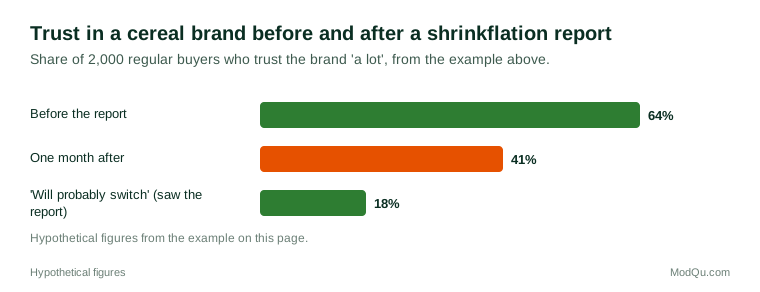
A survey of 2,000 regular buyers of a breakfast cereal finds that 64% trust the brand "a lot" before a news report shows the pack has shrunk from 500 g to 450 g with no price change. A repeat survey a month later finds that 41% trust it "a lot", a fall of 23 percentage points. Among people who saw the report, the share who say they will "probably switch" is 18%.
How brands try to recover
When trust is damaged, companies respond in different ways. Responses that are often described as more effective include:
- acting quickly and openly, rather than waiting or denying;
- apologizing clearly and taking responsibility;
- explaining what went wrong and what will change;
- compensating people who were affected;
- fixing the problem and showing the change over time.
Responses often described as less effective include silence, blaming others, legal language and apologies that seem forced. Trust usually takes much longer to rebuild than to lose.
Example
A home appliance maker discovers a fault that can cause some kettles to overheat. It announces a recall within days, offers free replacements or refunds, and contacts registered customers directly. A survey a year later finds that most customers who knew about the recall say they trust the brand as much as before or more, because of how it was handled.
Trust in big brands and small brands
People often have mixed feelings about large brands. Many trust big brands for consistency, safety and reliable service, especially when buying something unfamiliar. At the same time, large companies are often less trusted than small ones when people are asked about honesty and caring about customers. Local and family businesses are frequently rated as more trustworthy, though they may not be chosen as often.
Trust in different countries
Trust in brands and businesses varies between countries and groups. Where trust in institutions such as government and media is low, people may rely more on brands they know or on personal recommendations. In markets where counterfeit and fake goods are common, a trusted brand name can be a sign that a product is real and safe. Younger people often say they trust reviews, friends and online creators more than traditional advertising.
Trust online
Buying online has raised new trust questions. People cannot touch products before buying, and many sellers on online marketplaces are unknown. Fake reviews, counterfeit goods and scam websites are common concerns. Signals people use include ratings, the number of reviews, return policies, secure payment, recognizable brand names and whether the seller has a physical presence. Regulators in several countries have taken action against fake reviews.
How trust is measured
Surveys measure trust with questions such as:
- "How much do you trust [brand] to do what is right?"
- "How confident are you that [brand]'s products are safe?"
- "Would you trust [brand] with your personal data?"
- "Has a brand ever lost your trust? What happened?"
Tracking these questions over time can show how events affect trust. Open-ended answers about why people trust or distrust a brand are often more useful than scores alone.
Reviews and word of mouth
Recommendations from people they know are among the sources people trust most when judging a brand. Online reviews from strangers come next for many people, especially for products they have not bought before. People often read several reviews, look at the lowest ratings to see what goes wrong, and give more weight to detailed reviews with photos. Many say they distrust reviews that are all five stars or that use very similar wording, because they suspect them of being fake or paid for.
What people disagree about
People disagree about whether trusting brands is wise or naive, whether big brands deserve more or less trust than small ones, whether brands should comment on social and political issues, and whether a brand can ever fully recover after a scandal. Many people say they distrust advertising but still trust particular brands they know well.
Questions that brand owners, agencies, regulators and media want answered include how much people trust big brands, what builds and breaks trust, which events have made people lose trust, and what would win it back.
Key terms
- Brand trustThe belief that a brand will keep its promises and act honestly.
- CompetenceA brand's ability to deliver products and services that work.
- IntegrityA brand's honesty and fairness.
- Product recallA request by a company or regulator to return or fix a faulty product.
- Data breachAn incident in which personal data is exposed or stolen.
- ShrinkflationMaking a product smaller while keeping the price the same.
- WarrantyA promise to repair or replace a product if it fails within a period.
- CounterfeitA fake product made to look like a genuine brand.
Full glossary: brand strategy terms on EditingTests.com.
Trust in brands vocabulary test
How well do you know the language of this topic? Try 8 quick questions. Your score is shown straight away and is not saved.
What the trust in brands survey asks
This survey is part of ModQu's Brands and Advertising survey. The trust in brands part takes about five minutes and covers:
- How much you trust big brands in general, and in particular categories.
- What makes you trust a brand.
- Whether a brand has ever lost your trust, and what happened.
- Whether a brand has won your trust back, and how.
- Which sources you trust when choosing a brand: friends, reviews, experts, advertising or creators.
After that you can choose to continue with other short parts of the Brands and Advertising survey, such as brand awareness or brand loyalty, or stop.
Ready to take part?
Your answers help show what people really think and do. Results are only ever reported as totals; no one can see your individual answers.
Start the surveyQuestions about this survey
Who can take part?
Adults.
Do I have to give my name?
No. You may be asked for your age group, region and similar details so results can be broken down, but not your name. ModQu never asks for passwords, card numbers or account numbers.
How are the results used?
Answers are combined into totals and percentages and published in ModQu reports. Individual answers are never shown.
Is the vocabulary test part of the survey?
No. It is optional and separate, and your score is not stored.