
Share how you use green spaces
Tell us how often you visit a park, how far your nearest green space is and whether your area needs more trees. Your answers are combined with other people's and reported only as totals.
Start the trees, parks and green spaces surveyAbout 5 minutes. No account needed. You can stop at any time.
What counts as green space
Green space is land partly or fully covered with grass, trees, shrubs or other plants. In towns and cities it includes:
- public parks, from small neighbourhood parks to large city parks;
- street trees and green verges;
- playgrounds and playing fields;
- community gardens and allotments;
- nature reserves, woods and wetlands;
- riverbanks, canal paths and greenways;
- cemeteries and churchyards;
- green roofs and walls;
- school grounds, sometimes open to the public outside school hours.
Blue space, such as rivers, lakes and seafronts, is often studied alongside green space because people use it in similar ways.
How people use green spaces
People visit green spaces for many reasons:
- walking, running and cycling;
- playing with children;
- walking dogs;
- sport and exercise classes;
- picnics, barbecues and family gatherings;
- quiet time, reading and relaxing;
- meeting friends and neighbours;
- events, markets and festivals;
- gardening and growing food;
- watching wildlife.
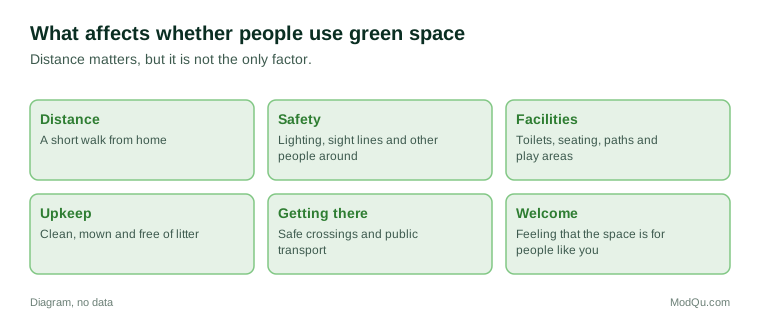
How often people visit depends on distance, safety, facilities, weather, time and whether the park feels welcoming. Many guidelines and studies use a short walking distance, such as within a few hundred metres or a 10-minute walk, as a measure of good access.
Example
A parent in a flat with no garden takes their two children to a park five minutes away almost every day after school. The park has a playground, a field and benches. On weekends they take a bus to a larger park with woods and a lake, which they say feels like a day out of the city.
Who has access
Access to green space is uneven. In many cities, wealthier neighbourhoods have more trees, larger parks and better-kept facilities, while poorer and denser areas have less. People without gardens, people without cars and people with disabilities often depend most on nearby public green space but may have the least of it. In fast-growing cities, green space can be lost to building.
Access is not only about distance. People may avoid parks that feel unsafe, are poorly lit, lack toilets or seating, or are hard to reach across busy roads. Some groups, such as older people, women alone at night or people from minority communities, may feel less welcome in some spaces.
What trees and parks do
Trees and green spaces provide benefits that are widely studied:
- Shade and cooling: trees cool streets in hot weather, reducing the urban heat island effect.
- Flood control: soil and plants absorb rain, reducing run-off.
- Air quality: trees can trap some pollutants, though effects depend on species and location.
- Wildlife: habitat for birds, insects and other animals.
- Health: research links access to green space with more physical activity and better reported mental wellbeing. The World Health Organization has published guidance on urban green space and health.
- Social life: places for communities to meet.
- Property values: homes near parks often sell for more.
Not all effects are positive. Some trees cause allergies, drop leaves on paths or damage pavements with roots. Parks need staff and money to stay safe and clean.
Looking after green spaces
Parks are usually run by local governments, sometimes with help from volunteers, charities and community groups. Budgets for parks are often among the first cut when public money is tight. Problems people report include litter, dog fouling, vandalism, broken equipment, poor lighting, closed toilets and overgrown areas.
Many cities run tree-planting programs, sometimes with targets for tree canopy cover. Volunteers plant and water trees, run "friends of the park" groups, pick litter and lead nature walks.
Example (hypothetical figures)
A city plans to plant 10,000 street trees over five years. Each tree costs about 400, in local currency, to buy and plant, and about 50 a year to water and care for in the first three years. The planting costs 4 million, and three years of care for every tree adds 1.5 million, a total of 5.5 million.
Climate and green space
As heatwaves become more frequent in many regions, trees and parks are increasingly seen as part of how cities adapt. Cities in hot climates have long used trees, courtyards and water to cool streets. Choosing tree species that survive drought, heat and new pests is a growing concern for city planners.
Example
During a heatwave, residents of a street with mature trees find the pavement noticeably cooler than a nearby street with none. The local council receives requests from the second street for trees and adds it to its planting list.
What people disagree about
People disagree about how land should be used: new housing or green space, sports pitches or wild areas, car parks or trees. Tree planting can be contested when trees block views, light or parking. Some people want parks with more facilities and events; others want quiet, natural spaces. Debates also cover who should pay for upkeep, how to make parks feel safe without making them less open, and whether new developments should be required to include green space.
Questions that local governments, planners and environmental groups want answered include how often people visit parks, how far they live from green space, what stops them using it and whether their area should have more trees.
Key terms
- Green spaceLand covered with grass, trees or other plants, such as parks and gardens.
- Blue spaceOutdoor areas with water, such as rivers, lakes and seafronts.
- Tree canopy coverThe share of an area covered by tree crowns when seen from above.
- Urban heat islandA city area that is warmer than its surroundings because of buildings and paving.
- AllotmentA plot of land rented by an individual for growing food or flowers.
- Community gardenA garden managed and worked by a group of local people.
- GreenwayA path or strip of green land for walking and cycling.
- BiodiversityThe variety of plant and animal life in an area.
Full glossary: urban forestry terms on EditingTests.com.
Trees, parks and green spaces vocabulary test
How well do you know the language of this topic? Try 8 quick questions. Your score is shown straight away and is not saved.
What the trees, parks and green spaces survey asks
This survey is part of ModQu's Energy and Environment survey. The trees, parks and green spaces part takes about five minutes and covers:
- How often you visit a park or other green space.
- How far your nearest green space is, and how you get there.
- What you use green spaces for.
- What stops you using green spaces more.
- How you rate the upkeep and safety of local parks.
- Whether your area should have more trees or green space.
After that you can choose to continue with other short parts of the Energy and Environment survey, such as home energy use and bills or solar power at home, or stop.
Ready to take part?
Your answers help show what people really think and do. Results are only ever reported as totals; no one can see your individual answers.
Start the surveyQuestions about this survey
Who can take part?
Adults.
Do I have to give my name?
No. You may be asked for your age group, region and similar details so results can be broken down, but not your name. ModQu never asks for passwords, card numbers or account numbers.
How are the results used?
Answers are combined into totals and percentages and published in ModQu reports. Individual answers are never shown.
Is the vocabulary test part of the survey?
No. It is optional and separate, and your score is not stored.
Does the survey ask about beaches and rivers?
Yes. Blue spaces such as rivers, lakes and seafronts are included with green spaces.
Why does the survey ask what stops people using parks?
Councils and planners want to know whether distance, safety, facilities or upkeep keep people away, so they can decide what to fix first.
Does a private garden count as green space?
The survey focuses on public green space, but it asks whether you have a garden because that affects how much people use parks.
Can I answer if I live in the countryside?
Yes. Rural residents can describe their access to parks, woods and other green areas.
Will my local council see my answers?
Results are reported for groups and areas, not individuals, and ModQu does not ask for your address.