
Share your experience of air quality
Tell us how wildfire smoke has affected you, how you check air quality and what you do to protect yourself. Your answers are combined with other people's and reported only as totals.
Start the air quality and wildfire smoke surveyAbout 5 minutes. No account needed. You can stop at any time.
What air quality covers
Air quality describes how clean or polluted the air is. Outdoor air quality is affected by:
- Wildfire smoke, which can travel thousands of kilometres and affect cities far from any fire.
- Traffic, especially near busy roads and highways.
- Industry, power plants and construction.
- Wood burning in stoves and fireplaces, especially in winter.
- Weather, such as hot, still days that trap pollution near the ground.
- Natural sources, such as pollen and dust.
Indoor air quality matters too, because most people spend most of their time indoors. It is affected by cooking, smoking, candles, cleaning products, mould, poor ventilation and radon, a natural radioactive gas that can seep into basements from the ground. Health Canada recommends that all homes be tested for radon.
What is in wildfire smoke
Wildfire smoke is a mix of gases and fine particles. The part of most concern for health is fine particulate matter, known as PM2.5: particles 2.5 micrometres across or smaller, small enough to be breathed deep into the lungs. Smoke can also contain carbon monoxide and other compounds.
Short-term effects that public health agencies describe include sore eyes, a scratchy throat, coughing, headaches and shortness of breath. Some groups are more likely to be affected:
- people with asthma, chronic obstructive pulmonary disease (COPD) or heart disease;
- older adults;
- pregnant people;
- infants and young children;
- people who work or exercise outdoors.
How air quality is reported
In Canada, the main public measure is the Air Quality Health Index (AQHI), developed by Health Canada and Environment and Climate Change Canada. It is reported on a scale from 1 upward, grouped into low, moderate, high and very high health risk, with advice for the general public and for people at higher risk. The United States uses a different scale, the Air Quality Index (AQI), run by the Environmental Protection Agency, which uses colour bands from good to hazardous. Because the two scales work differently, a number on one does not mean the same thing on the other.
Environment and Climate Change Canada also issues special air quality statements and smoky skies bulletins when wildfire smoke is expected. Many people now check air quality on a weather app or website, and some buy low-cost home sensors.
Example
A parent of a child with asthma lives in a city that rarely had smoky days until a few years ago. They now check the AQHI every morning during fire season, keep the child's inhaler in their school bag and ask the school how it decides whether recess will be held indoors on smoky days.
What people do to protect themselves
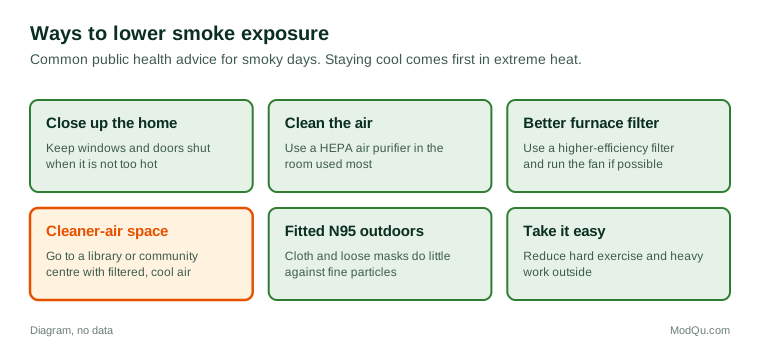
When smoke arrives, public health advice usually focuses on reducing exposure. Common actions include:
- Staying indoors with windows and doors closed, when it is not too hot to do so.
- Using an air purifier with a HEPA filter, or a portable air cleaner, in the room where people spend the most time.
- Upgrading the furnace filter to a higher-efficiency type and running the fan, if the system allows it.
- Reducing outdoor exercise and heavy work outside.
- Wearing a well-fitted respirator mask, such as an N95, when outside. Cloth and loose surgical masks give much less protection against fine particles.
- Going to a cleaner-air space, such as a library, community centre or shopping centre, when home is too smoky or hot.
Some people also build a do-it-yourself box fan filter by attaching a furnace filter to a box fan, an approach some public health agencies have described as a lower-cost option.
Example (hypothetical figures)
A household compares two ways to clean the air in a bedroom during a smoky week. A portable HEPA purifier costs $180 and uses about 50 watts. Running it for 20 hours a day for 7 days uses 7 kWh, which at a hypothetical 15 cents per kWh costs $1.05. A box fan with a furnace filter costs $70 in total. They buy the purifier for the bedroom and make a box fan filter for the living room.
Smoke, heat and difficult trade-offs
Smoky days often come during hot weather, which creates a dilemma. Closing windows keeps smoke out but can make a home without air conditioning dangerously hot. Public health agencies generally advise that staying cool is the priority during extreme heat, and that people should seek a cool, cleaner-air space if they cannot keep both heat and smoke down at home.
Other trade-offs include whether to cancel outdoor events, sports practices and summer camps, and whether outdoor workers should stop work. Employers, schools and event organizers increasingly have smoke policies, but they vary.
Example
A summer day camp has a rule that activities move indoors when the AQHI is high. On a hot, smoky day, the indoor gym has no air conditioning. Camp staff move the group to a cooled community centre with a portable air cleaner and send a message to parents explaining the change.
Long-term worries and changes in behaviour
Wildfire seasons in parts of Canada and the western United States have become longer and more intense in recent years. People who have lived through smoky summers often change how they plan:
- buying air purifiers, filters and masks before fire season;
- planning holidays or outdoor events for times of year with fewer fires;
- considering air conditioning or a heat pump for the first time;
- thinking about health effects of repeated smoke exposure, which researchers are still studying;
- in some cases, thinking about whether to move.
Indoor air at other times of year
Air quality is not only a summer issue. In winter, wood smoke, poor ventilation and moisture can affect indoor air. Gas stoves, unvented heaters and attached garages can add pollutants. Simple steps include running a range hood vented outdoors while cooking, using bathroom fans, testing for radon and installing carbon monoxide alarms.
Example
A couple who just bought an older house with a finished basement order a long-term radon test kit after reading Health Canada's advice. The result is above the guideline, so they hire a certified professional to install a radon mitigation system that vents the gas from under the foundation.
What people disagree about
People disagree about how much to change daily life on smoky days, how to manage forests and fire risk, how much wildfire seasons are linked to climate change compared with other causes, and who should pay for cleaner-air spaces and protective equipment. Questions that businesses and public agencies want answered include whether wildfire smoke has affected people this year, whether they own an air purifier and whether they check air quality reports.
Key terms
- PM2.5Fine particles 2.5 micrometres across or smaller that can be breathed deep into the lungs.
- Air Quality Health Index (AQHI)Canada's public scale for reporting air pollution and health risk.
- HEPA filterA high-efficiency particulate air filter that traps very fine particles.
- N95 respiratorA mask designed to filter at least 95% of airborne particles when well fitted.
- RadonA natural radioactive gas that can build up in homes from the ground.
- Special air quality statementA public notice that air quality is expected to be poor.
- Cleaner-air spaceA building with filtered air that people can go to during smoky periods.
- VentilationBringing fresh outdoor air into a building and removing stale air.
Full glossary: air quality monitoring terms on EditingTests.com.
Air quality and wildfire smoke vocabulary test
How well do you know the language of this topic? Try 8 quick questions. Your score is shown straight away and is not saved.
What the air quality and wildfire smoke survey asks
This survey is part of ModQu's Energy and Environment survey. The air quality and wildfire smoke part takes about five minutes and covers:
- Whether wildfire smoke or poor air quality has affected you this year, and how.
- Whether you check air quality reports, and where.
- What you do to protect yourself and your household on smoky days.
- Whether you own an air purifier, mask or upgraded furnace filter.
- Whether anyone in your home has a condition that air quality affects.
- How smoky summers have changed your plans, purchases or views.
After that you can choose to continue with other short parts of the Energy and Environment survey, such as home energy use and bills or solar power at home, or stop.
Ready to take part?
Your answers help show what people really think and do. Results are only ever reported as totals; no one can see your individual answers.
Start the surveyQuestions about this survey
Who can take part?
Adults.
Do I have to give my name?
No. You may be asked for your age group, region and similar details so results can be broken down, but not your name. ModQu never asks for passwords, card numbers or account numbers.
How are the results used?
Answers are combined into totals and percentages and published in ModQu reports. Individual answers are never shown.
Is the vocabulary test part of the survey?
No. It is optional and separate, and your score is not stored.