
Share your views on home solar
Tell us whether you have considered solar panels, what stops you and who you would trust to install them. Your answers are combined with other people's and reported only as totals.
Start the solar power at home surveyAbout 5 minutes. No account needed. You can stop at any time.
What home solar covers
Home solar usually means photovoltaic (PV) panels mounted on a roof or on the ground that turn sunlight into electricity. A typical system has:
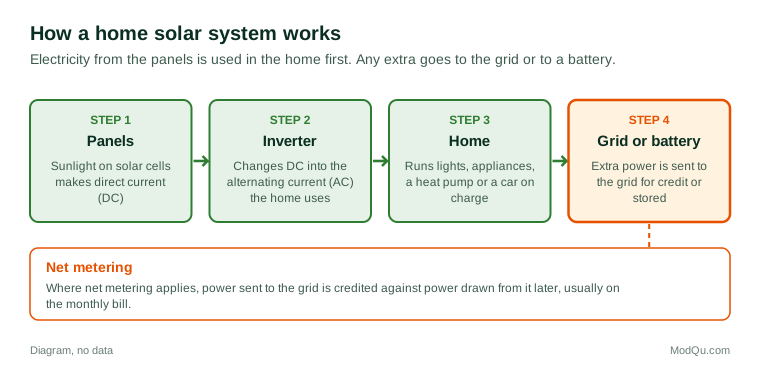
- Panels, made of solar cells, that produce direct current (DC) electricity when light falls on them.
- An inverter, which turns DC into the alternating current (AC) used in the home. Some systems use one central inverter; others use small microinverters behind each panel.
- Mounting and wiring, including a disconnect switch for safety.
- A meter that records electricity flowing to and from the grid.
- An optional battery that stores daytime electricity for use in the evening or during a power outage.
Solar water heating, which uses the sun to heat water directly, is a separate and less common technology. This page is mainly about solar electricity.
How solar electricity is used in a home
During the day, the electricity the panels produce goes first to whatever is running in the home: the fridge, a computer, a heat pump or a car on charge. When the panels produce more than the home needs, the extra either flows to the grid or charges a battery. At night, or on dark winter days, the home draws from the grid or the battery as usual.
How much a system produces depends on:
- the size of the system, measured in kilowatts (kW);
- the direction and angle of the roof, with south-facing roofs usually best in Canada and the United States;
- shade from trees, chimneys and nearby buildings;
- the local climate and the season, since days are much shorter in a Canadian winter and snow can cover panels;
- the age and condition of the panels, which slowly produce less over many years.
Example
A household with a south-facing roof and a large shade tree at the back asks two installers for quotes. One proposes panels on both the south and west faces. The other proposes panels only on the south face, saying the west side is shaded in the afternoon. The second quote is smaller and cheaper, and the installer says it will produce almost as much electricity in a year.
Net metering and selling power to the grid
How a household is credited for the extra electricity it sends to the grid has a large effect on whether solar makes sense. Several Canadian provinces and many US states have net metering programs. Under net metering, electricity sent to the grid is credited against electricity drawn from it, usually on the monthly bill, with any remaining credit carried forward for a set period.
Rules vary by place and change over time. Some programs credit exported power at the full retail price, others at a lower rate, and some cap the size of system allowed. A few places have offered feed-in programs that paid a set price for every kilowatt-hour produced. Homeowners usually need permission from the local utility before connecting a system to the grid, and an electrical inspection is normally required.
Costs, savings and payback
The cost of a home solar system depends on its size, the equipment chosen, the roof and the local cost of labour and permits. Savings depend on how much electricity the system produces, local electricity prices and the net metering rules.
People often judge solar by its payback period: the number of years it takes for savings on bills to equal the cost of the system. Other ways to look at it include the total savings over the life of the system and the effect on the home's value.
Example (hypothetical figures)
A homeowner is quoted $24,000 for a system. A rebate covers $5,000, leaving $19,000. The installer estimates the system will save $1,250 a year on electricity bills. Ignoring price changes and maintenance, the simple payback is $19,000 ÷ $1,250 = 15.2 years. If electricity prices rise, the payback would be shorter; if an inverter needs replacing, it would be longer.
Ways people pay for solar include cash, a home equity loan or line of credit, a loan from a government or utility program, and in some markets a lease or a power purchase agreement, where a company owns the panels and the household pays for the electricity they produce. Each option shares cost and risk differently, and contracts can be long.
Batteries and backup power
A home battery stores electricity for later use. Reasons people give for adding one include:
- using more of their own solar electricity in the evening;
- keeping some power on during an outage, if the system is set up to do so;
- avoiding high time-of-use prices by using stored power at peak times.
Batteries add a lot to the cost of a system and have a limited number of charge cycles. Many solar systems without batteries shut off during a grid outage for the safety of line workers, which surprises some owners.
Example
After a winter storm leaves their street without power for two days, a couple with rooftop solar learn that their system turned itself off during the outage. They had assumed the panels would keep the lights on. They ask their installer about adding a battery and a switch that would let the home run on solar and battery during an outage.
What stops people from installing solar
Many homeowners say they are interested in solar but have not gone ahead. Common reasons include:
- Up-front cost, even when the long-term savings look good.
- Uncertainty about savings, including future electricity prices and changes to net metering rules.
- The roof: its direction, shade, age or condition. A roof that needs replacing soon is usually replaced first.
- Plans to move, which make a long payback less attractive.
- Trust in installers, especially after high-pressure sales calls or door-to-door offers.
- Looks and rules, including condominium or heritage restrictions.
- Renting, since tenants cannot usually install panels.
Some places offer community solar, where people buy or subscribe to a share of a larger solar installation elsewhere and receive credits on their bills. This allows renters and people with unsuitable roofs to take part.
Choosing an installer
Homeowners who decide to go ahead usually get several quotes. Points they tend to compare include:
- the system size and the estimated yearly production, and how the estimate was made;
- the brand and warranty of the panels and inverter, and the installer's own workmanship warranty;
- whether the installer is licensed and insured, and who handles permits, utility approval and rebate paperwork;
- reviews and references from past customers;
- how long the company has been in business, since warranties are only as good as the firm behind them.
Example
A homeowner receives a door-to-door offer for "free solar" that turns out to be a 20-year lease with yearly price increases. They decline, then contact two local installers recommended by neighbours. They choose the one that explained the production estimate in detail and offered a ten-year workmanship warranty, even though its price was slightly higher.
What people disagree about
People disagree about whether rooftop solar is a good financial choice in places with long winters and low electricity prices, about whether net metering is fair to customers without solar, and about how much public money should support home solar compared with large solar farms. Questions that businesses and governments want answered include how many homeowners have considered solar, what stops them, how they would pay, and who they would trust to install a system.
Key terms
- Photovoltaic (PV)Technology that turns sunlight directly into electricity.
- InverterA device that changes the direct current from solar panels into alternating current for the home.
- Net meteringA billing arrangement that credits electricity sent to the grid against electricity drawn from it.
- Kilowatt (kW)A unit of power, used to describe the size of a solar system.
- Payback periodThe time it takes for savings to equal the cost of a purchase.
- MicroinverterA small inverter attached to a single solar panel.
- Community solarA shared solar installation that several households subscribe to or buy into.
- Power purchase agreementA contract to buy electricity from panels owned by another company.
Full glossary: solar power installation terms on EditingTests.com.
Solar power at home vocabulary test
How well do you know the language of this topic? Try 8 quick questions. Your score is shown straight away and is not saved.
What the solar power at home survey asks
This survey is part of ModQu's Energy and Environment survey. The solar power at home part takes about five minutes and covers:
- Whether you own your home and what kind of roof it has.
- Whether you have considered solar panels or a home battery, and why.
- What stops you from installing them, such as cost, the roof or trust.
- How you would pay for a system, if you went ahead.
- Who you would trust to install solar and where you would look for information.
- For households with solar: how it has worked and whether you would do it again.
After that you can choose to continue with other short parts of the Energy and Environment survey, such as home energy use and bills or recycling and waste, or stop.
Ready to take part?
Your answers help show what people really think and do. Results are only ever reported as totals; no one can see your individual answers.
Start the surveyQuestions about this survey
Who can take part?
Homeowners.
Do I have to give my name?
No. You may be asked for your age group, region and similar details so results can be broken down, but not your name. ModQu never asks for passwords, card numbers or account numbers.
How are the results used?
Answers are combined into totals and percentages and published in ModQu reports. Individual answers are never shown.
Is the vocabulary test part of the survey?
No. It is optional and separate, and your score is not stored.
Do solar panels work in winter?
Yes, panels produce electricity whenever light falls on them, but output is lower in winter because days are shorter and snow can cover the panels.
Do I need a battery to have solar?
No. Most home systems are connected to the grid without a battery. A battery is an optional extra for evening use or backup power.