
Share how you shop for greener products
Tell us whether you buy products because they are better for the environment, whether you would pay more and which labels you trust. Your answers are combined with other people's and reported only as totals.
Start the sustainable products surveyAbout 5 minutes. No account needed. You can stop at any time.
What sustainable products cover
A sustainable product is one designed, made, used and disposed of with less harm to the environment, and often to people, than the usual alternative. There is no single legal definition, so the word covers a wide range of products and claims.
Ways a product can be more sustainable include:
- Materials: recycled content, renewable materials, or materials grown or harvested with less damage.
- Manufacturing: less energy, water or pollution used in making it.
- Packaging: less packaging, or packaging that is recyclable, compostable or refillable.
- Use: lower energy or water use while in use, such as an efficient appliance.
- Durability: lasting longer, being repairable and having spare parts available.
- End of life: being recyclable, compostable or taken back by the maker.
- Social standards: fair pay and safe conditions for workers along the supply chain.
Most products are better on some of these points and worse on others. A product made from recycled plastic may still be hard to recycle again; a product shipped from far away may have been made with less energy.
Where people buy greener products
Interest in sustainable products shows up across many categories:
- Cleaning and personal care: refills, concentrated products, bar soap and shampoo.
- Food: organic, local, seasonal, plant-based and fair trade products.
- Clothing: second-hand, durable or recycled-fibre clothing, and repair services.
- Household goods: reusable bags, bottles, containers and beeswax or silicone wraps.
- Electronics and appliances: efficient models, refurbished devices and longer-lasting products.
- Large purchases: electric vehicles, heat pumps and solar panels.
Example
A parent switches the family's dish soap and laundry detergent to a refill station at a local shop, bringing back the same bottles each month. They keep buying conventional shampoo because the refill version did not suit their children's hair. Their household is green in some categories and conventional in others, which is common.
Labels and certifications
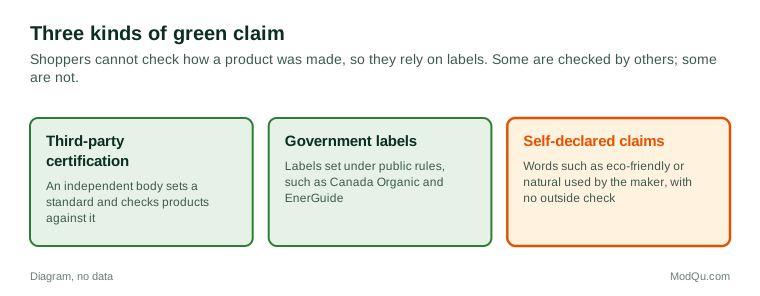
Because shoppers cannot check how a product was made, they rely on labels. These fall into a few kinds:
- Third-party certifications, where an independent organization sets standards and checks products against them, such as organic, fair trade, sustainably managed forest and ENERGY STAR labels.
- Government labels and standards, such as Canada Organic for food certified under federal rules, and EnerGuide ratings for appliances and homes.
- Self-declared claims made by the company itself, such as "eco-friendly", "natural", "green" or "carbon neutral".
Self-declared claims are the hardest to judge. In Canada, the Competition Bureau can act against environmental claims that are false or misleading, and amendments to the Competition Act in 2024 added specific requirements for environmental claims about a product's benefits and for claims about a business's climate actions. Similar rules exist in the United States and the European Union.
Greenwashing and trust
Greenwashing is when a company makes a product or itself look better for the environment than it is. Common forms include:
- vague words such as "eco" or "natural" with no explanation;
- highlighting one small green feature while ignoring larger harms;
- images of leaves, forests or the colour green that suggest a benefit that is not stated;
- claims that cannot be checked, or labels that look like certifications but are created by the company;
- "carbon neutral" claims that rely mainly on offsets that may not deliver what they promise.
Many shoppers say they do not trust green claims, and distrust can lead people to ignore genuine claims as well as false ones.
Example
A shopper sees two paper towel brands. One package is green, has a picture of a tree and says "earth friendly". The other is plain but carries a forest certification logo and states its recycled content as a percentage. The shopper picks the second, saying the plain one at least told them something specific.
Price and willingness to pay
Sustainable versions of products often cost more, at least up front. Whether people pay the difference depends on:
- How large the price gap is, and whether it is a one-time or repeat cost.
- Whether there is a personal benefit as well, such as lower energy bills, better health or a longer-lasting product.
- Trust that the product really is better.
- Income: households with less money have less room to pay extra, even if they care.
- Habit and convenience, such as whether the product is in the usual store.
Surveys often find that more people say they would pay more for sustainable products than actually do so. This difference between stated and actual behaviour is called the say-do gap, or the intention-behaviour gap.
Example (hypothetical figures)
A survey asks shoppers whether they would pay 10% more for a cleaning spray in recycled packaging. Of 1,000 people, 540 say yes. Sales data from a trial store later show the greener spray, priced 10% higher, took 18% of sales in its category. The two figures measure different things, but the gap between 54% saying yes and 18% of sales is a reminder that intentions are not purchases.
Buying less, buying used and repairing
For many people, sustainability is less about which new product to buy and more about buying fewer new things. This includes:
- buying second-hand clothing, furniture, books and electronics;
- renting or borrowing items used rarely, such as tools or camping gear;
- repairing items, from clothing and shoes to phones and appliances;
- choosing products that are built to last and can be repaired, a topic linked to "right to repair" debates about access to parts, tools and manuals.
Example
A student whose laptop battery fails is told by the store that a new laptop would be easier. Instead, they find a local repair shop that replaces the battery for much less than a new machine. The laptop lasts two more years.
Who buys and why
Research on green consumers generally shows that values, income, age, education and where people live all play a part, but the picture is mixed. Some people buy sustainable products mainly for health, quality or saving money rather than for the environment. Others care deeply about the environment but buy little that is labelled green, because they buy very little at all.
What people disagree about
People disagree about whether individual shopping choices make a real difference, how much responsibility falls on companies compared with consumers, whether eco-labels should be regulated more tightly, and whether higher prices for greener products are fair. Questions that businesses want answered include whether people buy products because they are better for the environment, how much more they would pay, and which green labels they trust.
Key terms
- Eco-labelA label that tells buyers a product meets certain environmental standards.
- Third-party certificationChecking of a product by an independent organization against a published standard.
- GreenwashingMaking misleading claims that a product or company is better for the environment than it is.
- Say-do gapThe difference between what people say they will do and what they actually do.
- Recycled contentThe share of a product or package made from recycled material.
- Carbon offsetA credit for an emissions reduction made elsewhere, used to balance a company's own emissions.
- Life-cycle assessmentA study of a product's environmental impact from raw materials to disposal.
- Right to repairThe idea that owners should be able to get parts, tools and information to repair what they buy.
Full glossary: sustainability reporting terms on EditingTests.com.
Sustainable products vocabulary test
How well do you know the language of this topic? Try 8 quick questions. Your score is shown straight away and is not saved.
What the sustainable products survey asks
This survey is part of ModQu's Energy and Environment survey. The sustainable products part takes about five minutes and covers:
- Whether you buy products because they are better for the environment, and which ones.
- How much more you would pay for a greener version of everyday products.
- Which green labels or certifications you know and trust.
- How you judge whether an environmental claim is true.
- Whether you buy second-hand, repair items or buy less to reduce waste.
- What would make it easier for you to buy more sustainably.
After that you can choose to continue with other short parts of the Energy and Environment survey, such as home energy use and bills or solar power at home, or stop.
Ready to take part?
Your answers help show what people really think and do. Results are only ever reported as totals; no one can see your individual answers.
Start the surveyQuestions about this survey
Who can take part?
Adults.
Do I have to give my name?
No. You may be asked for your age group, region and similar details so results can be broken down, but not your name. ModQu never asks for passwords, card numbers or account numbers.
How are the results used?
Answers are combined into totals and percentages and published in ModQu reports. Individual answers are never shown.
Is the vocabulary test part of the survey?
No. It is optional and separate, and your score is not stored.