
Share your recycling habits
Tell us how you sort your waste, what confuses you and what you think about packaging. Your answers are combined with other people's and reported only as totals.
Start the recycling and waste surveyAbout 5 minutes. No account needed. You can stop at any time.
What household waste covers
Household waste is everything a home throws away. In most Canadian cities it is collected in a few streams:
- Garbage, which usually goes to a landfill or, in some places, to an energy-from-waste plant.
- Recycling, often called the blue box or blue bin, for paper, cardboard, metal cans and some plastics and glass.
- Organics, often called the green bin, for food scraps and sometimes yard waste and soiled paper.
- Yard waste, such as leaves and branches, collected at certain times of year.
- Special waste taken to depots: paint, batteries, electronics, light bulbs, propane tanks and household chemicals.
- Bulky items such as furniture and appliances, collected on request or taken to a drop-off site.
Collection is usually run by the municipality, either with its own crews or through contractors. Apartment buildings and condominiums often have their own arrangements, with shared bins in a garbage room.
How recycling works after the bin
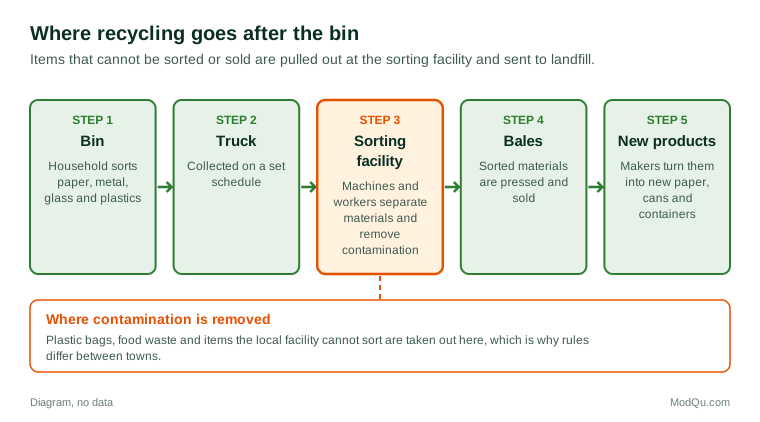
Once a recycling truck collects a bin, the material goes to a material recovery facility (MRF), where machines and workers separate it into paper, cardboard, metals, glass and different plastics. The sorted materials are baled and sold to companies that make new products from them.
Not everything in the bin gets recycled. Items that are the wrong material, too small, too dirty or tangled with other things are pulled out as contamination and sent to landfill. A greasy pizza box, a plastic bag wrapped around a sorting machine or a bottle half full of liquid can all cause problems. Markets for some materials are strong and stable, such as aluminium cans and cardboard, while others, such as some plastics, are harder to sell.
Example
A household puts all their plastic bags into the blue bin, thinking they are being helpful. A neighbour who works at the local sorting facility explains that loose bags wrap around the machines and have to be cut off by hand. The household starts taking clean bags back to a store drop-off bin instead, as their city's guide recommends.
Why the rules differ from place to place
One of the most common complaints about recycling is that the rules are different in every town. A yogurt container accepted in one city may be garbage in the next. The reasons include:
- the equipment at the local sorting facility, which decides which materials can be separated;
- local markets for sorted materials;
- the contract between the city and the hauler or facility;
- whether the program is run by the city, the province or the producers who make the packaging.
Several Canadian provinces have moved, or are moving, to extended producer responsibility (EPR), where the companies that sell packaged goods pay for, and in some cases run, the recycling of that packaging. Supporters say this gives companies a reason to use less packaging and packaging that is easier to recycle. Some provinces are also aiming for more consistent lists of accepted items across communities.
Composting and food waste
Food scraps make up a large share of household waste by weight. When they go to landfill, they break down without air and release methane. Many cities now collect organics separately and send them to composting or anaerobic digestion facilities, which produce compost and, in the case of digestion, biogas.
Households also compost at home in a backyard bin. Home composting can handle fruit and vegetable scraps, coffee grounds and leaves, but city programs often accept more, such as meat, bones and soiled paper, because their facilities run at higher temperatures.
Example
A family that composts in the backyard is surprised to learn that the city green bin accepts meat and dairy scraps, which they had been putting in the garbage because they attract animals to a backyard bin. They start using both: the backyard bin for garden waste and vegetable peels, the green bin for everything else.
Packaging and what people would pay
Packaging is the part of waste people tend to feel most strongly about. Common concerns are:
- products with several layers of packaging;
- packaging made of mixed materials that cannot be separated;
- single-use plastic items such as cutlery, straws and bags;
- labels such as "recyclable" that may not match local rules.
The federal government has introduced regulations on certain single-use plastic items, which have been challenged in court, and several provinces and cities have their own rules on bags and containers. Some shoppers choose products with less packaging, bring their own containers to refill stores, or buy in bulk.
Whether people would pay more for less packaging is a common survey question. People often say yes, but their actual purchases do not always match what they say, a pattern researchers call the say-do gap.
Example (hypothetical figures)
A shopper compares two brands of laundry detergent. One comes in a 2 kg plastic jug for $12.00. The other comes as 2 kg of powder in a cardboard box for $13.50. The cardboard option costs $1.50, or 12.5%, more. The shopper buys it the first time, then switches back to the jug when it goes on sale.
Deposit-return systems
In much of Canada, beverage containers such as bottles and cans carry a refundable deposit paid at purchase and returned when the container is brought back to a depot or store. Deposit systems usually recover a higher share of containers than curbside recycling alone, and the returned material tends to be cleaner. Rules on which containers carry a deposit, and how much it is, vary by province.
Common problems and confusion
People describe similar problems with waste and recycling:
- Not knowing what goes where, especially for plastics, coffee cups, takeout containers and items made of several materials.
- Wishcycling: putting items in the recycling in the hope they will be recycled, which can add to contamination.
- Doubts that recycling happens at all, often after news stories about material being sent to landfill or overseas.
- Missed collections, full bins and limits on the number of garbage bags.
- Shared bins in apartments, where one person's sorting mistakes affect the whole building.
- Illegal dumping of furniture, mattresses and electronics.
Example
A condominium board finds that its shared recycling bins are often rejected by the hauler because of contamination. The board posts a one-page picture guide in the garbage room, adds a separate bin for soft plastics and sends a short reminder by email. Rejections fall over the next few months.
What people disagree about
People disagree about how much recycling achieves compared with reducing and reusing, whether producers or taxpayers should pay for recycling, whether bans on single-use items work, and whether "pay as you throw" fees, where households pay by the bag or bin size, are fair. Questions that businesses and governments want answered include how sure people are about what goes in each bin, whether they compost, and whether they would pay more for products with less packaging.
Key terms
- ContaminationWrong or dirty items in a recycling or organics stream that have to be removed.
- Material recovery facility (MRF)A plant that sorts mixed recycling into separate materials.
- OrganicsFood scraps and other plant or animal waste collected for composting.
- Extended producer responsibility (EPR)A policy that makes producers pay for or manage recycling of their packaging.
- Deposit-return systemA system where a refundable deposit is paid on containers and returned when they are brought back.
- WishcyclingPutting an item in the recycling in the hope it will be recycled, without knowing it is accepted.
- Anaerobic digestionBreaking down organic waste without oxygen to produce biogas and digestate.
- LandfillA site where waste is buried in the ground.
Full glossary: waste recycling terms on EditingTests.com.
Recycling and waste vocabulary test
How well do you know the language of this topic? Try 8 quick questions. Your score is shown straight away and is not saved.
What the recycling and waste survey asks
This survey is part of ModQu's Energy and Environment survey. The recycling and waste part takes about five minutes and covers:
- Which waste streams you have at home: garbage, recycling, organics and others.
- How sure you are about what goes in each bin, and which items confuse you.
- Whether you compost, at home or through a city program.
- How you feel about the packaging on products you buy.
- Whether you would pay more for less packaging or for refill options.
- How satisfied you are with waste collection where you live.
After that you can choose to continue with other short parts of the Energy and Environment survey, such as home energy use and bills or solar power at home, or stop.
Ready to take part?
Your answers help show what people really think and do. Results are only ever reported as totals; no one can see your individual answers.
Start the surveyQuestions about this survey
Who can take part?
Adults.
Do I have to give my name?
No. You may be asked for your age group, region and similar details so results can be broken down, but not your name. ModQu never asks for passwords, card numbers or account numbers.
How are the results used?
Answers are combined into totals and percentages and published in ModQu reports. Individual answers are never shown.
Is the vocabulary test part of the survey?
No. It is optional and separate, and your score is not stored.
Should I rinse containers before recycling them?
Many programs ask for containers to be empty and lightly rinsed so that food does not spoil paper and cardboard. Check your local guide.
What does the recycling symbol on plastic mean?
The number inside the triangle identifies the type of plastic. It does not mean the item is accepted by your local program.