
Share your experience of water at home
Tell us whether you drink tap water, whether you use a filter and what you do to save water. Your answers are combined with other people's and reported only as totals.
Start the water use and quality surveyAbout 5 minutes. No account needed. You can stop at any time.
Where household water comes from
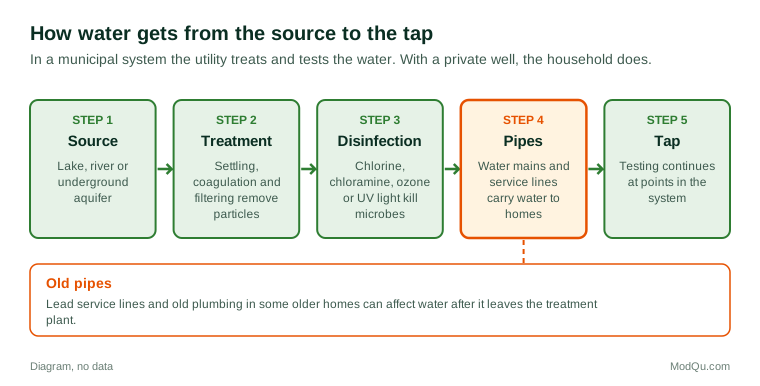
Most Canadians get their water from a municipal water system. Water is drawn from a lake, river or underground aquifer, treated at a plant, and piped to homes. The rest rely mainly on private wells, especially in rural areas, and a smaller number on cisterns or other sources.
The two set-ups differ in who is responsible for quality:
- In a municipal system, the utility treats and tests the water and must meet provincial or territorial drinking water rules. In Canada, these rules are based largely on the Guidelines for Canadian Drinking Water Quality, developed by Health Canada with the provinces and territories.
- With a private well, the household is responsible for testing and treating its own water. Many provinces and public health units offer or recommend regular testing of well water for bacteria and some chemicals.
In the United States, public water systems are regulated under federal and state rules, and private wells are mostly the owner's responsibility, as in Canada.
How tap water is treated
A typical municipal treatment process includes:
- Screening and settling to remove large particles and sediment.
- Coagulation and filtration to remove smaller particles.
- Disinfection, usually with chlorine, chloramine, ozone or ultraviolet light, to kill bacteria, viruses and parasites.
- Residual disinfectant, a small amount of chlorine or chloramine left in the water to keep it safe as it travels through the pipes.
- Testing, both at the plant and at points in the distribution system.
Some communities add fluoride to drinking water to help prevent tooth decay. Whether to do so is decided locally and has been debated in a number of Canadian cities.
How people judge water quality
Most people judge their water by how it looks, tastes and smells. Common observations include:
- a chlorine taste or smell, which is a sign of disinfection and is not a health concern at normal levels;
- cloudy water that clears from the bottom of the glass, usually caused by tiny air bubbles;
- hard water, with high levels of calcium and magnesium, which leaves scale on kettles and taps;
- rusty or discoloured water, often linked to old pipes or work on water mains;
- an earthy taste at certain times of year, caused by natural compounds in lakes and rivers.
What people cannot see is often what worries them most: lead from old pipes, chemicals, or bacteria after a flood or a main break. Older homes may still have lead service lines or lead solder in their plumbing, and many cities have programs to replace them.
Example
A family in a house built in the 1940s hears that their city is replacing lead service lines. They are not sure if their home has one. They contact the city, which offers free testing. The test finds lead above the guideline, so they use a filter certified for lead removal while the city schedules replacement of the pipe on its side, and they arrange to replace the section on their property.
Tap, bottled and filtered water
Households make different choices about what they drink:
- Tap water straight from the tap, the cheapest option.
- Filtered tap water using a jug filter, a tap-mounted filter, an under-sink system or a refrigerator filter.
- Bottled water, bought in single bottles or large jugs for a water cooler.
- Well water, sometimes treated with a softener, filter or ultraviolet system.
Reasons people give for using filters or bottled water include taste, worry about old pipes or chemicals, past advisories, habit, and convenience when out of the house. Reasons for drinking tap water include cost, less plastic waste and trust in the local utility. Filters only remove what they are designed and certified to remove, and need regular cartridge changes to keep working.
Example (hypothetical figures)
A household of two drinks about 3 litres of water a day between them. Buying it in single 500 mL bottles at a hypothetical $1.00 each would mean 6 bottles a day, or $2,190 a year. A jug filter at $35 plus six $15 cartridges a year costs $125 in the first year. Tap water alone would cost only a few dollars a year at typical municipal rates.
Boil water advisories
When water may be unsafe, a public health authority or utility can issue a boil water advisory, telling people to boil water before drinking it or using it for cooking. Advisories may follow a water main break, a treatment problem, flooding or a test showing bacteria. A do not consume advisory is issued when boiling will not make the water safe, for example when there is chemical contamination.
Long-term drinking water advisories in some First Nations communities in Canada have been a major public issue. The federal government and First Nations have worked to lift many of them, but some communities have lived with advisories for years.
Example
A small town issues a boil water advisory after a main break. A resident who works night shifts misses the announcement on the radio and finds out from a neighbour the next morning. They sign up for the town's text alert service so they hear about future advisories directly.
How households use water
Inside the home, the main uses of water are toilets, showers and baths, laundry, dishes, and drinking and cooking. Outside, lawn watering, gardens, car washing and pools can make summer use much higher than winter use.
Many cities charge for water through a water meter, with a bill based on the volume used plus fixed charges. Some still charge a flat rate. Where water is metered, the bill gives households a reason to save. During dry spells, cities often limit lawn watering to certain days or hours.
Ways households save water include:
- fixing leaking taps and toilets, which can waste a surprising amount;
- installing low-flow showerheads and toilets;
- running full loads in the dishwasher and washing machine;
- taking shorter showers;
- watering the garden in the early morning, using rain barrels, or planting species that need less water.
Example
A homeowner's quarterly water bill is much higher than usual. The city's billing office suggests checking for a running toilet. They put a few drops of food colouring in the toilet tank and see colour in the bowl within minutes, meaning the flapper is leaking. A replacement part fixes the problem.
What people disagree about
People disagree about adding fluoride to drinking water, about whether bottled water should be discouraged, about how to pay for replacing old pipes, and about how water should be priced. Questions that businesses and governments want answered include whether people drink tap water at home, whether they use a filter, how much they trust their water supplier and what they do to save water.
Key terms
- Municipal water systemA public system that treats water and pipes it to homes and businesses.
- AquiferAn underground layer of rock or sediment that holds water.
- Boil water advisoryA notice telling people to boil water before drinking it or cooking with it.
- Hard waterWater with high levels of dissolved calcium and magnesium.
- Lead service lineAn old lead pipe connecting a building to the water main.
- DisinfectionTreatment that kills or inactivates bacteria, viruses and parasites in water.
- Water meterA device that measures how much water a property uses.
- Water softenerEquipment that removes calcium and magnesium from hard water.
Full glossary: drinking water utilities terms on EditingTests.com.
Water use and quality vocabulary test
How well do you know the language of this topic? Try 8 quick questions. Your score is shown straight away and is not saved.
What the water use and quality survey asks
This survey is part of ModQu's Energy and Environment survey. The water use and quality part takes about five minutes and covers:
- Where your water comes from: a municipal system or a private well.
- Whether you drink tap water at home, and if not, why not.
- Whether you use a water filter or buy bottled water.
- How much you trust the quality of your tap water.
- What you do to save water inside and outside your home.
- Your experience of boil water advisories or other water problems.
After that you can choose to continue with other short parts of the Energy and Environment survey, such as home energy use and bills or solar power at home, or stop.
Ready to take part?
Your answers help show what people really think and do. Results are only ever reported as totals; no one can see your individual answers.
Start the surveyQuestions about this survey
Who can take part?
Households.
Do I have to give my name?
No. You may be asked for your age group, region and similar details so results can be broken down, but not your name. ModQu never asks for passwords, card numbers or account numbers.
How are the results used?
Answers are combined into totals and percentages and published in ModQu reports. Individual answers are never shown.
Is the vocabulary test part of the survey?
No. It is optional and separate, and your score is not stored.