
Share your experience of repairing
Tell us what you have repaired this year, who repaired it and what stops you repairing more. Your answers are combined with other people's and reported only as totals.
Start the repairing instead of replacing surveyAbout 5 minutes. No account needed. You can stop at any time.
What repair covers
Repair means fixing an item so it can be used again, rather than throwing it away and buying a replacement. It covers a wide range of goods:
- clothing and shoes: sewing seams, replacing zips and buttons, patching holes, resoling shoes;
- phones, computers and tablets: replacing screens, batteries and charging ports;
- household appliances: washing machines, fridges, vacuum cleaners and kettles;
- furniture: re-gluing joints, reupholstering, replacing handles;
- bicycles: punctures, brakes, chains;
- toys, lamps, tools and small electrical goods;
- watches, jewellery and bags.
Repair can be done by the owner, by a friend or family member, at a repair café or community workshop, by an independent repair shop, or by the manufacturer or an authorized service centre.
Why people repair
People give several reasons for repairing:
- Saving money, especially when a repair costs much less than a new item.
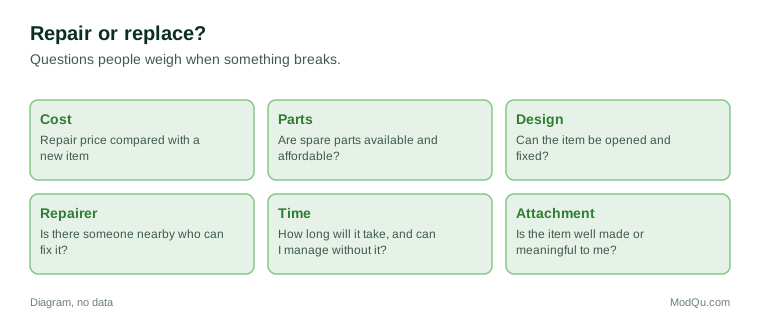
- Attachment: an item has sentimental value or is well made.
- Reducing waste and environmental impact.
- Habit and skill: people who grew up repairing things, or who enjoy it.
- No good replacement: an older model is better or the same item is no longer sold.
In many parts of the world, repair is a normal part of life, with tailors, cobblers, phone repairers and appliance mechanics found in every market. In others, repair declined as cheaper goods became available and repair shops closed.
Example
A student's laptop battery no longer holds a charge. A new laptop would cost several hundred in local currency. A local repair shop replaces the battery for a fraction of that in one afternoon. The laptop runs for another three years.
What stops people repairing
Common barriers include:
- Cost: repair may cost close to the price of a new item, especially for cheap goods.
- Spare parts: parts may be unavailable, expensive or sold only to authorized repairers.
- Design: products glued together, with special screws, or with parts that cannot be separated.
- Information: no repair manuals or diagnostic tools for owners or independent repairers.
- Software locks: some devices only accept parts paired by the manufacturer.
- Time and convenience: finding a repairer, waiting for parts, being without the item.
- Skills and confidence.
- Warranties: fear that opening a device will void the warranty.
- Trust: worry about poor-quality repairs or data on devices.
Example (hypothetical figures)
A washing machine stops draining. A repairer quotes 90, in local currency, for a new pump and labour. A new machine costs 400. The owner repairs it. Two years later the motor fails and the quote is 250. The machine is ten years old, so the owner decides to replace it.
Repair cafés and community workshops
Repair cafés are free or low-cost events where volunteers with repair skills help people fix their own items. The first repair café was held in Amsterdam in 2009, and the idea has spread to thousands of locations in many countries. Similar initiatives include community tool libraries, sewing circles, bicycle workshops and "fix-it" clinics at libraries and schools.
These events aim to fix items, teach skills and change attitudes to repair. Visitors often say they value learning how things work as much as getting an item fixed.
Example
A retired electrician volunteers at a monthly repair café in a community hall. Visitors bring toasters, lamps, radios and clothes. The volunteer explains each step and lets the owner do the work where safe. Most items are fixed; some cannot be, because parts are unavailable or the item cannot be opened without breaking it.
Right to repair
"Right to repair" refers to laws and campaigns that aim to make repair easier and cheaper. Measures include:
- requiring manufacturers to make spare parts available for a set number of years;
- requiring repair manuals and diagnostic information to be available to independent repairers and owners;
- banning designs or software that block repair;
- repairability scores on product labels;
- requiring sellers to offer repair during the legal guarantee period.
The European Union has adopted ecodesign rules requiring spare parts for some appliances and, in 2024, a directive promoting the repair of goods. France introduced a repairability index for some electronic products in 2021. Several US states have passed right-to-repair laws covering electronics, farm equipment or wheelchairs. Rules elsewhere vary widely.
Repair and the circular economy
Repair is part of the circular economy, an approach that aims to keep products and materials in use for as long as possible through repair, reuse, refurbishment and recycling, rather than making, using and throwing away. Refurbished phones and computers, repaired by sellers and sold with a warranty, are one growing part of this.
What people disagree about
People disagree about whether manufacturers should be required to make repair easier, whether repair restrictions are needed for safety and security, and whether cheaper goods mean repair will always lose out on cost. Some manufacturers argue that independent repairs can be unsafe or damage devices; repair advocates argue that restrictions keep prices high and create waste.
Questions that manufacturers, retailers, recyclers and governments want answered include how often people repair things, what they repair, who does the repair, and what stops them from repairing more.
Repair skills
Many people say they would repair more if they knew how. Skills such as sewing on a button, patching a bicycle tyre or replacing a plug were once commonly taught at home or school. Today, people often learn from online videos, repair guides and community workshops. Basic tools, such as a screwdriver set, a needle and thread and a puncture kit, make simple repairs possible at home. For electrical and gas appliances, safety rules mean many repairs should be left to qualified repairers.
Key terms
- RepairFixing an item so it can be used again.
- Right to repairLaws and campaigns to make repair easier and cheaper.
- Repair caféA community event where volunteers help people fix items.
- Spare partA replacement component used to repair an item.
- Planned obsolescenceDesigning products to wear out or become outdated sooner.
- RefurbishedRepaired, checked and resold, often with a warranty.
- Repairability scoreA rating of how easy a product is to repair.
- Circular economyAn approach that keeps products and materials in use for as long as possible.
Full glossary: circular economy solutions terms on EditingTests.com.
Repairing instead of replacing vocabulary test
How well do you know the language of this topic? Try 8 quick questions. Your score is shown straight away and is not saved.
What the repairing instead of replacing survey asks
This survey is part of ModQu's Energy and Environment survey. The repairing instead of replacing part takes about five minutes and covers:
- Whether you have repaired something instead of replacing it this year.
- What you repaired and who did the repair.
- What the repair cost compared with buying new.
- What stops you repairing more.
- Whether you have used a repair café, workshop or repair shop.
- Whether repairability would affect what you buy.
After that you can choose to continue with other short parts of the Energy and Environment survey, such as home energy use and bills or solar power at home, or stop.
Ready to take part?
Your answers help show what people really think and do. Results are only ever reported as totals; no one can see your individual answers.
Start the surveyQuestions about this survey
Who can take part?
Adults.
Do I have to give my name?
No. You may be asked for your age group, region and similar details so results can be broken down, but not your name. ModQu never asks for passwords, card numbers or account numbers.
How are the results used?
Answers are combined into totals and percentages and published in ModQu reports. Individual answers are never shown.
Is the vocabulary test part of the survey?
No. It is optional and separate, and your score is not stored.
Does buying second-hand or refurbished count as repair?
Not directly, but the survey asks about it separately because it is closely linked.
Can repairers take part?
This survey is for people who own items. People who repair for a living can answer about their own household.
Does a repair under warranty count?
Yes. The survey asks who did the repair, including manufacturers under warranty.
Does mending clothes count?
Yes. Clothing and shoe repairs are included, whether you do them yourself or use a tailor or cobbler.
Can I answer if I never repair anything?
Yes. Your reasons are an important part of the results.