
Share your views on sustainable travel
Tell us whether you consider the environment when planning trips, whether you have offset emissions and whether you would pay more. Your answers are combined with other people's and reported only as totals.
Start the sustainable and eco-tourism surveyAbout 5 minutes. No account needed. You can stop at any time.
What this topic covers
Sustainable tourism is travel that tries to limit harm to the environment and to local communities while bringing them benefits. Eco-tourism is a narrower idea: travel to natural areas that supports conservation and the wellbeing of local people, often with an element of learning.
This topic covers:
- whether travellers consider the environment when planning trips;
- the choices they make on transport, accommodation and activities;
- carbon offsetting and other ways of paying for impact;
- eco-labels and certifications;
- willingness to pay more for lower-impact travel;
- the gap between what people say and what they do.
The main impacts of travel
Travel affects places and people in several ways:
- Emissions: flying, especially long-haul, is usually the largest source of a trip's greenhouse gas emissions. Cruises and long car journeys also contribute.
- Overtourism: too many visitors in popular places, leading to crowding, higher housing costs for residents and damage to sites.
- Nature: disturbance of wildlife, damage to reefs, trails and fragile habitats, and waste.
- Water and energy: heavy use by hotels and resorts in places where water is scarce.
- Local economy: whether money spent stays in the community or goes to companies elsewhere, sometimes called economic leakage.
- Culture: respect for local customs, and whether communities have a say in tourism.
Choices travellers make
Travellers who want to lower their impact describe a range of choices:
- Transport: taking a train or bus instead of a short flight, flying direct rather than with connections, flying less often but staying longer.
- Destination and timing: avoiding the most crowded places and seasons, choosing places closer to home.
- Accommodation: choosing locally owned places and those with environmental policies.
- Activities: choosing wildlife experiences that do not involve touching or riding animals, staying on marked trails, and avoiding activities that harm reefs or habitats.
- Spending locally: eating at local restaurants and buying from local makers.
- Waste and water: refillable bottles, reusing towels, limiting plastic.
Example
A couple plan a holiday to a city about 700 kilometres away. A flight would take 90 minutes plus airport time; a train takes six and a half hours from city centre to city centre. They choose the train, partly to cut emissions and partly because they can work and read on the way. On a later trip to another continent they fly, but stay three weeks instead of one.
Carbon offsetting
Carbon offsetting means paying for a project that reduces or removes greenhouse gas emissions elsewhere, such as planting trees, protecting forests or supplying clean cookstoves, to balance out emissions from a trip. Airlines, booking sites and independent organizations offer offsets.
Views on offsets differ. Supporters say they let travellers take responsibility and fund useful projects. Critics say some projects do not deliver the reductions claimed, that benefits can take decades, and that offsets may make people feel less need to fly less. Certification standards aim to improve quality, but travellers often find it hard to judge a project.
Example (hypothetical figures)
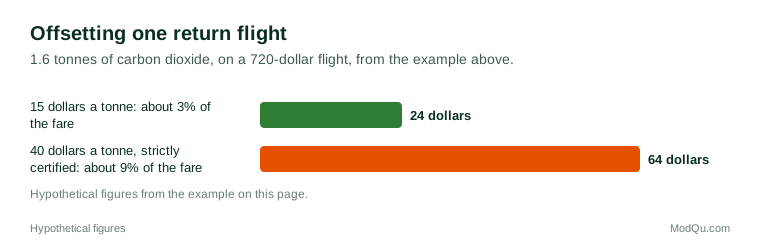
A traveller's return flight is estimated to produce 1.6 tonnes of carbon dioxide. An offset provider charges 15 dollars per tonne, so the offset costs 24 dollars. A different, more strictly certified project charges 40 dollars per tonne, which would cost 64 dollars. The flight itself cost 720 dollars, so the offsets would add about 3% or about 9% to the price.
Figure 1 compares the costs in that example.
Eco-labels and certifications
Many hotels, tour operators and destinations display eco-labels or certifications. Some are run by independent organizations with published criteria and audits; others are little more than marketing. The Global Sustainable Tourism Council, an international non-profit body, sets baseline criteria and recognizes certification schemes that meet them.
Travellers often say they do not recognize most labels or know which to trust. Concern about greenwashing, where companies make environmental claims that are vague, misleading or untrue, is common. Some countries have introduced or are considering rules on environmental claims in advertising.
Willingness to pay
Many travellers say they care about the environment and would pay more for lower-impact travel. In practice, price, convenience and time often decide what they book. This difference between stated intentions and actual behaviour is sometimes called the intention-action gap, and it is an important issue for survey research on this topic.
Survey designers try to narrow the gap by:
- asking about recent real trips rather than hypothetical ones;
- offering realistic trade-offs, such as a longer journey or a higher price;
- reducing pressure to give socially approved answers.
Example
A family say in a survey that they would pay 10% more for an eco-certified hotel. When they book their summer holiday, the certified hotel is 15% more expensive and further from the beach, so they choose the cheaper hotel. They do choose a local guide for a day trip because they read that the guide's company supports a nearby nature reserve.
Eco-tourism and communities
Well-run eco-tourism can fund conservation and give local communities a reason to protect forests, reefs and wildlife. Examples include community-run lodges, guided wildlife watching with income shared with local people, and entry fees that pay for park rangers. Poorly run eco-tourism can bring too many visitors into fragile places or give communities little benefit.
Questions travellers ask include who owns a lodge, how much of the price reaches local people, and whether wildlife activities follow welfare guidelines.
Debates and trends
Debates and trends include:
- Flying less: whether people should cut flights, and whether rail can replace short flights. Some countries have restricted certain short domestic flights where rail alternatives exist.
- Tourist taxes and visitor limits in crowded cities and fragile places.
- Sustainable aviation fuel and other technology, and how much they can reduce emissions.
- Responsibility: whether change should come from travellers, companies or governments.
- Fairness: whether calls to fly less fall unfairly on people from countries that depend on tourism or on people with family abroad.
Questions that businesses want answered here include how often people consider the environment when planning trips, which changes they have made, whether they have paid for offsets and how much more they would pay for lower-impact options.
Key terms
- Sustainable tourismTravel that limits harm to the environment and local communities while benefiting them.
- Eco-tourismTravel to natural areas that supports conservation and local people.
- Carbon offsetPaying for a project that reduces or removes emissions to balance out your own.
- OvertourismToo many visitors in a place, harming residents, sites or nature.
- GreenwashingVague, misleading or false environmental claims.
- Eco-labelA label or certification showing that a business meets environmental criteria.
- Carbon footprintThe total greenhouse gas emissions caused by an activity or person.
- Intention-action gapThe difference between what people say they will do and what they actually do.
Full glossary: travel tourism terms on EditingTests.com.
Sustainable and eco-tourism vocabulary test
How well do you know the language of this topic? Try 8 quick questions. Your score is shown straight away and is not saved.
What the sustainable and eco-tourism survey asks
This survey is part of ModQu's Travel and Hospitality survey. The sustainable and eco-tourism part takes about five minutes and covers:
- Whether you consider the environment when planning trips, and how much.
- Which changes you have made, such as transport, destination or accommodation choices.
- Whether you have paid to offset travel emissions, and why or why not.
- Whether you recognize or trust eco-labels for travel.
- How much more, if anything, you would pay for lower-impact travel.
- What stops you from making more sustainable travel choices.
After that you can choose to continue with other short parts of the Travel and Hospitality survey, such as holiday and leisure travel or air travel, or stop.
Ready to take part?
Your answers help show what people really think and do. Results are only ever reported as totals; no one can see your individual answers.
Start the surveyQuestions about this survey
Who can take part?
Adults who travel for leisure.
Do I have to give my name?
No. You may be asked for your age group, region and similar details so results can be broken down, but not your name. ModQu never asks for passwords, card numbers or account numbers.
How are the results used?
Answers are combined into totals and percentages and published in ModQu reports. Individual answers are never shown.
Is the vocabulary test part of the survey?
No. It is optional and separate, and your score is not stored.