
Share your spa experiences
Tell us whether you have been to a spa in the last year, which treatments you had and how much you spent. Your answers are combined with other people's and reported only as totals.
Start the spa and relaxation surveyAbout 5 minutes. No account needed. You can stop at any time.
What spas and relaxation cover
A spa is a place that offers treatments and facilities for relaxation, wellbeing and personal care. The word is linked to the town of Spa in Belgium, known for its mineral springs. The main kinds include:
- Day spas, offering treatments such as massages and facials without an overnight stay.
- Hotel and resort spas, attached to accommodation.
- Thermal and mineral springs, where people bathe in naturally heated or mineral-rich water.
- Public baths and saunas, often run by local authorities or communities.
- Medical or health spas, offering treatments with medical supervision, common in some European countries.
- Wellness retreats, multi-day stays with activities such as yoga, healthy meals and treatments.
- Massage clinics, offering massage only.
Bathing traditions around the world
Many cultures have long bathing and relaxation traditions:
- Finnish sauna, a hot, dry or steamy room, central to life in Finland, where saunas are found in a large share of homes.
- Turkish hammam, a steam bath with washing and scrubbing, found across the Middle East and North Africa.
- Japanese onsen, hot spring baths, often in natural settings, with strict washing rules before entering.
- Korean jjimjilbang, large bathhouses with pools, saunas and areas for resting, often open late.
- Russian banya, a steam bath, often with bundles of leafy branches used to stimulate the skin.
- Thermal baths in Central Europe, such as in Hungary and the Czech Republic.
- Temazcal, a traditional sweat lodge in Mexico and Central America.
These traditions often focus on community and routine rather than luxury.
Example
A traveller visiting Japan stays at an inn with an onsen. They learn that guests wash thoroughly at seated showers before entering the bath and do not wear swimwear. They enjoy the bath each evening and buy a book about hot spring towns before leaving.
Common treatments
Spas offer a wide range of treatments:
- Massage, such as Swedish, deep tissue, hot stone, Thai and aromatherapy massage.
- Facials, for cleansing and skin care.
- Body treatments, such as scrubs, wraps and mud treatments.
- Hydrotherapy, using water in pools, jets or contrasting hot and cold baths.
- Saunas and steam rooms.
- Manicures and pedicures.
- Reflexology, massage of the feet or hands based on the idea that points link to other parts of the body; its health claims are debated.
- Relaxation areas, with loungers, quiet rooms and drinks.
Why people visit spas
People give many reasons:
- Relaxation and stress relief.
- Treats and celebrations, such as birthdays, anniversaries and hen or stag events.
- Gifts, with spa vouchers a common present.
- Muscle aches and recovery, for example after sport.
- Time alone or with a partner or friends.
- Tradition and routine, such as weekly sauna visits.
- Health reasons, in countries where some spa treatments are prescribed or covered by health systems.
Research on massage, saunas and bathing has reported benefits for relaxation and wellbeing, though results vary and many health claims made by spas are not well tested.
Costs and spending
Spa prices vary widely by country, type and location. Common pricing includes:
- Day passes for facilities such as pools and saunas.
- Individual treatments, priced by length.
- Packages, combining facilities, treatments and sometimes lunch.
- Memberships, for regular visitors.
- Overnight and retreat packages.
- Tips, expected in some countries and not in others.
Public baths and saunas are often much cheaper than private spas.
Example (hypothetical figures)
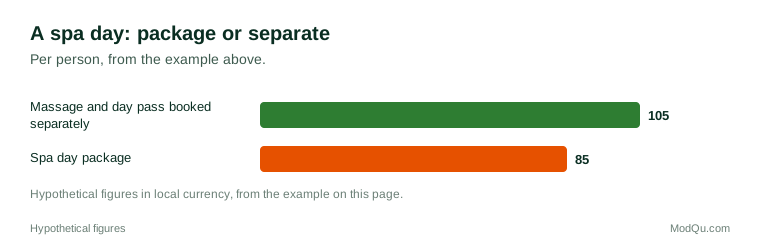
Two friends book a spa day package for 85 each in their local currency, which includes a 50-minute massage and use of the pools. Booked separately, the massage would cost 65 and a day pass 40, a total of 105 each. The package saves each of them 20, and 40 in total.
Etiquette and what to expect
People new to spas often wonder what to expect. Practices differ, but common points include:
- Clothing: some spas require swimwear; others, such as many saunas and onsen, do not allow it. Robes and towels are often provided.
- Showering before using pools and saunas.
- Quiet, especially in relaxation areas.
- Phones, often not allowed in some areas.
- Arriving early for treatments.
- Telling the therapist about health conditions, allergies or pressure preferences.
- Mixed or separate areas, which differ by country and spa.
Safety and health
Spa treatments are generally low-risk for healthy people, but there are points to consider:
- Heat in saunas and hot tubs can be risky for people with some heart conditions, low blood pressure, or during pregnancy, and alcohol increases the risks.
- Hygiene of pools, hot tubs and equipment.
- Allergies to oils and products.
- Massage may not suit people with certain injuries or conditions.
- Therapist training and licensing, which varies by country.
Spas commonly ask clients to fill in a health questionnaire before treatments.
Example
A person with high blood pressure books a spa day. On the health form they mention their condition, and the therapist suggests a gentler massage and advises them to limit time in the hottest sauna.
Trends and debates
Current trends include:
- Wellness tourism, with travel focused on health and relaxation.
- Contrast therapy, such as moving between saunas and cold plunges.
- Social saunas and community bathing in cities.
- Men's spa use, which has grown.
- Spa treatments at home, with home saunas, massage devices and products.
- Sustainability, given the energy and water spas use.
What people and businesses want to know
Questions businesses want answered include how many people visited a spa in the last year, what kind, which treatments they had, who they went with, how much they spent, whether the visit was a gift, and what would make them visit again.
Key terms
- Day spaA spa that offers treatments without an overnight stay.
- Thermal springA natural spring of warm or hot water.
- HydrotherapyUsing water, such as pools and jets, for relaxation or treatment.
- SaunaA hot room used for sweating and relaxation.
- HammamA steam bath tradition from the Middle East and North Africa.
- OnsenA Japanese hot spring bath.
- ReflexologyMassage of the feet or hands based on claimed links to other parts of the body.
- Wellness retreatA multi-day stay focused on relaxation and health activities.
Full glossary: wellness terms on EditingTests.com.
Spa and relaxation vocabulary test
How well do you know the language of this topic? Try 8 quick questions. Your score is shown straight away and is not saved.
What the spa and relaxation survey asks
This survey is part of ModQu's Leisure and Lifestyle survey. The spa and relaxation part takes about five minutes and covers:
- Whether you have been to a spa, sauna or bathhouse in the last year, and what kind.
- Which treatments or facilities you used.
- Who you went with, and whether it was a gift or a special occasion.
- How much you spent on your most recent visit.
- Why you go, and how often.
- What would make you visit more often, or less.
After that you can choose to continue with other short parts of the Leisure and Lifestyle survey, such as gambling and lotteries or cannabis, or stop.
Ready to take part?
Your answers help show what people really think and do. Results are only ever reported as totals; no one can see your individual answers.
Start the surveyQuestions about this survey
Who can take part?
Adults.
Do I have to give my name?
No. You may be asked for your age group, region and similar details so results can be broken down, but not your name. ModQu never asks for passwords, card numbers or account numbers.
How are the results used?
Answers are combined into totals and percentages and published in ModQu reports. Individual answers are never shown.
Is the vocabulary test part of the survey?
No. It is optional and separate, and your score is not stored.
Do I have to be naked in a sauna?
It depends on the country and the venue. In some places nudity is expected and swimwear is not allowed; in others swimwear is required. Venues usually explain their rules.
Is a spa visit suitable during pregnancy?
Many spas offer pregnancy treatments but limit heat treatments such as saunas and hot tubs. Spas usually ask about pregnancy on their health forms.