
Share your view of local roads
Tell us how you rate the roads where you live, which repairs are most needed and where spending should go. Your answers are combined with other people's and reported only as totals.
Start the public roads and infrastructure surveyAbout 5 minutes. No account needed. You can stop at any time.
What public infrastructure includes
Infrastructure means the basic physical systems a society needs to function. Public infrastructure commonly includes:
- roads, streets and highways;
- bridges and tunnels;
- pavements, footpaths and cycle lanes;
- street lighting and traffic signals;
- public transport: rail, buses, trams and stations;
- water supply, drainage and sewers;
- ports and airports;
- energy and telecommunications networks, which may be public or private.
This page focuses on roads and related infrastructure, which most people use every day.
Who is responsible
Responsibility for roads is usually split between levels of government:
- National or federal governments often manage motorways and major highways.
- Regional, state or provincial governments manage main roads between towns.
- Local councils or municipalities manage local streets, pavements and lighting.
- Private operators run some toll roads and bridges under concessions.
Splitting responsibility can confuse residents, who may not know whom to contact about a problem. Many cities now offer apps or websites for reporting potholes, broken lights and other faults.
How infrastructure is paid for
Roads and infrastructure are funded through:
- general taxes;
- fuel taxes and vehicle registration fees;
- tolls and road user charges;
- property taxes and local rates;
- borrowing, such as government bonds;
- public-private partnerships, where private firms build or run infrastructure in return for payments or tolls;
- development charges on new building projects;
- international loans and grants, in many lower-income countries.
As vehicles become more fuel-efficient and more are electric, fuel tax revenue falls in some countries, leading to debate about new ways to pay for roads, such as charging by distance driven.
Common road problems
People commonly report:
- potholes and cracked surfaces;
- congestion and long journey times;
- poor drainage, causing flooding;
- unsafe junctions and lack of crossings;
- broken or missing pavements, affecting people walking, using wheelchairs or pushing prams;
- poor street lighting;
- unpaved roads, common in rural areas of many countries;
- long or poorly managed roadworks.
Example
A cyclist hits a deep pothole on their commute and damages a wheel. They report it through the council's app with a photo. The council fills it two weeks later, but by then several other cyclists have reported damage, and two have claimed compensation.
Maintenance and the repair backlog
Infrastructure wears out over time. Regular maintenance, such as resurfacing roads before they break up, is usually cheaper than waiting for major failure. However, maintenance budgets are often cut when money is tight, because the effects are not seen immediately. This creates a maintenance backlog: repairs that are needed but not yet funded.
Engineers often describe the cost of delay: a road that could be resurfaced cheaply now may need full reconstruction later at several times the cost.
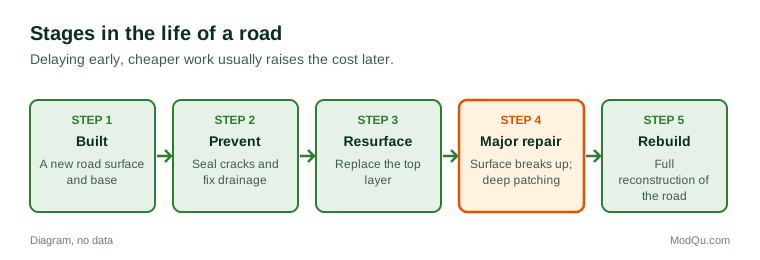
Example (hypothetical figures)
A council can resurface one kilometre of road for 150,000, in local currency. If it waits until the road breaks up, rebuilding the same kilometre costs 600,000. With a budget of 1.2 million, it can resurface 8 kilometres or rebuild 2. It chooses to resurface the roads in fair condition first and patch the worst roads until more money is available.
Roads or public transport?
A frequent question is how to divide spending between roads and public transport, walking and cycling. Arguments include:
- For more road spending: many people depend on cars, freight moves by road, and rural areas have few alternatives.
- For more public transport, walking and cycling: they move more people in less space, cut emissions and congestion, and serve people who do not drive.
Many cities try to balance both. The answer often depends on the place: dense cities may favour public transport, while rural regions may need better roads first.
Example
A suburban town consults residents on a budget choice: widening a congested road or adding a new bus lane and more frequent buses. Drivers mostly favour widening; residents without cars and those near the road mostly favour the bus option. The council chooses a mix: improved junctions and a bus lane at peak hours.
What people disagree about
People disagree about how much to spend on infrastructure, how to pay for it, whether to charge road users directly through tolls or congestion charges, and how to divide spending between cars, public transport, walking and cycling. Infrastructure projects can also be contested over their routes, their effect on homes and nature, and their cost overruns.
Questions that governments, municipalities and engineering firms want answered include how people rate local roads, which repairs are most needed, how people travel, and where they think spending should go.
Road safety and design
How roads are designed affects safety for everyone using them. Features such as safe crossings, separated cycle lanes, lower speed limits near schools, traffic calming, good lighting and clear signs can reduce crashes. The World Health Organization reports that road traffic crashes kill around 1.2 million people a year worldwide, with pedestrians, cyclists and motorcyclists making up a large share of deaths. Many countries now follow a "safe system" approach, which designs roads on the basis that people will make mistakes and aims to stop those mistakes from causing death or serious injury.
People's views of road safety often depend on how they travel. Drivers may focus on surface quality and congestion, while people walking or cycling focus on crossings, speed and space. Parents often mention routes to school. Older people and people with disabilities often mention uneven pavements, kerbs and the time allowed at crossings.
Key terms
- InfrastructureThe basic physical systems a society needs, such as roads, bridges and pipes.
- PotholeA hole in a road surface caused by wear, water and traffic.
- ResurfacingReplacing the top layer of a road.
- Maintenance backlogRepairs that are needed but not yet funded or done.
- Toll roadA road that drivers pay to use.
- Congestion chargeA fee for driving in a busy area at certain times.
- Public-private partnershipAn agreement where a private firm builds or runs public infrastructure.
- Road user chargeA fee based on use of roads, such as distance driven.
Full glossary: civil engineering terms on EditingTests.com.
Public roads and infrastructure vocabulary test
How well do you know the language of this topic? Try 8 quick questions. Your score is shown straight away and is not saved.
What the public roads and infrastructure survey asks
This survey is part of ModQu's Government and Public Services survey. The public roads and infrastructure part takes about five minutes and covers:
- How you rate the roads, pavements and street lighting where you live.
- Which repairs are most needed in your area.
- How you usually travel, and how road conditions affect you.
- Whether you have reported a problem, and what happened.
- Whether spending should go to roads, public transport, walking or cycling.
- How infrastructure should be paid for.
After that you can choose to continue with other short parts of the Government and Public Services survey, such as local services or trust in government, or stop.
Ready to take part?
Your answers help show what people really think and do. Results are only ever reported as totals; no one can see your individual answers.
Start the surveyQuestions about this survey
Who can take part?
Adults.
Do I have to give my name?
No. You may be asked for your age group, region and similar details so results can be broken down, but not your name. ModQu never asks for passwords, card numbers or account numbers.
How are the results used?
Answers are combined into totals and percentages and published in ModQu reports. Individual answers are never shown.
Is the vocabulary test part of the survey?
No. It is optional and separate, and your score is not stored.
Does the survey cover rural roads?
Yes. It asks about roads in towns, cities and rural areas, including unpaved roads.
Will my answers be sent to my council?
No. Results are reported for areas and groups, not individuals.
Does the survey ask about public transport?
It asks how you travel and about spending priorities. Public transport services have their own topic.
Can I answer if I do not drive?
Yes. Pavements, crossings, lighting and bus routes matter to everyone.