
Share your view of plastic packaging
Tell us how concerned you are about plastic packaging and whether you use refill or reusable options. Your answers are combined with other people's and reported only as totals.
Start the plastic packaging surveyAbout 5 minutes. No account needed. You can stop at any time.
Why plastic packaging is used
Plastic is light, cheap, strong, flexible and can be made airtight. Those qualities make it useful for packaging:
- Protecting food from damage, dirt and germs.
- Extending shelf life, for example by keeping air out of fresh meat or cheese.
- Reducing weight in transport compared with glass or metal.
- Showing products through clear films.
- Portion control and convenience, such as single-serve packs.
Packaging is one of the largest uses of plastic. Much of it is designed to be used once, sometimes only for minutes, and then thrown away.
What happens to plastic packaging after use
After use, plastic packaging can be:
- recycled into new materials, if it is collected, sorted and there is a market for it;
- burned, sometimes to produce energy;
- sent to landfill;
- littered or dumped, ending up in streets, rivers and the sea;
- exported to other countries for recycling or disposal.
Recycling rates for plastic packaging are much lower than for paper, glass or metal in many countries. Reasons include the many different types of plastic, mixed materials that are hard to separate, contamination with food, and low prices for recycled plastic. Some plastics, such as clear drinks bottles, are widely recycled; others, such as flexible films and multi-layer pouches, are rarely recycled.
How people feel about plastic
Concern about plastic, especially plastic in the oceans, has grown in many countries. Images of plastic in the sea and on beaches, and news about microplastics, have raised awareness. Shoppers often say they feel there is too much packaging, especially on fruit and vegetables, and that they feel guilty about how much they throw away.
At the same time, people value what packaging does: keeping food fresh, safe and convenient. Many say they would like to reduce plastic but find it hard because plastic-free options are limited, more expensive or less convenient.
Example
A shopper wants to buy loose vegetables to avoid plastic bags. Their local supermarket sells most vegetables pre-packed, and the loose ones cost more per kilogram. They buy loose vegetables at a weekly market instead, but still buy pre-packed salad and berries at the supermarket during the week.
Refill and reuse
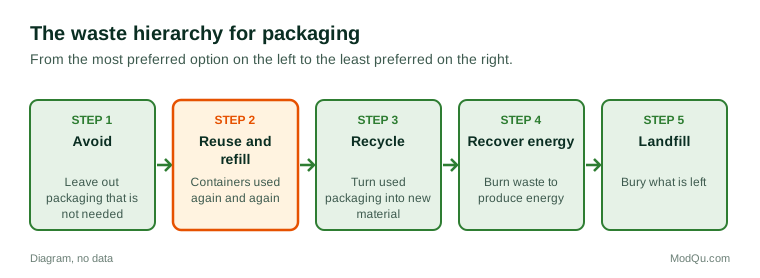
Alternatives to single-use plastic include:
- Refill stations in shops for dry foods, cleaning products, toiletries and drinks, where customers bring containers.
- Returnable packaging, such as glass bottles with a deposit, collected, cleaned and refilled.
- Reusable containers for takeaway food and coffee.
- Refill pouches that use less material than new bottles.
- Concentrated products, such as cleaning tablets added to water at home.
- Bulk buying in larger containers.
Refill and reuse systems were common in the past, such as milk delivered in glass bottles, and still are in many places. Their success depends on convenience, price, hygiene and how easy it is to return containers.
Example (hypothetical figures)
A household buys washing-up liquid in new 500-millilitre bottles at 2 each, in local currency, using one a fortnight, which is 52 a year. A refill shop charges 1.50 for the same amount poured into the old bottle, which is 39 a year. The household saves 13 a year but must make a separate trip each fortnight.
Rules and policies
Governments use many tools to reduce plastic packaging:
- bans on some single-use plastics, such as bags, straws or cutlery;
- charges on plastic carrier bags;
- deposit return schemes for drinks containers;
- extended producer responsibility, which makes producers pay for collecting and recycling their packaging;
- taxes on plastic packaging with little recycled content;
- labelling rules on recyclability.
Many countries have introduced bans or charges on single-use plastic bags. United Nations member states have been negotiating a global treaty on plastic pollution. Rules differ widely between and within countries.
Willingness to pay and the say-do gap
In surveys, many people say they would pay more for products with less plastic or with recyclable packaging. In practice, purchases often do not match. This difference between what people say and what they do, sometimes called the say-do gap or attitude-behaviour gap, is common in research on environmental choices. It can arise because price and convenience matter more at the shelf, because options are not available, or because people overstate their good intentions when asked.
Example
A shopper says in a survey that they would pay more for shampoo with no plastic bottle. In the shop, the solid shampoo bar costs nearly twice as much per wash, is in a different aisle and is a brand they do not know. They buy their usual bottle and decide to try the bar when it is on offer.
Other materials
Replacing plastic with other materials is not always better for the environment. Glass is heavier to transport. Paper and card can need more energy and water to make, and lose strength when wet. Compostable plastics often need industrial composting facilities, which are not available everywhere. Life-cycle assessments compare the full impact of different packaging, and results depend on the product and how the packaging is disposed of.
What people disagree about
People disagree about who should be responsible for reducing plastic: shoppers, retailers, manufacturers or governments. They also disagree about whether bans work, whether recycling can ever solve the problem, whether alternatives are really better, and how much extra cost or inconvenience is acceptable.
Questions that recyclers, retailers, packaging makers and governments want answered include how concerned people are about plastic, whether they use refill or reuse options, what stops them, and how much more they would pay for less packaging.
Key terms
- Single-use plasticPlastic designed to be used once and then thrown away.
- RecyclingTurning used materials into new materials or products.
- Refill stationA place in a shop where customers refill their own containers.
- Deposit return schemeA system where a small deposit on a container is refunded when it is returned.
- Extended producer responsibilityMaking producers pay for the collection and recycling of their packaging.
- MicroplasticsVery small pieces of plastic, less than 5 millimetres across.
- CompostableAble to break down into natural materials under composting conditions.
- Say-do gapThe difference between what people say they will do and what they actually do.
Full glossary: plastic packaging terms on EditingTests.com.
Plastic packaging vocabulary test
How well do you know the language of this topic? Try 8 quick questions. Your score is shown straight away and is not saved.
What the plastic packaging survey asks
This survey is part of ModQu's Energy and Environment survey. The plastic packaging part takes about five minutes and covers:
- How concerned you are about plastic packaging.
- Which products you think have too much packaging.
- Whether you use refill, reuse or loose options, and how often.
- What stops you using less plastic.
- How much more you would pay for less or better packaging.
- How you dispose of plastic packaging at home.
After that you can choose to continue with other short parts of the Energy and Environment survey, such as home energy use and bills or solar power at home, or stop.
Ready to take part?
Your answers help show what people really think and do. Results are only ever reported as totals; no one can see your individual answers.
Start the surveyQuestions about this survey
Who can take part?
Adults.
Do I have to give my name?
No. You may be asked for your age group, region and similar details so results can be broken down, but not your name. ModQu never asks for passwords, card numbers or account numbers.
How are the results used?
Answers are combined into totals and percentages and published in ModQu reports. Individual answers are never shown.
Is the vocabulary test part of the survey?
No. It is optional and separate, and your score is not stored.
Is paper packaging always better?
Not always. It depends on the product, how the packaging is made and what happens to it afterwards. The page above explains some of the trade-offs.
Does the survey ask about recycling at home?
Yes. It asks how you sort and dispose of packaging, and whether local collections take the plastics you use.
Will I be asked which brands I buy?
You may be asked about types of products, but results are reported by category, not by brand.
Does this survey cover plastic bags?
Yes. Carrier bags and charges for them are included with other packaging.