
Share what you do with your pet when you travel
Tell us what you do with your pet when you go away, which services you have used and whether you have taken your pet abroad. Your answers are combined with other people's and reported only as totals.
Start the pet travel and boarding surveyAbout 5 minutes. No account needed. You can stop at any time.
The main options when owners travel
When owners go away, they usually choose one of these:
- Boarding kennels for dogs and catteries for cats, where pets stay in a dedicated facility.
- Home boarding, where a pet stays in a carer's home.
- Pet sitters who visit the owner's home to feed and care for pets, or stay overnight.
- House sitting, where someone lives in the home for free in exchange for caring for pets.
- Friends, family and neighbours, the most common option for many owners.
- Dog day care, for shorter absences.
- Taking the pet along.
The choice depends on the pet's species, age, health and temperament, the length of the trip, cost and trust.
Kennels and catteries
Boarding facilities range from basic runs to "pet hotels" with private rooms, cameras and play sessions. Many countries or local authorities require boarding businesses to be licensed and inspected, with rules on space, hygiene and staff.
Owners often look at:
- cleanliness and space;
- how often dogs are walked or played with;
- whether cats are kept away from dogs;
- vaccination requirements, such as against kennel cough for dogs;
- how medicines and special diets are handled;
- access to a vet;
- reviews and a visit before booking.
Cats often find changes of place stressful, so some owners prefer a sitter for cats and a kennel for dogs.
Pet sitters and home boarding
Pet sitters let pets stay in familiar surroundings. Owners usually find them through recommendations, local businesses or apps and websites that list sitters with reviews. Concerns include trust, giving a stranger access to the home, insurance and reliability.
Example
A cat owner travels for work twice a month. Their elderly cat stopped eating in a cattery once, so they now use a local sitter who visits twice a day, sends photos and gives the cat its daily tablet. They pay more than they would for a cattery but say the cat is calmer.
What it costs
Costs depend on the country, city, type of care and season. Holiday periods are usually more expensive and book up early.
Example (hypothetical figures)
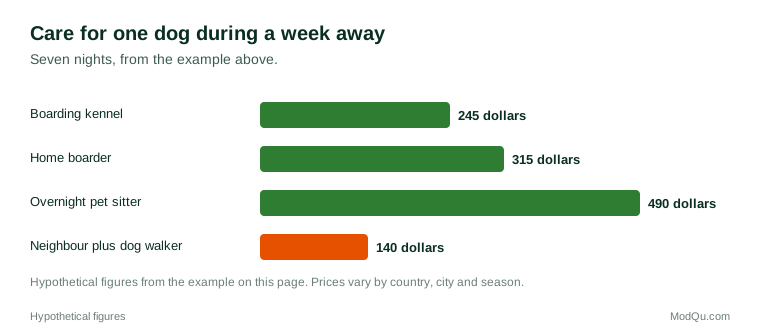
An owner going away for a week compares options for one dog. A kennel charges 35 dollars a night, 245 dollars for seven nights. A home boarder charges 45 dollars a night, 315 dollars. A pet sitter who stays overnight charges 70 dollars a night, 490 dollars. A neighbour offers to help for free, but only for two daily visits, so the owner would still need a dog walker at 20 dollars a day, 140 dollars for the week.
Travelling with pets
Many owners take pets on trips, especially dogs. Travel with pets includes:
- car trips, with crates, carriers or seat-belt harnesses;
- pet-friendly accommodation, which often charges a fee;
- trains, buses and ferries, whose rules vary widely between countries and operators;
- flights, where small pets may travel in the cabin in a carrier and larger pets in the hold or as cargo, depending on the airline and route.
Flying with pets raises concerns about stress, temperature and handling, and some airlines restrict flat-faced breeds because of breathing risks.
Example
A family drives 600 kilometres to a holiday cottage with their dog. They book accommodation that allows pets, stop every two hours for water and a short walk, and use a crate in the car. They say the dog enjoyed the beach but was unsettled for the first night in the new place.
Taking pets across borders
Crossing borders with pets involves rules that vary widely and change over time. Common requirements include:
- a microchip;
- rabies vaccination, sometimes with a waiting period and a blood test;
- a health certificate from a vet, often signed within a set number of days before travel;
- parasite treatments for some destinations;
- pet passports within some regions, such as the European Union;
- quarantine on arrival in some countries, particularly islands and countries free of rabies, such as Australia and New Zealand.
Owners usually check with the official animal health authority of the destination country, since mistakes can lead to a pet being refused entry or held in quarantine.
Pets and relocation
People moving abroad for work or family often bring pets with them. Some use specialist pet relocation services that handle paperwork, crates and flights. The process can take months for some destinations and cost a large sum, so some owners decide to rehome pets with family instead.
Preparing a pet for a stay away
Owners who use boarding or sitters often prepare in similar ways. They check that vaccinations are up to date, leave written notes on feeding, medicines and habits, pack the pet's own food to avoid stomach upsets, and include a familiar blanket or toy. Many book a short trial stay before a long trip. Owners also leave their vet's details and decide in advance how much they are willing to spend on treatment if the pet falls ill while they are away.
Common worries
Owners often mention:
- guilt about leaving a pet;
- whether the pet will eat and settle;
- illness or escape while away;
- the cost of care, especially for long trips;
- trust in strangers looking after the pet and the home;
- limited pet-friendly transport and accommodation.
What people disagree about
Pet travel raises some debates:
- whether pets should travel in aircraft holds at all;
- whether more transport, shops and accommodation should welcome pets;
- whether pet-sitting apps check sitters enough;
- whether boarding businesses are inspected enough.
Questions pet service companies, insurers and travel firms want answered include what owners do with pets when they travel, which services they use and pay for, and how often they take pets with them.
Key terms
- Boarding kennelA business that looks after dogs while owners are away.
- CatteryA business that looks after cats while owners are away.
- Home boardingCare for a pet in a carer's own home.
- Pet sitterA person who cares for pets in the owner's home.
- Kennel coughA contagious respiratory illness in dogs; vaccination is often required for boarding.
- Pet passportA document recording a pet's microchip and vaccinations for travel within some regions.
- QuarantineA period of isolation on arrival to prevent the spread of disease.
- Health certificateA vet's document confirming a pet is fit to travel.
Full glossary: animal health terms on EditingTests.com.
Pet travel and boarding vocabulary test
How well do you know the language of this topic? Try 8 quick questions. Your score is shown straight away and is not saved.
What the pet travel and boarding survey asks
This survey is part of ModQu's Pets and Animals survey. The pet travel and boarding part takes about five minutes and covers:
- What you do with your pet when you travel.
- Whether you have used a kennel, cattery, home boarder or pet sitter, and how you chose.
- How much you paid for pet care on your last trip.
- Whether you travel with your pet, and how.
- Whether you have taken your pet abroad, and how the process went.
- What worries you most about leaving your pet.
After that you can choose to continue with other short parts of the Pets and Animals survey, such as pet ownership or veterinary care, or stop.
Ready to take part?
Your answers help show what people really think and do. Results are only ever reported as totals; no one can see your individual answers.
Start the surveyQuestions about this survey
Who can take part?
Pet owners.
Do I have to give my name?
No. You may be asked for your age group, region and similar details so results can be broken down, but not your name. ModQu never asks for passwords, card numbers or account numbers.
How are the results used?
Answers are combined into totals and percentages and published in ModQu reports. Individual answers are never shown.
Is the vocabulary test part of the survey?
No. It is optional and separate, and your score is not stored.
Is this page a guide to border rules?
No. Rules change often, so owners usually check with the official animal health authority of the destination country.
Can I answer if I never travel?
Yes. The survey also asks why people do not travel or do not use pet care services.