
Share how you chose your pet
Tell us whether you adopted or bought your pet, how you chose it and whether the costs matched what you expected. Your answers are combined with other people's and reported only as totals.
Start the choosing a pet surveyAbout 5 minutes. No account needed. You can stop at any time.
Why the choice matters
A pet is a long commitment. Many dogs and cats live well over a decade, some parrots and tortoises outlive their owners, and even small pets need daily care. The choice of animal affects a household's budget, its daily routine, where it can rent, how it travels and how it gets on with neighbours. When the match is poor, the result can be stress for the owner, behaviour problems for the animal and, in some cases, the animal being given up to a shelter.
Deciding what kind of pet
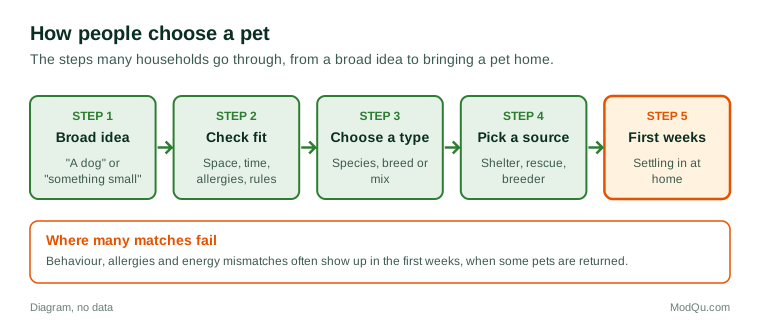
Most people start with a broad idea, such as "a dog" or "something small for the kids", and narrow it down. The questions people weigh include:
- Space: an apartment, a house, a yard, or access to parks.
- Time: how many hours the household is out each day, and who will do the daily care.
- Activity level: whether the household wants a running partner or a quiet companion.
- Allergies in the household or among frequent visitors.
- Children and other pets already in the home.
- Lifespan: whether the household can plan for 2 years, 15 years or longer.
- Rules: lease conditions, condominium bylaws and municipal limits.
Example
A family with two young children wants a dog but both parents work full time. After talking with a shelter, they decide that a young, high-energy dog would be alone too long. They adopt a calm eight-year-old dog that is used to children and happy to sleep through the day.
Choosing a breed or a type
For dogs and cats, many people look at breeds or at broad types such as "small dog", "short-haired cat" or "mixed breed". A breed tells people something about likely size, coat, energy and grooming needs, but individual animals vary, and mixed-breed animals can make excellent pets. Some breeds have well-known health problems linked to their body shape or genetics, which owners may not learn about until later.
People find breed information from vets, breed clubs, books, shelter staff, friends who own the breed, online groups and videos. Survey research often looks at which sources people trust most and whether looks, popularity or temperament drove the choice.
Where people get pets
The main sources of pets are:
- Animal shelters run by municipalities or humane societies.
- Rescue groups, often volunteer-run, many of them focused on one breed or kind of animal.
- Breeders, from small hobby breeders to larger operations, with very different standards.
- Pet stores, which in some cities may sell only animals from shelters or rescues because of local rules.
- Friends, family and neighbours rehoming a pet or giving away a litter.
- Online listings and classified ads, which carry a higher risk of scams and of animals from poor conditions.
Adoption usually includes a fee that covers spaying or neutering, vaccines and a microchip, along with an application and sometimes a home visit. Buying from a breeder is usually more expensive and may involve a waiting list, a contract and health records for the parents.
Example (hypothetical figures)
A buyer compares a puppy from a breeder at $2,500 with a young adult dog from a rescue at $450. The rescue fee includes spaying, vaccines and a microchip, which would cost about $800 at their vet for the puppy. Before food and supplies, the puppy's first-year cost is $3,300 and the rescue dog's is $450, a difference of $2,850.
Research and red flags
People vary greatly in how much research they do. Some spend months reading and visiting breeders; others choose on the day they meet an animal. Shelters, vets and consumer protection bodies point to common warning signs when buying a pet:
- a seller who will not let buyers see the animal's parents or living conditions;
- many breeds or litters available at once;
- pressure to pay a deposit quickly, often by untraceable payment;
- no health records, or an animal that seems too young to leave its mother;
- an offer to ship a pet without meeting the buyer.
Example
A buyer finds a listing for a puppy at a low price and is asked to send a deposit by e-transfer, then a "shipping fee", then an "insurance fee". The seller stops replying. The buyer later learns that the photos were copied from another site, and reports the scam to the police and the Canadian Anti-Fraud Centre.
Expected costs and real costs
Many new owners underestimate the cost of a pet. The purchase or adoption fee is usually the smallest part. Food, supplies, vet care, grooming, training, boarding during holidays and pet insurance add up over the animal's life. Unexpected illness or injury can cost more in one visit than the animal cost to buy.
Surveys that ask owners whether costs matched their expectations often find a gap, but they rely on people remembering what they expected, which can change once they know the answer. Asking people who are still planning to get a pet, then asking again a year later, gives a clearer picture.
The first weeks with a new pet
The weeks after bringing a pet home often decide whether the match works. A new animal may hide, have accidents in the house, chew things, cry at night or not get on with pets already in the home. Shelters and vets commonly describe an adjustment period of days to months, during which a predictable routine, a quiet space and patience help the animal settle.
Many owners book a first vet visit, sign up for training classes, and buy supplies in this period, which is why businesses pay close attention to new owners. It is also the period when some owners return an animal to a shelter or breeder, most often for behaviour, allergies, or a mismatch in energy or size.
Example
A household adopts a shy adult cat that hides under a bed for the first week. Following the shelter's advice, they keep the cat in one room with food, water and a litter box, and let it explore the rest of the home after it starts approaching them. After a month it sleeps on the sofa in the evenings.
What people disagree about
Choosing a pet raises questions where people hold strong views:
- whether people should buy from breeders when shelters have animals waiting;
- whether pet stores should sell animals at all;
- whether breeds with known health problems should still be bred;
- whether exotic animals should be kept as pets;
- how strict adoption rules should be, and whether they turn good owners away.
Questions businesses want answered include how many people adopt versus buy, how long they research, which sources they trust, and what costs they planned for.
Key terms
- RehomingFinding a new home for a pet the owner can no longer keep.
- Adoption feeA fee paid to a shelter or rescue, often covering spaying, vaccines and a microchip.
- PurebredAn animal whose parents are of the same recognized breed.
- Mixed breedAn animal whose parents are of different breeds or unknown breeds.
- TemperamentAn animal's typical behaviour and reactions, such as calm or excitable.
- HypoallergenicSaid of breeds claimed to cause fewer allergy symptoms; no breed is free of allergens.
- Puppy millA large commercial breeding operation with poor care standards.
- Home checkA visit by a rescue to see whether a home suits an animal.
Full glossary: animal health terms on EditingTests.com.
Choosing a pet vocabulary test
How well do you know the language of this topic? Try 8 quick questions. Your score is shown straight away and is not saved.
What the choosing a pet survey asks
This survey is part of ModQu's Pets and Animals survey. The choosing a pet part takes about five minutes and covers:
- Whether you adopted, bought or were given your pet, and from where.
- How you chose the kind of animal and the breed or type.
- How long you researched before deciding, and which sources you used.
- What you expected the pet to cost, and how that compared with reality.
- What surprised you most in the first year.
- What you would do differently next time.
After that you can choose to continue with other short parts of the Pets and Animals survey, such as pet ownership or veterinary care, or stop.
Ready to take part?
Your answers help show what people really think and do. Results are only ever reported as totals; no one can see your individual answers.
Start the surveyQuestions about this survey
Who can take part?
Pet owners and people planning to get a pet.
Do I have to give my name?
No. You may be asked for your age group, region and similar details so results can be broken down, but not your name. ModQu never asks for passwords, card numbers or account numbers.
How are the results used?
Answers are combined into totals and percentages and published in ModQu reports. Individual answers are never shown.
Is the vocabulary test part of the survey?
No. It is optional and separate, and your score is not stored.