
Share your experience of owning a cat
Tell us how many cats you have, whether they live indoors or outdoors and what you spend on them. Your answers are combined with other people's and reported only as totals.
Start the cat ownership surveyAbout 5 minutes. No account needed. You can stop at any time.
What cat ownership involves
Cats are often seen as easier to keep than dogs, because they do not need walks and are happy alone for longer. They still need daily care:
- food suited to their age and health, and fresh water;
- a clean litter tray if they live indoors or use one;
- a place to scratch, climb and hide;
- play, especially for indoor cats and young cats;
- grooming, particularly for long-haired breeds;
- vaccinations, parasite treatment, neutering and regular check-ups;
- company, since many cats bond closely with their people.
Cats often live 12 to 18 years or more, so owning one is a long commitment. Around the world they are kept as indoor pets, as indoor-outdoor pets, and as working cats on farms and in shops. Many communities also have street or feral cats that people feed.
Indoor, outdoor or both
One of the biggest choices owners make is whether their cat goes outside. Practice varies widely between and within countries.
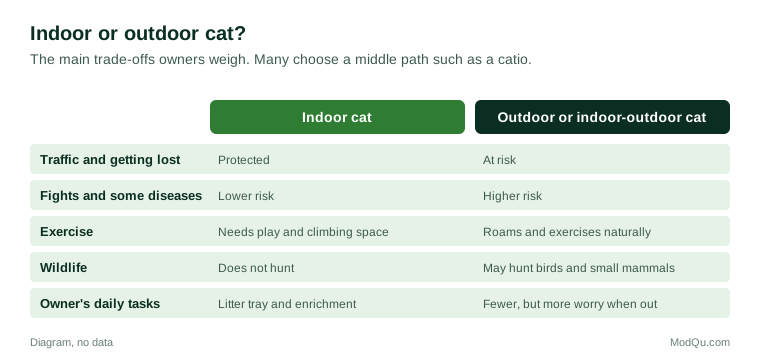
Indoor cats are safe from traffic, fights, some diseases and getting lost, and they do not hunt wildlife. They need more play, climbing space and enrichment to stay active and avoid boredom.
Outdoor or indoor-outdoor cats can roam, explore and exercise naturally. They face risks from traffic, other animals and disease, and they may hunt birds and small mammals.
Some owners choose a middle path: a catio (an enclosed outdoor area), a fenced garden, or supervised time outside on a harness. In some places, local rules require cats to be kept indoors at night or contained, to protect wildlife.
Example
A family moves from a farmhouse, where their cat roamed freely, to a flat beside a busy road. They decide to keep the cat indoors. They add a tall scratching post, shelves near the window and two short play sessions a day. After a few weeks of meowing at the door, the cat settles.
Feeding and litter
Cats are carnivores and need nutrients found in animal protein. Owners feed:
- dry food, which is convenient and keeps well;
- wet food, which adds moisture;
- a mix of both;
- raw or home-prepared diets, which some owners choose, though vets warn these need care to be balanced and safe.
Weight gain is common in indoor and neutered cats, so many vets recommend measuring food.
Litter is a daily task for indoor cats. Choices include clay, clumping, silica, wood, paper and plant-based litters. Owners weigh cost, smell, dust, weight and how easily it can be disposed of. Many vets suggest one tray per cat plus one, in quiet places.
Health care
Common parts of a cat's health care include:
- neutering or spaying, which prevents unwanted kittens and reduces some behaviour problems;
- vaccinations against common feline diseases, and against rabies where required;
- flea, tick and worm treatments;
- dental care, since dental disease is common in older cats;
- microchipping, required by law in some countries.
Cats often hide signs of pain or illness, so changes in appetite, litter habits or behaviour may be the first signs something is wrong.
What a cat costs
Costs include adoption or purchase, food, litter, vet care, insurance, toys and scratching posts, and care when owners travel.
Example (hypothetical figures)
An owner of one indoor cat spends 40 dollars a month on food, 15 on litter, 20 on insurance and 10 on toys and treats. That is 85 dollars a month, or 1,020 dollars a year. A yearly vet check and vaccinations cost another 150 dollars, bringing the total to 1,170 dollars for the year.
Costs vary by country, food choice and the cat's health. Older cats often need more vet care.
Kittens, adult cats and older cats
Cats' needs change through life. Kittens need several meals a day, vaccinations, neutering and gentle handling so they grow up comfortable with people. Adult cats settle into routines and often sleep for much of the day. Older cats, from around ten years, are more likely to develop kidney disease, thyroid problems, arthritis and dental disease, and many vets suggest more frequent check-ups.
Many people adopt adult or older cats from shelters, because their personalities are already known and they are often calmer than kittens. Owners of older cats often adjust the home with lower litter trays, steps to favourite spots and softer food.
Example
An owner notices that their 14-year-old cat no longer jumps onto the bed and drinks much more water than before. A vet diagnoses early kidney disease and arthritis. The owner switches to a prescription diet, adds a small step by the bed and books checks every six months.
Common problems for owners
Owners often mention:
- scratching furniture, usually reduced by providing good scratching posts;
- toileting outside the litter tray, which may be caused by stress, a dirty tray or a health problem;
- conflict between cats in multi-cat homes;
- hairballs and vomiting;
- finding care when travelling;
- rental rules that limit or ban pets;
- allergies in family members.
Example
A cat that has always used its tray starts urinating on a rug. The owner first changes the litter, but the problem continues. A vet visit finds a bladder infection. After treatment the cat goes back to using the tray.
Cats, wildlife and the community
Cats that go outdoors hunt, and scientists in several countries have studied their effect on birds and small mammals. This has made outdoor cats a subject of debate, especially on islands and in places with rare wildlife. Some councils encourage or require containment; many owners use collars with bells or keep cats in at dawn and dusk.
Feral and street cats raise other questions. Trap-neuter-return (TNR) programmes catch cats, neuter them and return them to where they live, aiming to reduce numbers over time. Some people support TNR; others argue for removing cats from sensitive areas.
What people disagree about
Cat ownership raises several debates:
- whether cats should be kept indoors;
- how to manage feral cat colonies;
- whether breeding for features such as very flat faces or folded ears should be limited;
- whether declawing should be banned, which it already is in many countries;
- what cats should be fed.
Questions pet food brands, vets, insurers and retailers want answered include how many cats people have, how they live, what owners spend and what care they choose.
Key terms
- Indoor catA cat kept inside the home at all times.
- CatioAn enclosed outdoor space where a cat can go outside safely.
- NeuteringSurgery that stops an animal from breeding.
- Litter trayA box with litter that indoor cats use as a toilet.
- EnrichmentToys, climbing spaces and activities that keep a pet active and interested.
- Feral catA cat that lives wild and avoids people.
- Trap-neuter-returnA programme that catches, neuters and releases feral cats.
- HairballA clump of swallowed fur that a cat brings back up.
Full glossary: animal health terms on EditingTests.com.
Cat ownership vocabulary test
How well do you know the language of this topic? Try 8 quick questions. Your score is shown straight away and is not saved.
What the cat ownership survey asks
This survey is part of ModQu's Pets and Animals survey. The cat ownership part takes about five minutes and covers:
- How many cats you have, and their ages.
- Whether your cat lives indoors, outdoors or both, and why.
- What you feed your cat and which litter you use.
- How much you spend on your cat in a typical month.
- How often your cat sees a vet.
- What you find hardest about owning a cat.
After that you can choose to continue with other short parts of the Pets and Animals survey, such as pet ownership or veterinary care, or stop.
Ready to take part?
Your answers help show what people really think and do. Results are only ever reported as totals; no one can see your individual answers.
Start the surveyQuestions about this survey
Who can take part?
Cat owners.
Do I have to give my name?
No. You may be asked for your age group, region and similar details so results can be broken down, but not your name. ModQu never asks for passwords, card numbers or account numbers.
How are the results used?
Answers are combined into totals and percentages and published in ModQu reports. Individual answers are never shown.
Is the vocabulary test part of the survey?
No. It is optional and separate, and your score is not stored.