
Share your views on animal welfare
Tell us how much animal welfare matters when you buy food, whether you have helped injured wildlife and whether you think welfare laws are strong enough. Your answers are combined with other people's and reported only as totals.
Start the wildlife and animal welfare surveyAbout 5 minutes. No account needed. You can stop at any time.
What animal welfare means
Animal welfare is about the wellbeing of individual animals: their health, comfort, ability to behave naturally and freedom from pain and fear. It is different from animal rights, the view that animals have rights that should not be overridden for human benefit, and from conservation, which is about protecting species and ecosystems.
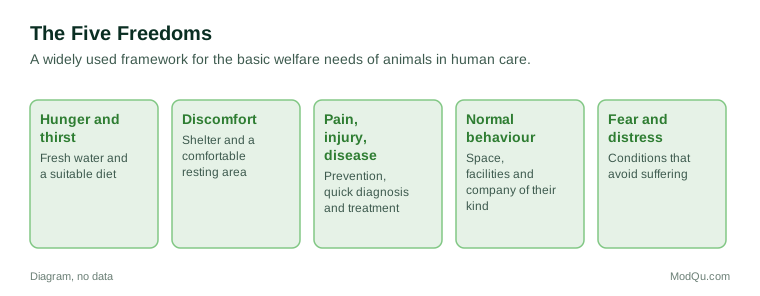
A widely used framework is the Five Freedoms, first set out in the United Kingdom and now used internationally:
- Freedom from hunger and thirst.
- Freedom from discomfort.
- Freedom from pain, injury and disease.
- Freedom to express normal behaviour.
- Freedom from fear and distress.
A newer approach, the Five Domains model, also considers positive experiences, not only the absence of suffering. The World Organisation for Animal Health (WOAH) sets international standards that many countries draw on.
Areas of concern
Animal welfare covers many settings:
- Farm animals: housing, space, transport and slaughter of animals raised for meat, milk and eggs.
- Fish: farming and catching methods.
- Pets: neglect, breeding practices and the pet trade.
- Wildlife: injured animals, hunting, trapping and wildlife trade.
- Animals in research: testing and how it is regulated.
- Entertainment: zoos, aquariums, circuses, racing and tourist attractions with animals.
- Working animals: horses, donkeys and dogs used for transport, farming or security.
People's concern differs between these areas, and many care strongly about some animals while giving little thought to others.
Welfare and food choices
Food is where most people meet animal welfare in daily life. Shoppers may see labels such as free-range, cage-free, organic, pasture-raised or higher-welfare certifications. The meaning of these labels differs between countries and schemes, and some are defined by law while others are set by retailers or private bodies.
Common choices people make include:
- buying higher-welfare eggs, meat or milk;
- eating less meat;
- avoiding certain products, such as foie gras or veal, for welfare reasons;
- vegetarian or vegan diets;
- buying from local farms they trust.
Price is a major barrier. Many people say welfare matters to them but buy on price, especially when budgets are tight.
Example (hypothetical figures)
A household buys 24 eggs a week. Standard eggs cost 3 dollars a dozen and free-range eggs 4.50 dollars a dozen. Switching to free-range adds 3 dollars a week, or 156 dollars a year. The household decides to switch for eggs but keeps buying standard chicken, where the price gap is larger.
Helping wildlife
Many people come into contact with wild animals near their homes. Common ways people help include:
- feeding birds and providing nest boxes;
- making gardens wildlife-friendly with native plants, water and hedgehog gaps;
- driving carefully where animals cross roads;
- reporting or taking injured animals to wildlife rescue centres;
- avoiding pesticides and slug pellets;
- supporting wildlife charities.
Wildlife rescue groups often advise people not to take young animals that seem abandoned, since parents are often nearby, and to call for advice before handling an injured animal. Some species are protected by law, and handling them without a licence may be illegal.
Example
A person finds a young bird on the ground in spring. They call a local wildlife rescue line, which explains that it is a fledgling learning to fly and its parents are probably feeding it. They keep their cat indoors for two days and watch from a distance as the parents return.
Wildlife in tourism and trade
Tourism raises welfare questions. Activities such as riding elephants, holding wild animals for photos, or visiting attractions where animals perform have been criticized by welfare groups. Many travellers now look for ethical wildlife experiences, such as watching animals in the wild with responsible guides or visiting genuine sanctuaries that do not breed or trade animals.
The wildlife trade, legal and illegal, also affects welfare and conservation. The international treaty CITES regulates trade in many endangered species.
Example
A couple on holiday are offered a chance to hold a young wild cat for a photo. They decline after reading that such animals are often taken from their mothers. Instead they book a guided walk in a national park, where they see animals from a distance.
Animals in research and entertainment
Two other areas often come up in public debate. Animals are used in medical and scientific research, and many countries regulate this through licensing, ethical review and the principle of the 3Rs: replace animals where possible, reduce the number used, and refine methods to reduce suffering. In entertainment, rules on wild animals in circuses, marine parks and racing differ widely; several countries have banned wild animals in travelling circuses, while others allow them under licence.
Animal welfare laws
Most countries have laws against cruelty to animals, but their scope and strength vary widely. Areas that differ include:
- whether animals are recognized in law as sentient, able to feel pain and pleasure;
- rules for farm animal housing, such as bans on certain cages or crates;
- rules on transport and slaughter;
- bans on cosmetic testing on animals, as in the European Union and several other countries;
- rules on wild animals in circuses;
- enforcement, and who investigates cruelty.
Some people think laws are strong enough but poorly enforced; others think laws need to go much further; and some feel rules put too much burden on farmers and businesses.
What people disagree about
Animal welfare is one of the most debated public topics:
- whether eating meat can be compatible with good welfare;
- whether hunting can be humane or is needed for wildlife management;
- whether zoos help conservation or should be phased out;
- whether animal research is justified when alternatives are limited;
- how to balance farmers' costs with higher welfare standards;
- whether cultural practices involving animals should be exempt from rules.
Questions food companies, charities, retailers and policymakers want answered include how much welfare matters to people, how it affects what they buy, and what laws they would support.
Key terms
- Animal welfareThe wellbeing of individual animals, including health, comfort and natural behaviour.
- Animal rightsThe view that animals have rights that should not be overridden for human benefit.
- Five FreedomsA framework of basic welfare needs, from freedom from hunger to freedom from fear.
- SentienceThe ability to feel pain, pleasure and other experiences.
- Free-rangeFarming that gives animals some access to outdoors; definitions vary by country.
- FledglingA young bird that has left the nest but cannot yet fly well.
- CITESAn international treaty that regulates trade in endangered species.
- Wildlife rescueA service that treats injured wild animals and returns them to the wild.
Full glossary: hunting wildlife management terms on EditingTests.com.
Wildlife and animal welfare vocabulary test
How well do you know the language of this topic? Try 8 quick questions. Your score is shown straight away and is not saved.
What the wildlife and animal welfare survey asks
This survey is part of ModQu's Pets and Animals survey. The wildlife and animal welfare part takes about five minutes and covers:
- How important animal welfare is to you when you buy food.
- Which welfare labels you look for, if any.
- Whether you have helped injured or orphaned wildlife.
- How you feel about animals in tourism, zoos and entertainment.
- Whether you think animal welfare laws in your country are strong enough.
- Which animal welfare issues matter most to you.
After that you can choose to continue with other short parts of the Pets and Animals survey, such as pet ownership or veterinary care, or stop.
Ready to take part?
Your answers help show what people really think and do. Results are only ever reported as totals; no one can see your individual answers.
Start the surveyQuestions about this survey
Who can take part?
Adults.
Do I have to give my name?
No. You may be asked for your age group, region and similar details so results can be broken down, but not your name. ModQu never asks for passwords, card numbers or account numbers.
How are the results used?
Answers are combined into totals and percentages and published in ModQu reports. Individual answers are never shown.
Is the vocabulary test part of the survey?
No. It is optional and separate, and your score is not stored.
Does the survey judge my food choices?
No. It asks what you buy and why, and all views are welcome.
Can I answer if I do not have pets?
Yes. This survey is for all adults, whether or not they keep animals.