
Share your experience of getting a pet
Tell us whether you adopted or bought your pet, why you chose that route and how easy the process was. Your answers are combined with other people's and reported only as totals.
Start the pet adoption and rescue surveyAbout 5 minutes. No account needed. You can stop at any time.
What pet adoption and rescue mean
Pet adoption means taking a pet from a shelter or rescue group to give it a permanent home. Animals come to shelters for many reasons: they were found as strays, their owners could no longer keep them, they were taken from neglect or cruelty, or they were born to unneutered animals.
Rescue organizations come in several forms:
- Municipal or government shelters, run by a city or council, often taking in strays.
- Charity shelters run by animal welfare societies.
- Foster-based rescue groups, where animals live in volunteers' homes until adopted.
- Breed-specific rescues that specialize in one breed.
- Rescues for other animals, such as rabbits, guinea pigs, birds, reptiles and horses.
- International rescues that bring dogs and cats from one country to another; rules on importing animals vary and are strict in some countries.
Some shelters accept every animal brought to them; others limit intake. Policies on euthanasia differ, and some describe themselves as no-kill.
Adopting or buying
People who want a pet usually choose between:
- adopting from a shelter or rescue;
- buying from a breeder, often for a specific breed;
- buying from a pet shop or online seller;
- taking a pet from friends, family or neighbours.
Reasons people give for adopting include giving an animal a second chance, lower costs, finding adult pets with known personalities, and concern about poor breeding practices. Reasons for buying include wanting a particular breed, wanting a puppy or kitten with a known background, allergies, and finding that shelters near them have few suitable animals.
Example
A family wants a dog that is good with young children. They visit two shelters and find mostly large young dogs that need experienced owners. A foster-based rescue suggests a five-year-old small dog whose foster family has young children. After a visit, they adopt the dog and say that knowing how it behaved in a real home made the decision easier.
The adoption process
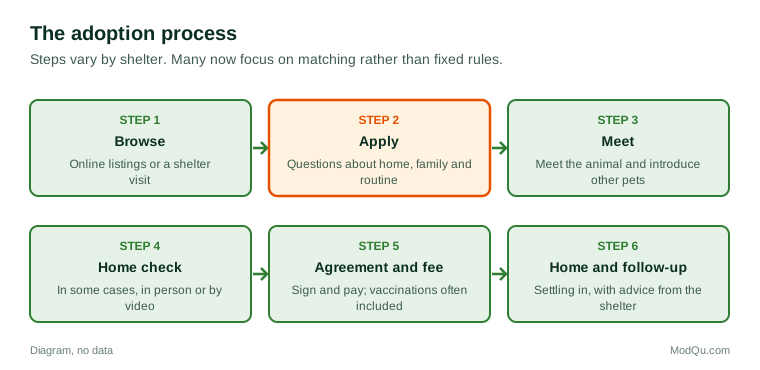
Shelters try to match animals with homes where they will stay. A typical process includes:
- Browsing animals online or visiting the shelter.
- Applying, with questions about the home, family, work hours, other pets and experience.
- Meeting the animal, sometimes several times, and introducing it to other pets.
- A home check in some cases, in person or by video.
- Paying an adoption fee and signing an adoption agreement.
- Taking the pet home, with a follow-up call or visit.
Some people find the process reassuring; others find it slow or strict, especially when applications are turned down because of renting, long working hours or no garden. Many shelters have relaxed some rules in recent years, focusing on matching rather than fixed requirements.
Fees and what they cover
Adoption fees vary by country, shelter and animal. They often include vaccinations, neutering, a microchip, worm and flea treatment and a health check, which would cost more if paid separately.
Example (hypothetical figures)
A shelter charges an adoption fee of 200 dollars for a young dog. If bought separately from a vet, the dog's neutering would cost 300 dollars, vaccinations 90 dollars, a microchip 50 dollars and parasite treatment 30 dollars, a total of 470 dollars. The adopter receives these services for 270 dollars less than paying for them separately.
Settling in
The first weeks after adoption can be hard for both the animal and the family. Many shelters describe a 3-3-3 rule for dogs: about three days to decompress, three weeks to learn the routine and three months to feel at home. It is a rough guide, not a rule. Common issues include:
- hiding, poor appetite or toilet accidents in the first days;
- anxiety when left alone;
- unknown fears, such as of men, hats or cars;
- tension with other pets.
Many shelters offer advice lines, training help and a trial period.
Example
A cat adopted from a shelter hides under the bed for four days. The adopters leave food, water and a litter tray in the room and sit quietly nearby each evening. On the fifth day the cat comes out, and within a month it sleeps on the sofa with them.
When adoptions do not work out
Some adopted animals are returned, often within the first weeks. Reasons include behaviour problems, conflict with other pets, allergies, a change in housing or the family's circumstances, and a mismatch between expectations and reality. Shelters try to reduce returns with careful matching, honest descriptions and support after adoption. Most shelters prefer that a pet is returned to them rather than passed on or abandoned.
Other ways to help shelters
People who cannot adopt often help shelters in other ways. They foster animals for a few weeks, volunteer to walk dogs or socialize cats, donate food and bedding, give money, share listings on social media, or drive animals to vets and new homes. Fostering in particular lets shelters care for more animals, and some fosters later adopt the animal they cared for, sometimes called a "foster fail".
Pressures on shelters
Shelters in many countries report periods of high intake, linked to rising living costs, housing rules that ban pets, and owners giving up animals bought on impulse. In some regions, many animals come from stray populations, and neutering programmes are a large part of shelter work. Adoption demand also changes over time: interest rose in several countries during COVID-19 lockdowns, and some of those animals later came back to shelters.
What people disagree about
Pet adoption raises several debates:
- whether "adopt, don't shop" should be encouraged or whether responsible breeders have a role;
- whether adoption rules are too strict;
- whether pet shops should be allowed to sell puppies and kittens, which some places have banned;
- whether rescues should import animals from abroad;
- how no-kill policies affect intake and animal welfare.
Questions shelters, pet product brands, vets and insurers want answered include where people get their pets, why they choose adoption or buying, and how they found the process.
Key terms
- ShelterA place that takes in animals and finds them new homes.
- Rescue groupAn organization that saves animals and rehomes them, often through foster homes.
- Foster homeA volunteer's home where an animal lives until it is adopted.
- Adoption feeThe charge paid when adopting a pet, often covering vaccinations and neutering.
- Home checkA visit or call to see whether a home suits an animal.
- Adoption agreementA contract setting out the adopter's duties to the pet.
- No-kill shelterA shelter that does not put down healthy or treatable animals.
- StrayA pet that is lost or living on the streets without an owner.
Full glossary: animal behavior terms on EditingTests.com.
Pet adoption and rescue vocabulary test
How well do you know the language of this topic? Try 8 quick questions. Your score is shown straight away and is not saved.
What the pet adoption and rescue survey asks
This survey is part of ModQu's Pets and Animals survey. The pet adoption and rescue part takes about five minutes and covers:
- Whether your current pet was adopted, bought, or came from friends or family.
- Why you chose adoption or buying.
- How easy the adoption process was, if you adopted.
- What the adoption fee or price was, as a range.
- How your pet settled in, and what support you used.
- Whether you would adopt in future.
After that you can choose to continue with other short parts of the Pets and Animals survey, such as pet ownership or veterinary care, or stop.
Ready to take part?
Your answers help show what people really think and do. Results are only ever reported as totals; no one can see your individual answers.
Start the surveyQuestions about this survey
Who can take part?
Adults who own or plan to get a pet.
Do I have to give my name?
No. You may be asked for your age group, region and similar details so results can be broken down, but not your name. ModQu never asks for passwords, card numbers or account numbers.
How are the results used?
Answers are combined into totals and percentages and published in ModQu reports. Individual answers are never shown.
Is the vocabulary test part of the survey?
No. It is optional and separate, and your score is not stored.