
Share your experience of keeping small pets
Tell us which small pets you keep, where you got them and what you spend on them. Your answers are combined with other people's and reported only as totals.
Start the fish, birds and small pets surveyAbout 5 minutes. No account needed. You can stop at any time.
What counts as a small pet
"Small pets" and "exotic pets" are broad terms for animals other than dogs and cats. Common groups include:
- Fish: freshwater fish such as goldfish, tetras and bettas, and marine fish in saltwater aquariums; pond fish such as koi.
- Birds: budgerigars, canaries, finches, cockatiels, parrots and poultry kept as pets.
- Small mammals: rabbits, guinea pigs, hamsters, gerbils, rats, mice, chinchillas and ferrets.
- Reptiles: lizards such as bearded dragons and geckos, snakes, tortoises and turtles.
- Amphibians: frogs and axolotls.
- Invertebrates: tarantulas, stick insects, snails and hermit crabs.
Which animals are popular differs between countries, and some species are restricted or banned as pets in some places to protect native wildlife or for safety.
Why people choose small pets
People choose small pets for many reasons:
- limited space, such as a flat with no garden;
- rental rules that allow small animals but not dogs or cats;
- allergies to cats or dogs;
- a first pet for children;
- interest in a particular animal, such as reptiles or birds;
- less time needed for walks and company, although many small pets still need daily care;
- lower expected costs, though setup costs can be high.
Example
A family in a flat with a no-dogs rule buys two guinea pigs for their nine-year-old. They are surprised to learn that guinea pigs need a large indoor enclosure, daily fresh vegetables, hay and company of their own kind. The child does the daily feeding and a parent cleans the enclosure each weekend.
Care needs are often underestimated
Welfare groups often say that small and exotic pets are among the animals most often kept in poor conditions, because their needs are less widely known. Examples include:
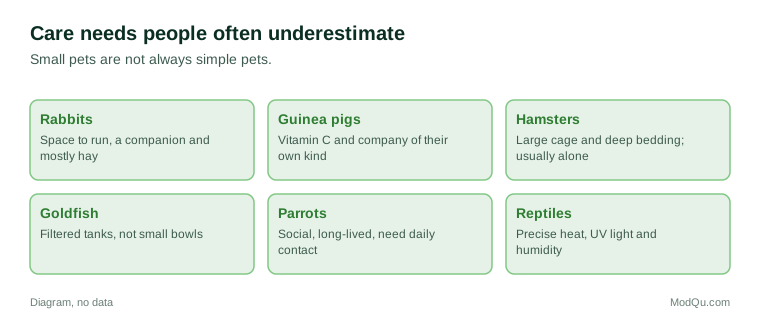
- Rabbits are social and need space to run, a companion rabbit and a diet based mostly on hay; small hutches are now widely discouraged.
- Guinea pigs need vitamin C in their diet and the company of other guinea pigs.
- Hamsters are mostly solitary and need a large cage with deep bedding to burrow.
- Goldfish grow larger than many people expect and need filtered tanks rather than small bowls.
- Parrots are intelligent, social and long-lived, sometimes for decades, and can develop behaviour problems if bored or alone.
- Reptiles need precise heat, light, often ultraviolet light, and humidity; mistakes can cause illness.
Many species also need vets with specialist knowledge, which can be hard to find and more expensive.
Where people get small pets
Small pets come from:
- pet shops and garden centres;
- breeders and hobby clubs;
- rescue centres, many of which have rabbits, guinea pigs and other small animals waiting for homes;
- friends, family and online adverts;
- reptile and bird shows.
Some concerns arise about wild-caught animals, especially some reptiles, birds and marine fish, and about the transport and sale of animals bought on impulse.
What small pets cost
Setup costs are often higher than people expect, while running costs can be lower than for dogs and cats.
Example (hypothetical figures)
A new owner sets up a tank for a bearded dragon. The enclosure costs 250 dollars, heat lamp and UV lighting 90 dollars, thermostat and thermometers 40 dollars, and decor and substrate 60 dollars, a setup total of 440 dollars. Monthly costs for insects, vegetables, supplements and electricity come to about 50 dollars, or 600 dollars a year. The dragon itself cost 80 dollars.
Other costs include replacement bulbs, filters, bedding, specialist vet care and holiday care.
Fish keeping
Fish keeping is a hobby in its own right. Owners learn about water quality, the nitrogen cycle, filtration, temperature and which species can live together. Planted aquariums, marine reef tanks and garden ponds can involve a lot of equipment and knowledge. Common mistakes include adding fish to a new tank too soon, overstocking and overfeeding.
Example
A student buys a small tank and six fish on the same day. Within a week several fish die. A local aquarium shop explains the nitrogen cycle and suggests letting the tank mature for several weeks before adding fish slowly. On the second try, the tank stays healthy.
Birds as pets
Pet birds range from small finches kept in pairs to large parrots that can live for many decades. Owners need to provide space to fly or climb, safe toys, a varied diet and social contact. Some species are noisy, and parrots can bite or pluck feathers when stressed. Bird flu rules in some countries also affect people who keep poultry or birds outdoors.
Small pets and children
Small animals are often bought as children's first pets, and they can teach responsibility and care. Welfare groups point out that adults remain responsible for the animal's welfare, since children's interest can fade and some animals, such as rabbits and hamsters, may not enjoy being picked up. Many families agree in advance who will feed, clean and check the pet each day, and plan for who will care for it during holidays.
Rehoming and releases
Some small and exotic pets are given up when owners lose interest, cannot manage their needs or move. Releasing pets into the wild is illegal in many places and can harm native wildlife; some released species, such as certain turtles, fish and parakeets, have established wild populations. Rescue centres for rabbits, reptiles and birds rehome many such animals.
What people disagree about
Small and exotic pets raise several debates:
- whether some species should be kept as pets at all;
- whether pet shops should sell animals with complex needs;
- whether rabbits and guinea pigs should be sold as children's pets;
- whether wild-caught animals should be traded;
- whether keepers should need a licence for some species.
Questions pet product brands, retailers and vets want answered include which small pets people keep, where they got them, what they spend and how much owners know about care.
Key terms
- Exotic petA pet other than a dog or cat, often a reptile, bird or unusual mammal.
- EnclosureThe tank, cage or pen a pet lives in.
- Nitrogen cycleThe process by which bacteria in a fish tank turn waste into less harmful substances.
- UV lightingUltraviolet light many reptiles need for health.
- SubstrateThe material on the floor of a tank or enclosure.
- HayDried grass that forms most of a rabbit's or guinea pig's diet.
- Wild-caughtAn animal taken from the wild rather than bred in captivity.
- OverstockingKeeping too many fish or animals for the space.
Full glossary: pet food manufacturing terms on EditingTests.com.
Fish, birds and small pets vocabulary test
How well do you know the language of this topic? Try 8 quick questions. Your score is shown straight away and is not saved.
What the fish, birds and small pets survey asks
This survey is part of ModQu's Pets and Animals survey. The fish, birds and small pets part takes about five minutes and covers:
- Which small pets you keep: fish, birds, small mammals, reptiles or others.
- Where you got them.
- How much you spent on setup and spend each month.
- Where you learned how to care for them.
- Whether you have found a vet who treats them.
- What you find hardest about keeping them.
After that you can choose to continue with other short parts of the Pets and Animals survey, such as pet ownership or veterinary care, or stop.
Ready to take part?
Your answers help show what people really think and do. Results are only ever reported as totals; no one can see your individual answers.
Start the surveyQuestions about this survey
Who can take part?
Owners of fish, birds, rabbits, reptiles or other small pets.
Do I have to give my name?
No. You may be asked for your age group, region and similar details so results can be broken down, but not your name. ModQu never asks for passwords, card numbers or account numbers.
How are the results used?
Answers are combined into totals and percentages and published in ModQu reports. Individual answers are never shown.
Is the vocabulary test part of the survey?
No. It is optional and separate, and your score is not stored.
Can I answer about pets I kept in the past?
The survey mainly asks about pets you keep now, with a few questions about past pets.
Does the survey cover farm animals kept as pets?
Yes, including backyard poultry kept as pets.