
Share what you buy for your pet's health
Tell us which health products you buy for your pet, where you buy them and whether you give supplements. Your answers are combined with other people's and reported only as totals.
Start the pet health products and medicines surveyAbout 5 minutes. No account needed. You can stop at any time.
What pet health products cover
Pet health products fall into several groups:
- Parasite treatments for fleas, ticks, worms, mites and, in some regions, heartworm.
- Prescription medicines prescribed by a vet, such as antibiotics, pain relief and medicines for long-term conditions.
- Supplements, such as products for joints, skin and coat, digestion and calm behaviour.
- Dental products: toothbrushes, pet toothpaste, dental chews and water additives.
- Wound and skin care: cleaning solutions, sprays and protective collars.
- Special diets for health conditions, often available only through vets.
- Calming products, including pheromone diffusers and anxiety wraps.
This page describes what is available and how owners buy. Decisions about treatment should be made with a vet, because dosages and suitability depend on the animal.
Parasite control
Parasite treatments are the most common health products owners buy. They come in several forms:
- spot-on treatments applied to the skin on the back of the neck;
- tablets and chewables;
- collars that release treatment over several months;
- sprays and shampoos;
- injections given by a vet in some countries.
Which parasites are a risk depends on the region, climate and the pet's lifestyle. Ticks may carry diseases in some areas, heartworm is a risk where certain mosquitoes live, and some worms can pass to people. Vets often recommend schedules based on local risk.
Owners need to take care with products made for one species. Some dog flea treatments contain ingredients that are toxic to cats, which is why labels and vet advice matter.
Example
A family uses a supermarket flea spray on their dog, but the fleas keep returning. Their vet explains that flea eggs and larvae live in carpets and bedding, and suggests a treatment for the dog plus a household spray. The family follows the plan and washes the dog's bedding weekly, and the problem clears within three months.
Where owners buy
Owners buy pet health products from:
- veterinary clinics, especially prescription items and parasite plans;
- online pharmacies, which in many countries can sell prescription medicines with a written prescription from a vet;
- pet shops and supermarkets, mainly for non-prescription products;
- farm and agricultural stores, often for larger animals;
- online marketplaces, where quality can vary.
Rules on which products need a prescription differ between countries. Some countries allow many parasite treatments to be sold freely; others require a vet's involvement.
Many vets offer pet health plans, paid monthly, which cover routine vaccinations, parasite treatments and check-ups. Owners like spreading costs; others prefer to buy as needed.
Cost and choosing products
Owners weigh price, effectiveness, ease of use and safety. Cost differences between buying from a vet and buying online can be large, and some owners buy online to save money. Others prefer the vet for advice and convenience.
Example (hypothetical figures)
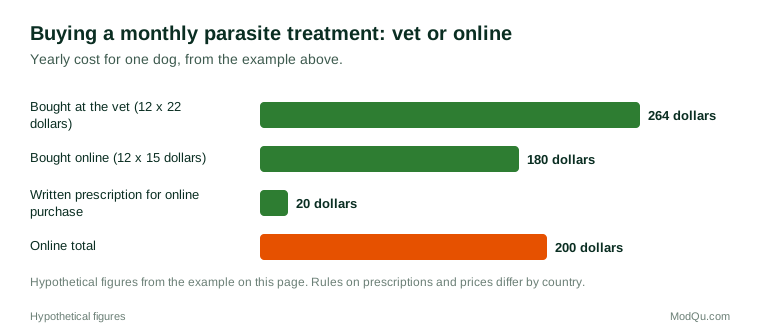
An owner pays 22 dollars a month for a monthly parasite treatment for their dog bought at the vet, or 264 dollars a year. The same product bought online costs 15 dollars a month, 180 dollars a year, but requires a written prescription from the vet costing 20 dollars a year. Buying online saves 64 dollars a year.
Supplements
Pet supplements are a growing market. Common types include:
- joint supplements, often with glucosamine or omega-3 fatty acids;
- skin and coat supplements;
- probiotics for digestion;
- calming supplements;
- multivitamins.
Owners often give supplements to ageing pets or pets with specific problems. The evidence for supplements varies, and in many countries they are regulated less strictly than medicines. Vets often advise that supplements are not needed for pets on a complete diet, and that some may interact with medicines.
Example
An owner of an older dog with stiff joints starts giving a joint supplement after seeing it recommended online. At the next check-up the vet finds arthritis and prescribes pain relief, saying the supplement may help some dogs but will not replace treatment. The owner continues both with the vet's agreement.
Long-term conditions
As pets live longer, more owners manage long-term conditions such as arthritis, diabetes, kidney disease, thyroid problems, allergies and heart disease. This may mean daily tablets, injections, special diets and regular blood tests. Costs and the effort of giving medicines can be a strain, and some owners find it hard to give tablets to cats or to inject insulin.
Giving medicines at home
Owners often find giving medicines harder than buying them. Cats in particular may refuse tablets, and some dogs learn to spit them out. Common approaches include hiding tablets in food or treats made for the purpose, using a pill dispenser, asking for liquid or chewable forms, or asking the vet whether a spot-on or long-acting injection is available. Owners are usually advised not to crush or split tablets unless the vet or label says this is safe, and to keep pet and human medicines apart to avoid mix-ups.
Safety and quality concerns
Owners raise several concerns:
- counterfeit or poor-quality products, especially from unregulated online sellers;
- giving human medicines to pets, some of which can be dangerous to animals;
- side effects and how to report them;
- resistance: parasites and bacteria becoming less responsive to treatments when overused;
- environmental effects of parasite treatments, which researchers in some countries have found in rivers.
Many countries have a regulator for veterinary medicines that approves products and records reported side effects.
What people disagree about
Pet health products raise some debates:
- whether parasite treatments should be given routinely all year or only when needed;
- whether vets should both prescribe and sell medicines;
- whether supplements are worth buying;
- whether more products should need a prescription.
Questions pet health companies, vets and retailers want answered include which products owners buy, where they buy them, what they spend and how they decide what to trust.
Key terms
- Parasite treatmentA product that kills or prevents fleas, ticks, worms or mites.
- Spot-on treatmentA liquid applied to the skin on the back of a pet's neck.
- HeartwormA parasitic worm spread by mosquitoes that affects the heart and lungs.
- Prescription medicineA medicine that a vet must authorize.
- Written prescriptionA vet's authorization that lets an owner buy a medicine elsewhere.
- SupplementA product added to a diet, such as for joints or coat.
- Pet health planA monthly payment plan for routine pet care.
- ResistanceWhen parasites or bacteria become less affected by a treatment.
Full glossary: veterinary medicine terms on EditingTests.com.
Pet health products and medicines vocabulary test
How well do you know the language of this topic? Try 8 quick questions. Your score is shown straight away and is not saved.
What the pet health products and medicines survey asks
This survey is part of ModQu's Pets and Animals survey. The pet health products and medicines part takes about five minutes and covers:
- Which health products you buy for your pet: parasite treatments, supplements, dental or others.
- Where you buy them: vet, online pharmacy, shop or marketplace.
- How much you spend on pet health products in a typical year.
- Whether you give supplements, and why.
- Whether you use a vet health plan.
- What concerns you about pet medicines and products.
After that you can choose to continue with other short parts of the Pets and Animals survey, such as pet ownership or veterinary care, or stop.
Ready to take part?
Your answers help show what people really think and do. Results are only ever reported as totals; no one can see your individual answers.
Start the surveyQuestions about this survey
Who can take part?
Pet owners.
Do I have to give my name?
No. You may be asked for your age group, region and similar details so results can be broken down, but not your name. ModQu never asks for passwords, card numbers or account numbers.
How are the results used?
Answers are combined into totals and percentages and published in ModQu reports. Individual answers are never shown.
Is the vocabulary test part of the survey?
No. It is optional and separate, and your score is not stored.
Does this page give treatment advice?
No. It describes products and how people buy them. Treatment decisions should be made with a vet.
Does the survey ask about my pet's illnesses?
It may ask about the kinds of products you buy. You can skip any question you prefer not to answer.