
Share what matters most to you
Tell us which values matter most to you, how they guide your choices and whether they have changed. Your answers are combined with other people's and reported only as totals.
Start the personal values surveyAbout 5 minutes. No account needed. You can stop at any time.
What personal values are
A value is a lasting belief that something is important and worth pursuing, such as honesty, family, freedom, security or fairness. Values are broader than opinions about a particular issue. They act as a guide when people make choices, especially hard ones where two good things conflict.
Values are different from goals, though they are linked. A goal is a specific result, such as getting a degree. A value is the reason behind it, such as learning, independence or providing for one's family. Values are also different from rules: a rule says what to do in a situation, while a value explains why it matters.
Most people hold many values at once and rank them differently. Two people may both value family and career, but when a job offer means moving far from relatives, their choices may differ because one ranks family higher.
Common values people hold
When people are asked to name what matters most to them, common answers include:
- Family and caring for those close to them.
- Honesty and integrity.
- Health and wellbeing.
- Security: financial, physical and emotional.
- Freedom and independence.
- Respect, for oneself and others.
- Fairness and justice.
- Faith or spiritual life.
- Achievement and doing work well.
- Kindness and helping others.
- Tradition and belonging to a community or culture.
- Enjoyment, adventure and new experiences.
The same word can mean different things to different people. "Freedom" may mean freedom of speech to one person, freedom from debt to another and freedom to travel to a third.
How researchers describe values
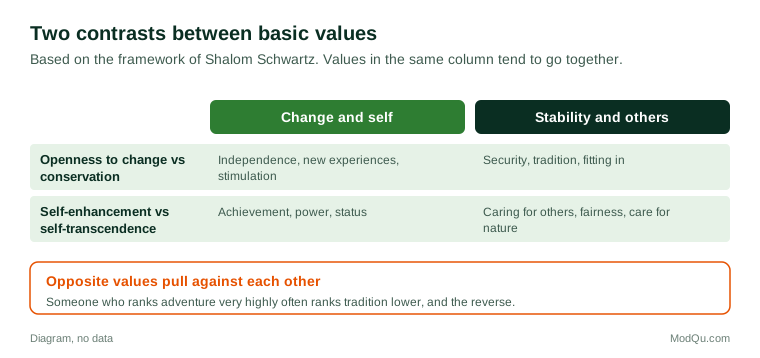
Social scientists have built several frameworks to compare values across people and countries. One widely used approach, developed by the psychologist Shalom Schwartz, groups basic human values around two contrasts, shown in the figure below:
- Openness to change (independence, stimulation, new experiences) versus conservation (security, conformity, tradition).
- Self-enhancement (achievement, power, status) versus self-transcendence (caring for others, universal fairness, care for nature).
Values next to each other in this scheme tend to go together; values on opposite sides tend to pull against each other. Someone who ranks adventure very highly often ranks tradition lower, and vice versa.
Large international survey programs have asked about values in many countries over several decades, which lets researchers compare how priorities differ by country, generation and religion and how they change over time.
How values guide everyday decisions
Values show up in many ordinary choices:
- Work: choosing a job for pay, security, purpose, flexibility or the chance to help others.
- Money: saving versus spending, giving to charity, supporting family members.
- Relationships: who people choose as partners and friends, and how they raise children.
- Time: how much goes to work, family, faith, community or leisure.
- Health: food choices, exercise and how much risk people accept.
- Civic life: voting, volunteering and joining causes.
Example
A software tester is offered a better-paid job at a company whose main product is online gambling. They value financial security and are paying off student debt, but they also value fairness and have seen a relative struggle with gambling. They turn the offer down and keep looking, saying the higher pay was not worth working against something they care about.
Values and what people buy
Many people say their values affect what they buy. They may look for products that are made locally, made without cruelty to animals, made with fair pay for workers, better for the environment, or in keeping with their faith, such as halal or kosher food.
There is often a gap between what people say and what they do. Price, convenience, habit and lack of information can lead people to buy things that do not match the values they state. Surveys that ask both about values and about recent purchases can show where that gap is largest.
Example (hypothetical figures)
A shopper says that buying from local producers matters to them. In one month their grocery spending is $480. When they check receipts, $96 went on locally produced items, which is 20 percent. They say price is the main reason: the local eggs and vegetables cost about a third more than the supermarket's own brand.
Questions that businesses want answered here include which values people say guide their purchases, how much extra they would pay, and how often values win over price.
Where values come from and how they change
Values are shaped by:
- Family and upbringing: what parents and carers taught and showed.
- Culture and religion: shared beliefs about what is right and important.
- Education and exposure to new ideas.
- Experience: hardship, migration, illness, success, loss or becoming a parent.
- Peers and community: the people one spends time with.
Core values tend to be fairly stable in adulthood, but their order can shift. People often report that having children raised the importance of security and family, that an illness made health and relationships more important, or that moving to a new country changed how they think about tradition and independence.
Researchers also study generational change: younger people in many countries have, on average, placed more emphasis on self-expression and less on traditional authority than older generations, though the pattern varies by place.
Example
A person raised in a farming community in which hard work and tradition came first moves to a large city for university. Over ten years they come to place more weight on personal freedom and new experiences. They still value hard work, and when they have children they find themselves returning to some traditions they once rejected.
When values conflict
Hard decisions often involve two values that cannot both be fully met: honesty and kindness when giving bad news, loyalty and fairness when a friend has done something wrong, security and adventure when deciding whether to start a business. People resolve these conflicts differently, and how they do so says a lot about which values come first for them.
Values can also conflict between people, within families, workplaces and societies. Disagreements over politics, religion and social issues are often, at root, disagreements about which values should take priority.
What people disagree about
- Are some values universal? Some argue that values such as fairness and care appear in every culture; others stress how much values differ.
- Should organisations have values? Many employers publish value statements; some workers see these as meaningful, others as public relations.
- Should values guide buying? Some see shopping by values as a way to change the world; others think it puts too much responsibility on individuals.
Key terms
- ValueA lasting belief that something is important and worth pursuing.
- Value priorityHow a person ranks their values against each other.
- Value conflictA situation in which two values cannot both be fully met.
- Openness to changeValues that stress independence, new experiences and stimulation.
- ConservationValues that stress security, tradition and fitting in.
- Self-transcendenceValues that stress caring for others and for the wider world.
- Ethical consumptionChoosing what to buy partly on the basis of moral values.
- Say-do gapThe difference between what people say they value and what they actually do.
Full glossary: behavioral science terms on EditingTests.com.
Personal values vocabulary test
How well do you know the language of this topic? Try 8 quick questions. Your score is shown straight away and is not saved.
What the personal values survey asks
This survey is part of ModQu's Personal Development survey. The personal values part takes about five minutes and covers:
- Which values matter most to you, and how you would rank them.
- Whether your values guide what you buy, and how often.
- How your values affect choices about work, money and time.
- A recent decision in which two of your values pulled against each other.
- Whether your values have changed, and what changed them.
- Where your values mainly come from.
After that you can choose to continue with other short parts of the Personal Development survey, such as self-improvement or productivity and time management, or stop.
Ready to take part?
Your answers help show what people really think and do. Results are only ever reported as totals; no one can see your individual answers.
Start the surveyQuestions about this survey
Who can take part?
Adults.
Do I have to give my name?
No. You may be asked for your age group, region and similar details so results can be broken down, but not your name. ModQu never asks for passwords, card numbers or account numbers.
How are the results used?
Answers are combined into totals and percentages and published in ModQu reports. Individual answers are never shown.
Is the vocabulary test part of the survey?
No. It is optional and separate, and your score is not stored.