
Share how confident you feel speaking up
Tell us how comfortable you are speaking in public, where you feel least confident and what has helped. Your answers are combined with other people's and reported only as totals.
Start the confidence and public speaking surveyAbout 5 minutes. No account needed. You can stop at any time.
What confidence is
Self-confidence is a person's belief that they can handle a task or situation. It is related to, but not the same as, self-esteem, which is a person's overall sense of their own worth. Someone can have healthy self-esteem and still feel nervous giving a speech, and someone can be very confident in one area, such as their job, and unsure in another, such as meeting new people.
Psychologists often use the term self-efficacy for confidence in a specific task: "I can run this meeting", "I can fix this car", "I can pass this exam". Self-efficacy tends to grow when a person succeeds at a task, sees others like them succeed, receives encouragement and learns to manage their nerves.
Confidence is not the same as being loud or outgoing. Quiet people can be very confident, and some people who appear bold feel anxious inside.
Where people feel least confident
Common situations in which people say they feel least confident include:
- Speaking in front of a group, at work, school, weddings, funerals or community meetings.
- Job interviews and performance reviews.
- Speaking up in meetings, especially to disagree or ask a question.
- Meeting new people and making small talk.
- Negotiating, for example over pay or the price of a car.
- Using a second language at work or in daily life.
- Physical appearance, including clothes, weight and skin.
- New skills or roles, such as a first management job or becoming a parent.
Confidence also varies with background. Being the only person of one's gender, age or ethnic group in a room, or being new to a country, can make speaking up feel riskier.
Why public speaking feels hard
When people feel watched and judged, the body reacts as if facing a threat. Common signs include a racing heart, shaking hands or voice, a dry mouth, sweating, blushing and a mind that goes blank. These reactions are normal and usually look less obvious to the audience than they feel to the speaker.
Fear of public speaking, sometimes called glossophobia, ranges from mild nerves to intense anxiety that leads people to avoid any situation where they might have to speak. Common worries include forgetting what to say, being boring, being asked a question they cannot answer, or being laughed at.
Example
A warehouse supervisor is asked to give a five-minute safety briefing to 30 staff each Monday. The first time, their voice shakes and they read every word from a sheet. By the sixth week they use a short list of points on a card, look up at the team, and say the shaking has mostly gone. They still feel nervous before starting, but the nerves fade after the first minute.
How people build confidence in speaking
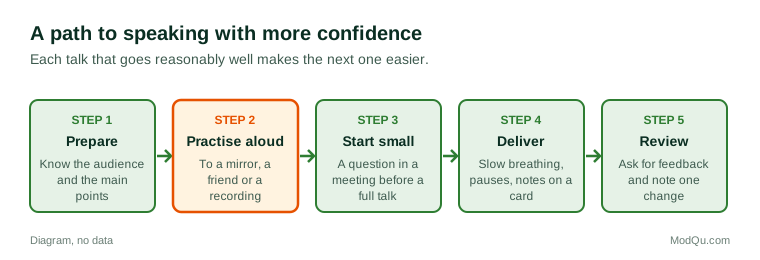
People use several approaches, often in combination. The figure below shows a common path from preparation to delivery and review.
- Preparation: knowing the material well, knowing the audience and having a clear structure with a beginning, main points and end.
- Practice aloud: rehearsing to a mirror, a friend or a phone recording, rather than only in one's head.
- Starting small: asking one question in a meeting before giving a full talk.
- Managing the body: slow breathing, standing steadily, pausing, drinking water.
- Changing how nerves are seen: some people find it helps to treat the racing heart as energy or excitement rather than danger.
- Feedback: asking a trusted person what worked and what to change.
- Repetition: confidence usually grows with each experience, especially when it goes reasonably well.
Courses, clubs and other help
Many people take formal steps to build confidence:
- Public speaking clubs where members practise short speeches and give each other feedback.
- Courses and workshops, in person or online, sometimes paid for by employers.
- Drama, improvisation and debate classes, which build comfort with being watched and thinking on one's feet.
- Coaching for interviews, presentations and leadership.
- Language classes for people who feel less confident speaking a second language.
- Professional help, such as therapy, for anxiety that is severe or affects daily life.
Example (hypothetical figures)
A course asks 12 participants to rate their comfort with public speaking from 1 (very uncomfortable) to 10 (very comfortable) at the start and end of an eight-week program. The average rating rises from 3.5 to 6.0, a rise of 2.5 points. Two participants report no change, and the person who improved most moved from 2 to 8. The course leader notes that people who gave the most practice talks improved most.
Questions that businesses want answered here include how many people have taken a course to build confidence, what kind, who paid, and whether they felt it helped.
Confidence at work
Confidence affects careers. People who feel confident are more likely to apply for promotions, ask for raises, share ideas and take on visible projects. Those who lack confidence may be overlooked even when their work is strong.
Workplaces affect confidence too. Managers who invite questions, give clear feedback and respond calmly to mistakes help staff speak up. This is sometimes called psychological safety: the shared belief that it is safe to take interpersonal risks such as asking questions or admitting errors. In workplaces where people are mocked or punished for speaking up, even confident people often stay quiet.
Overconfidence and imposter feelings
Confidence can go wrong in two directions.
- Overconfidence is a belief in one's own ability that is stronger than the evidence supports. It can lead to poor decisions, too little preparation and ignoring advice.
- Imposter feelings are the opposite: persistent doubt about one's own ability despite evidence of success, and fear of being "found out". Many capable people, including experienced professionals, report these feelings at some point.
Example
A newly promoted team leader feels they were chosen by mistake and that their team knows more than they do. They avoid making decisions and over-prepare for every meeting. After talking with a mentor who describes having had the same feelings in their first leadership role, they begin to share their plans with the team and ask for input, and find the team responds well.
What people disagree about
- Can confidence be taught? Some see it as mostly a personality trait; others say it can be built like a skill.
- Fake it until you make it? Some recommend acting confident until the feeling follows; others say this adds pressure and prefer honest acknowledgement of nerves.
- Is the problem the person or the setting? Some focus on individual confidence; others say workplaces and schools should change so more people feel able to speak.
Key terms
- Self-confidenceA person's belief that they can handle a task or situation.
- Self-esteemA person's overall sense of their own worth.
- Self-efficacyConfidence in one's ability to do a specific task.
- GlossophobiaFear of public speaking.
- Stage frightNervousness before or during a performance or speech.
- Psychological safetyThe shared belief that it is safe to ask questions, disagree or admit mistakes.
- Imposter feelingsPersistent doubt about one's ability despite evidence of success.
- OverconfidenceBelief in one's own ability that is stronger than the evidence supports.
Full glossary: business coaching terms on EditingTests.com.
Confidence and public speaking vocabulary test
How well do you know the language of this topic? Try 8 quick questions. Your score is shown straight away and is not saved.
What the confidence and public speaking survey asks
This survey is part of ModQu's Personal Development survey. The confidence and public speaking part takes about five minutes and covers:
- How comfortable you are speaking in public and in meetings.
- Where you feel least confident: work, social settings, appearance, a second language or others.
- What you feel before and during a talk.
- Whether you have taken a course, joined a club or used a coach to build confidence.
- What has helped most, and what has not.
- How confidence has affected your work or studies.
After that you can choose to continue with other short parts of the Personal Development survey, such as self-improvement or productivity and time management, or stop.
Ready to take part?
Your answers help show what people really think and do. Results are only ever reported as totals; no one can see your individual answers.
Start the surveyQuestions about this survey
Who can take part?
Adults.
Do I have to give my name?
No. You may be asked for your age group, region and similar details so results can be broken down, but not your name. ModQu never asks for passwords, card numbers or account numbers.
How are the results used?
Answers are combined into totals and percentages and published in ModQu reports. Individual answers are never shown.
Is the vocabulary test part of the survey?
No. It is optional and separate, and your score is not stored.