
Tell us how life is going
Tell us how happy you are these days, what makes you happiest and what would improve your life most. Your answers are combined with other people's and reported only as totals.
Start the happiness and life satisfaction surveyAbout 5 minutes. No account needed. You can stop at any time.
What happiness and life satisfaction mean
Happiness is used in everyday speech for several different things. Researchers usually separate at least three:
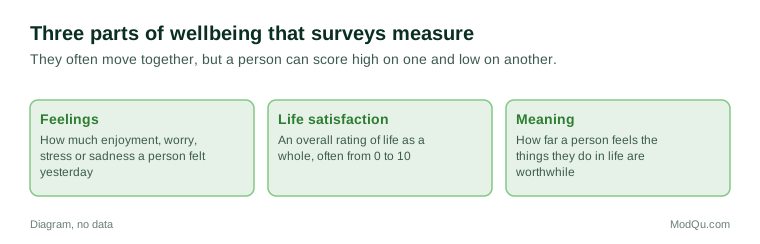
- Feelings in the moment: how cheerful, calm, sad, worried or stressed a person feels during a day. This is sometimes called emotional wellbeing or affect.
- Life satisfaction: how a person judges their life as a whole when they stop to think about it. Someone can have a stressful week and still be satisfied with their life overall.
- Meaning and purpose: whether a person feels their life is worthwhile and their activities matter. This is sometimes called eudaimonic wellbeing, from an ancient Greek idea of a life lived well.
These three often move together but not always. A parent of a newborn may report little sleep and a lot of stress, yet a strong sense of purpose. A person on a long holiday may feel cheerful each day but unsure what their life is for.
How happiness is measured
Because wellbeing is personal, the main way to measure it is to ask people. Common question types include:
- A life evaluation scale. People rate their life from 0 to 10, where 0 is the worst possible life and 10 the best. A well-known version asks them to picture a ladder with the best possible life at the top.
- A life satisfaction question. "Overall, how satisfied are you with your life nowadays?" answered on a numbered scale.
- Questions about yesterday. Whether a person felt enjoyment, worry, sadness, anger or stress for much of the previous day.
- Worthwhile questions. How far a person feels the things they do in life are worthwhile.
National statistics offices in several countries now include such questions in regular surveys, and international reports compare average life evaluations across countries each year. The scales are simple, but answers are affected by the order of questions, the mood of the day and cultural habits in how people use scales. The figure below shows the main parts of wellbeing that surveys try to capture.
What people say makes them happy
When asked what makes them happiest, people across many countries give similar kinds of answers:
- Close relationships: family, partners, children, friends.
- Health: their own and that of people they love.
- Security: enough money for needs, a safe home and a stable job.
- Freedom and control: being able to make choices about one's own life.
- Purpose: work, faith, volunteering, creating something or helping others.
- Small daily pleasures: food, nature, music, hobbies, rest, time outdoors.
People often rank relationships and health above money when asked directly, though money worries are one of the most common things they say would improve their life if solved.
Example
A retired teacher rates their life satisfaction as high. Asked why, they mention a weekly meal with their grandchildren, a garden, good health for their age and a pension that covers their needs. Asked what would improve life most, they say living closer to their sister, who moved abroad.
Money and happiness
The link between income and wellbeing is one of the most studied questions. Broadly, research finds that:
- people with very low incomes report lower life satisfaction, and more income makes a large difference to them;
- as income rises, each extra amount tends to make a smaller difference to life evaluations;
- how people compare with those around them matters as well as the amount itself;
- losing income, a job or a home tends to lower wellbeing sharply.
Researchers still debate whether there is a point beyond which more income stops raising daily emotional wellbeing, and the answer may differ by measure and by country.
Example (hypothetical figures)
A survey asks four people to rate their life from 0 to 10. One, out of work and behind on rent, answers 4. One with a steady low income answers 6. One with a middle income answers 7. One with a high income but long working hours and little time with family also answers 7. The example shows why researchers look at more than income alone.
Other things that go with higher or lower wellbeing
Studies of wellbeing consistently point to several factors besides money:
- Health, including chronic pain, disability and mental health.
- Work: having a job, and having a job that feels secure, fair and meaningful.
- Social connection: loneliness is linked with lower wellbeing at every age.
- Trust and safety: trust in neighbours and institutions, and feeling safe where one lives.
- Freedom: the sense of being able to choose one's path in life.
- Generosity: giving time or money to others is linked with higher reported wellbeing.
Age is linked too, though the pattern varies by country. Several studies have found that life satisfaction tends to dip in middle age and rise again later, while others find different shapes.
Example
A young professional moves to a new city for a better-paid job. Their income rises, but for the first year they rate their life lower than before because they know no one and work long hours. After joining a sports club and making friends, their rating rises above where it was before the move.
Differences across people and places
Average life evaluations differ between countries, and within countries between groups. Part of the difference reflects real conditions such as income, health, freedom and social support. Part may reflect how people in different cultures use rating scales: in some cultures people tend to avoid the extremes; in others, saying one is very happy is more usual.
Within any group, individuals differ widely. Personality, upbringing and life events all play a part, and the same circumstances can feel very different to two people.
Can people make themselves happier?
Many books, apps and courses promise greater happiness. Evidence suggests that some practices are linked with modest improvements for some people, such as spending time with others, regular physical activity, time outdoors, gratitude exercises, helping others and getting enough sleep. Effects vary, and none of these replaces treatment for depression or other conditions, which needs professional help.
There is also debate about whether chasing happiness directly can backfire. Some researchers suggest that focusing on meaning, relationships and doing things well brings more lasting satisfaction than trying to feel happy at all times.
What people disagree about
- Should governments measure wellbeing? Some say wellbeing should sit alongside income and output as a sign of national progress; others say it is too subjective.
- Can happiness be compared? Some doubt that a 7 in one country means the same as a 7 in another.
- Individual or society? Views differ on how much wellbeing depends on personal choices versus jobs, housing, health care and community.
Questions that businesses and public bodies want answered here include how people rate their lives, what they see as the main sources of happiness and what change would help them most.
Key terms
- WellbeingHow well a person's life is going, including feelings, satisfaction and purpose.
- Life satisfactionA person's overall judgement of their life as a whole.
- AffectFeelings and moods a person experiences, pleasant or unpleasant.
- Eudaimonic wellbeingThe sense that life is meaningful and worthwhile.
- Life evaluationA rating of one's life, often on a 0 to 10 scale.
- Self-reportAn answer a person gives about themselves, rather than a measurement taken by someone else.
- LonelinessThe painful feeling of having fewer or weaker social connections than one wants.
- Hedonic adaptationThe tendency to get used to changes, good or bad, so their effect on mood fades.
Full glossary: social psychology terms on EditingTests.com.
Happiness and life satisfaction vocabulary test
How well do you know the language of this topic? Try 8 quick questions. Your score is shown straight away and is not saved.
What the happiness and life satisfaction survey asks
This survey is part of ModQu's Personal Development survey. The happiness and life satisfaction part takes about five minutes and covers:
- How happy you are these days, and how satisfied you are with life overall.
- How you felt yesterday: enjoyment, worry, stress or calm.
- What makes you happiest.
- Whether you feel the things you do in life are worthwhile.
- What would improve your life most.
- How your wellbeing has changed in recent years, and why.
After that you can choose to continue with other short parts of the Personal Development survey, such as self-improvement or productivity and time management, or stop.
Ready to take part?
Your answers help show what people really think and do. Results are only ever reported as totals; no one can see your individual answers.
Start the surveyQuestions about this survey
Who can take part?
Adults.
Do I have to give my name?
No. You may be asked for your age group, region and similar details so results can be broken down, but not your name. ModQu never asks for passwords, card numbers or account numbers.
How are the results used?
Answers are combined into totals and percentages and published in ModQu reports. Individual answers are never shown.
Is the vocabulary test part of the survey?
No. It is optional and separate, and your score is not stored.
Is this a mental health test?
No. It asks how life is going for you. If you are struggling, please contact a health professional or a local support line.