
Share your goals for the next five years
Tell us what you most want to achieve, how close you are and what is in the way. Your answers are combined with other people's and reported only as totals.
Start the life goals surveyAbout 5 minutes. No account needed. You can stop at any time.
What life goals are
A life goal is a result a person hopes to reach over years rather than days or weeks. Some are concrete and measurable, such as buying a home or finishing a degree. Others are broad, such as being healthy, having a close family or feeling at peace. Life goals differ from daily tasks and short-term targets because they take sustained effort and often depend on things outside the person's control.
People hold life goals with different degrees of clarity. Some have a written plan with dates. Many have a general sense of direction. Some say they do not set goals at all and prefer to take life as it comes.
The kinds of goals people set
Life goals usually fall into a handful of areas:
- Family and relationships: finding a partner, marriage, having children, caring for parents, staying close to friends.
- Home: owning a home, moving to a better area, moving back to a home town or country.
- Career and education: a degree, a promotion, a change of career, running one's own business.
- Money: becoming debt-free, saving a set amount, retiring at a chosen age, leaving something to children.
- Health: reaching a healthy weight, managing a condition, staying active into old age.
- Experiences: travel, learning an instrument, completing a long walk or race.
- Contribution and meaning: volunteering, faith, community leadership, creative work, helping others.
The weight given to each area varies across cultures. In some places goals are framed mainly around the individual; in others, family duty, community standing or religious life come first. Survey research often explores how these priorities differ by country, age and circumstances.
How goals change with age
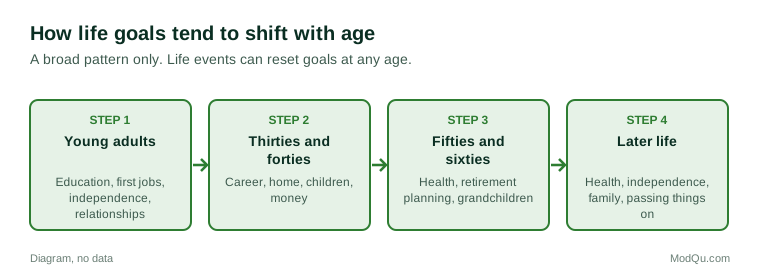
Life goals shift as people move through different stages. The figure below shows a broad pattern, though individual lives vary a great deal.
- Young adults often focus on education, first jobs, independence and relationships.
- People in their thirties and forties often focus on career progress, home, children and money.
- People in their fifties and sixties often shift towards health, retirement planning, grandchildren and doing things they have put off.
- Older adults often focus on health, staying independent, family, and passing on knowledge or property.
Life events reset goals at any age: illness, divorce, losing a job, moving countries or the death of someone close can make old goals irrelevant and new ones urgent.
Example
A person in their late twenties plans to save for a home in the city where they work. When a parent becomes ill in another region, they move back to help. Two years later their main goal is to find a job in the smaller town and buy a house there, which is cheaper but has fewer jobs in their field.
How people work towards goals
People who make steady progress on long-term goals often use similar approaches, though not always on purpose:
- Breaking the goal into steps. Saving for a home becomes a monthly savings target; a degree becomes one course at a time.
- Setting a time frame. A rough date gives a sense of pace.
- Writing it down or telling someone. This makes the goal more concrete and adds accountability.
- Tracking progress. A savings balance, a list of courses finished or a training log shows movement.
- Reviewing and adjusting. Checking once or twice a year whether the goal still matters and whether the plan still fits.
A well-known framework suggests goals should be specific, measurable, achievable, relevant and time-bound. Critics point out that some important goals, such as being a good parent, do not fit neatly into numbers.
Example (hypothetical figures)
A couple aim to pay off $24,000 of debt in five years. They set a target of $400 a month. After two years they have paid $8,400 instead of $9,600 because of a car repair and a period when one partner was out of work. They raise the payment to $450 a month, which would clear the remaining $15,600 in just under three years, keeping them close to the original five-year plan.
What holds people back
When asked what stops them, people give a fairly consistent set of answers:
- Money: not enough income, high costs of living, debt or unexpected bills.
- Time: work, caring responsibilities and commuting leave little left over.
- Health: illness, disability, tiredness or poor mental health.
- Circumstances outside their control: the job market, housing prices, immigration rules, discrimination, conflict or disaster.
- Uncertainty: not knowing what they want, or having too many competing goals.
- Fear: of failure, of change, or of what others will think.
- Lack of support: no one to encourage, advise or help.
Some barriers are personal and can be worked on; others are structural and need wider change. People often blame themselves for barriers that are mostly outside their control.
Example
A recent immigrant with an engineering degree from their home country finds their qualification is not fully recognised. Their five-year goal changes from "work as an engineer" to "get my credentials recognised and work in a related technical job while I study". They say the new goal feels slower but more realistic.
Measuring progress and success
Progress on life goals is hard to measure because many goals are long, uncertain and personal. People judge their own progress in different ways: against their own past, against friends or family, or against what they expected at an earlier age. Comparison with others, especially on social media, can make people feel behind even when they are doing well by their own standards.
Some people find that reaching a goal does not bring the satisfaction they expected, and they set a new one. Others find that the effort itself, and what they learned along the way, mattered more than the result.
What people disagree about
- Plan or flow? Some believe clear long-term goals are essential; others think too much planning makes people rigid and anxious.
- Big or small? Some argue for ambitious goals that stretch a person; others for modest goals that are more likely to be reached.
- Personal or shared? In many households, goals are set and pursued jointly, and individual goals may give way to family needs.
- Effort or luck? People differ on how much they think success depends on hard work versus circumstances.
Questions that businesses want answered here include which goals matter most to people at different ages, how close they feel to reaching them, and what kinds of help they would use.
Key terms
- Life goalA result a person hopes to reach over years rather than days or weeks.
- MilestoneA point along the way that shows progress towards a larger goal.
- SMART goalA goal that is specific, measurable, achievable, relevant and time-bound.
- Time frameThe period within which a person hopes to reach a goal.
- Life stageA broad period of life, such as early adulthood or retirement.
- BarrierSomething that makes a goal harder to reach.
- Structural barrierA barrier that comes from wider conditions, such as housing costs or rules, not the individual.
- Social comparisonJudging one's own progress against other people.
Full glossary: business coaching terms on EditingTests.com.
Life goals vocabulary test
How well do you know the language of this topic? Try 8 quick questions. Your score is shown straight away and is not saved.
What the life goals survey asks
This survey is part of ModQu's Personal Development survey. The life goals part takes about five minutes and covers:
- Your most important goal for the next five years.
- Other goals you hold for family, home, work, money, health or experiences.
- How close you feel to reaching your main goal.
- What holds you back most.
- How you plan and track progress, if you do.
- What kind of help or support would make the biggest difference.
After that you can choose to continue with other short parts of the Personal Development survey, such as self-improvement or productivity and time management, or stop.
Ready to take part?
Your answers help show what people really think and do. Results are only ever reported as totals; no one can see your individual answers.
Start the surveyQuestions about this survey
Who can take part?
Adults.
Do I have to give my name?
No. You may be asked for your age group, region and similar details so results can be broken down, but not your name. ModQu never asks for passwords, card numbers or account numbers.
How are the results used?
Answers are combined into totals and percentages and published in ModQu reports. Individual answers are never shown.
Is the vocabulary test part of the survey?
No. It is optional and separate, and your score is not stored.
What if I do not have any goals?
That is a useful answer too. The survey asks why some people prefer not to set goals.