
Share how you manage your time
Tell us how you plan your day, what tools you use and what distracts you most. Your answers are combined with other people's and reported only as totals.
Start the productivity and time management surveyAbout 5 minutes. No account needed. You can stop at any time.
What productivity and time management cover
Time management is the way a person decides what to do, when, and for how long. Productivity is how much useful work or progress comes out of that time. The two are linked but not the same: someone can be very organised and still spend their day on low-value tasks, and someone with no system at all can get a great deal done.
The topic covers paid work, study, housework, caring for others, side projects and personal goals. For many people the hard part is not any single task but fitting all of them into the same week.
How people plan their day
People plan in very different ways, and most do not follow one method strictly.
- No formal plan. Some people keep everything in their head and respond to what comes up.
- A to-do list. The most common tool, on paper, in a phone or on a sticky note.
- A calendar. Fixed appointments, meetings and deadlines, sometimes with time blocked for tasks.
- A weekly review. Looking at the coming week, deciding priorities and clearing old items.
- Shared plans. Family calendars, team task boards and shared shopping lists.
Planning also differs by job and life stage. A shift worker's time is set by a roster; a freelancer sets their own; a parent of young children plans around naps, school and meals.
Example
A nurse working rotating shifts keeps a paper diary with each month's roster written in pen. Personal tasks such as appointments and bill payments go in pencil on days off. They do not use any app because their shifts change too often for a fixed routine to work.
Common methods and techniques
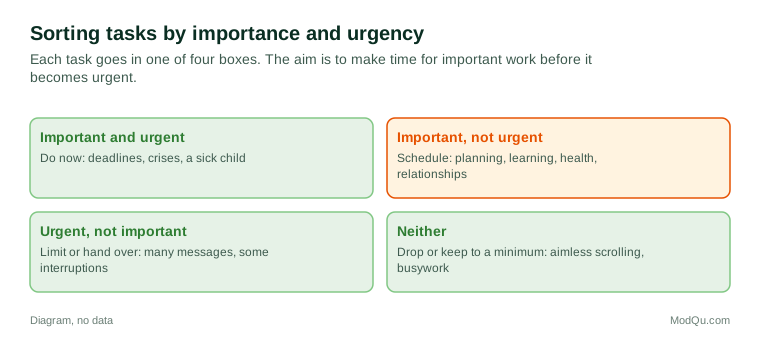
Many named methods are taught in books, courses and workplaces. The figure below shows the first of these methods.
- Prioritising by importance and urgency. Tasks are sorted into four boxes: important and urgent, important but not urgent, urgent but not important, and neither. The aim is to make time for important work before it becomes urgent.
- Time blocking. Setting aside blocks in the calendar for specific kinds of work, such as an hour each morning for writing.
- Timed work intervals. Working for a short fixed period, often around 25 minutes, then taking a short break.
- Batching. Doing similar small tasks together, such as replying to all messages at set times.
- The two-minute rule. If something takes less than two minutes, do it now rather than adding it to a list.
- Eating the frog. Doing the hardest or least pleasant task first.
- Getting things out of your head. Writing every task down in one trusted place so the mind is not trying to remember them.
No method suits everyone. People with creative work often need long uninterrupted periods; people in customer service need to respond quickly; carers often cannot block time at all.
Productivity apps and tools
Digital tools have multiplied. People use task list apps, calendar apps, note-taking apps, focus timers, apps that block distracting websites, shared project boards and the reminders built into phones.
Some people find these tools very helpful. Others try many apps, spend time setting them up and then return to a paper list. Switching between tools, or keeping tasks in several places, can create more work than it saves.
Example (hypothetical figures)
A university student tracks one week of study time. They planned 20 hours. A focus timer app shows 13 hours of actual study, 4 hours lost to checking messages during study sessions, 2 hours setting up a new note-taking system and 1 hour of breaks that ran long. They conclude the new system cost more time than it saved that week.
Questions that businesses want answered here include which apps people pay for, which they abandon, and whether people prefer paper or digital tools.
What distracts people most
Distraction is one of the main reasons people say they lose time. Common sources include:
- Phone notifications from messages, social media, news and games.
- Email and work chat, which can feel urgent even when it is not.
- Interruptions from other people, at home or in an open-plan office.
- Noise and surroundings, such as a busy household or a shared workspace.
- Internal distractions: worry, tiredness, hunger, boredom or putting off a task that feels hard.
- Switching between tasks, which costs time and attention each time a person changes focus.
Working from home has changed the mix. Some people say they focus better without office interruptions; others find household tasks, family and the lack of a clear end to the day harder to manage.
Procrastination
Procrastination means putting off a task even though the delay is likely to make things worse. It is not the same as laziness. People often delay tasks that feel boring, unclear, too large, or likely to bring criticism. Tiredness, stress and low mood make it more likely.
Common ways people try to deal with it include breaking a task into a first small step, setting a short timer, working alongside someone else, and removing distractions. Many people say they procrastinate on personal tasks such as paperwork, health appointments and home repairs more than on paid work.
Example
A self-employed designer puts off doing their annual tax paperwork for weeks. They finally book two hours at a library with their phone left in the car, sort receipts into envelopes by month and finish most of it in one sitting. They say the task was far smaller than it felt while they were avoiding it.
Rest, burnout and the limits of productivity
There is growing concern that pressure to be productive can go too far. Long hours, being always reachable and filling every gap with tasks can lead to exhaustion. Burnout, a state of long-term work-related stress with exhaustion, distance from one's job and a sense of not achieving much, is recognised by the World Health Organization as an occupational phenomenon.
Many time management approaches now include rest on purpose: protected time off, clear end times to the workday, and fewer goals rather than more. Some workplaces try meeting-free days or limits on messages outside working hours.
What people disagree about
- Systems or flexibility? Some people swear by strict routines; others say rigid plans break as soon as something unexpected happens.
- Is it the individual or the job? Some argue people need better habits; others argue many jobs and households simply have too much work for the time and people available.
- Do apps help? Some find them essential; others say they add another layer of work.
- Is busyness a good sign? In some workplaces long hours are admired; in others they are seen as a sign of poor planning.
Key terms
- Time managementDeciding what to do, when and for how long.
- ProductivityHow much useful work or progress comes out of the time spent.
- Time blockingReserving fixed periods in a calendar for specific kinds of work.
- BatchingGrouping similar small tasks and doing them together.
- ProcrastinationPutting off a task even though the delay is likely to make things worse.
- Task switchingMoving attention from one task to another, which costs time each time.
- DeadlineThe time by which a task must be finished.
- BurnoutLong-term work-related stress with exhaustion, distance from the job and a sense of not achieving much.
Full glossary: business coaching terms on EditingTests.com.
Productivity and time management vocabulary test
How well do you know the language of this topic? Try 8 quick questions. Your score is shown straight away and is not saved.
What the productivity and time management survey asks
This survey is part of ModQu's Personal Development survey. The productivity and time management part takes about five minutes and covers:
- How you plan your day and week, if at all.
- Which tools you use: paper, calendar, task apps, timers or shared boards.
- Which productivity apps you have paid for, kept or stopped using.
- What distracts you most, at work and at home.
- Which tasks you tend to put off, and what helps you start.
- How well your current approach works for you.
After that you can choose to continue with other short parts of the Personal Development survey, such as self-improvement or life goals, or stop.
Ready to take part?
Your answers help show what people really think and do. Results are only ever reported as totals; no one can see your individual answers.
Start the surveyQuestions about this survey
Who can take part?
Adults.
Do I have to give my name?
No. You may be asked for your age group, region and similar details so results can be broken down, but not your name. ModQu never asks for passwords, card numbers or account numbers.
How are the results used?
Answers are combined into totals and percentages and published in ModQu reports. Individual answers are never shown.
Is the vocabulary test part of the survey?
No. It is optional and separate, and your score is not stored.
Do you only want to hear from organised people?
No. We want to hear from everyone, including people with no system at all.
Does this survey cover paid work only?
No. It covers work, study, housework, caring and personal goals.