
Share the skills you are learning
Tell us what skill you learned this year, how you learned it and what you would like to learn next. Your answers are combined with other people's and reported only as totals.
Start the learning new skills surveyAbout 5 minutes. No account needed. You can stop at any time.
What informal skill learning is
Most of what adults learn does not come from a degree or certificate. It comes from watching others, trying things, reading, online videos, short courses, practice at work and help from friends and family. Researchers often separate three kinds of learning:
- Formal learning: structured study leading to a recognised qualification, such as a diploma or degree.
- Non-formal learning: organised courses and training that do not lead to a formal qualification, such as a community cooking class or a workplace workshop.
- Informal learning: learning that happens through daily life, work and self-directed effort, often without a plan.
This page focuses on the second and third kinds. They are harder to measure than formal education, which is one reason surveys of adult learning ask people directly what they have learned and how.
What skills people learn
Adults learn a very wide range of skills. Common areas include:
- Digital skills: using new apps and software, spreadsheets, online safety, photo and video editing, coding.
- Languages, for travel, work, family or moving to a new country.
- Practical skills: cooking, home repair, gardening, sewing, basic car maintenance.
- Work skills: project management, presenting, writing, sales, managing people, a trade.
- Money skills: budgeting, filing taxes, understanding pensions and investments.
- Health and care skills: first aid, caring for a relative, fitness techniques.
- Creative skills: music, drawing, writing, crafts.
- Social skills: negotiation, listening, handling conflict.
People often learn a skill because of a specific need: a new job, a new baby, a move abroad, a broken appliance or a relative who needs care.
Example
After a parent has a stroke, an adult child learns how to help them move safely, manage medications and use a wheelchair. They learn from hospital staff, a short course run by a local health service and online videos. They say they had never thought of these as skills until they had to learn them in a few weeks.
How people learn
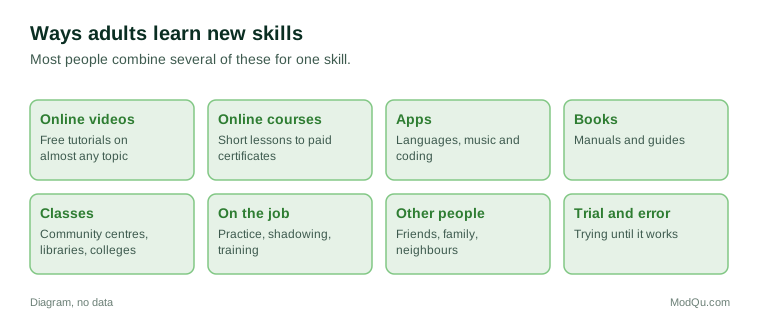
The methods adults use have widened greatly. The figure below shows the main routes.
- Online videos and tutorials, often free and available on almost any topic.
- Online courses, from short free lessons to paid programs with certificates.
- Apps, especially for languages, music and coding.
- Books and manuals.
- Classes in person, at community centres, libraries, colleges and clubs.
- Learning on the job, through practice, shadowing colleagues and workplace training.
- Friends, family and neighbours who show how something is done.
- Trial and error, simply trying until it works.
Many people combine methods: a video to see the basics, a book for detail, practice for skill, and a friend or class for feedback.
Example (hypothetical figures)
A person learning to use spreadsheets for a new job keeps a log for six weeks. They spend 9 hours on free online videos, 6 hours on a paid online course costing $40, 3 hours being shown by a colleague and 12 hours practising on real work. Of the 30 hours, 40 percent was practice. When asked which helped most, they say the colleague's 3 hours, because they could ask questions about the actual files they use.
What helps people learn
Research on learning and practical experience point to several things that help adults build skills:
- A clear reason: knowing why the skill matters.
- Practice spread over time rather than in one long session.
- Feedback on what is working and what is not.
- Starting with basics and building up.
- Applying the skill to real tasks soon after learning it.
- Testing oneself, for example trying to recall vocabulary rather than just rereading it.
- Support: a class, partner or group that keeps people going.
Many adults also bring experience that helps: they know how they like to learn and can connect new skills to what they already know.
What gets in the way
The most common barriers adults name are:
- Time, especially for people working long hours or caring for others.
- Cost of courses, materials or equipment.
- Confidence: worry about being too old, too slow or not good at learning.
- Access: no courses nearby, poor internet, or classes at times that do not fit.
- Too much choice: so many online options that it is hard to know which is good.
- Lack of recognition: skills learned informally may not be recognised by employers.
Access to learning is uneven. In many countries, people who already have more education are more likely to take part in adult learning, while those with less education, lower incomes or less time take part less, even though they may benefit most.
Example
A cleaner who works two part-time jobs wants to improve their English to apply for a supervisor role. Evening classes clash with their second job. They use a free app on the bus each day and practise speaking with a neighbour on Sundays. Progress is slower than they hoped, but after a year they pass the interview.
Proving what you have learned
Skills learned outside formal education can be hard to prove. Ways people show them include:
- Certificates from online or in-person courses.
- Digital badges and short credentials that list specific skills.
- Portfolios of work, such as photos, code, writing or finished projects.
- Recognition of prior learning schemes, offered in many countries, that assess skills gained through work or life and grant credit towards a qualification.
- References from employers or clients.
Employers vary in how much weight they give these. Some value demonstrated skills over formal qualifications; others still rely mainly on degrees and diplomas.
Trends in adult learning
Several changes are visible worldwide:
- Short, flexible learning in small units that fit busy lives.
- Reskilling and upskilling as jobs change with new technology.
- Public programs in a number of countries that give adults learning accounts, vouchers or credits to spend on approved courses.
- Learning in later life, with older adults taking courses for interest, health and social contact.
- Online learning across borders, letting people study with teachers in other countries.
What people disagree about
- Are online courses as good as classes? Some find them just as effective and more flexible; others miss the feedback and contact of a class.
- Who should pay? Views differ on how much the individual, the employer and the government should pay for adult learning.
- Do informal skills count? Some argue that skills should be judged by what people can do, not by where they learned it.
Questions that businesses want answered here include what skills people have learned recently, how they learned them, what they paid and what they want to learn next.
Key terms
- Formal learningStructured study leading to a recognised qualification.
- Non-formal learningOrganised courses that do not lead to a formal qualification.
- Informal learningLearning through daily life, work and self-directed effort.
- UpskillingLearning new skills to do one's current job better.
- ReskillingLearning new skills to move into a different kind of work.
- Spaced practiceSpreading practice over time rather than doing it all at once.
- Digital badgeAn online record showing a specific skill or course completed.
- Recognition of prior learningAssessment that grants credit for skills gained through work or life.
Full glossary: e learning content terms on EditingTests.com.
Learning new skills vocabulary test
How well do you know the language of this topic? Try 8 quick questions. Your score is shown straight away and is not saved.
What the learning new skills survey asks
This survey is part of ModQu's Personal Development survey. The learning new skills part takes about five minutes and covers:
- What new skill you have learned this year, and why.
- How you learned it: videos, courses, apps, classes, work, friends or trial and error.
- How much time and money it took.
- What helped and what got in the way.
- Whether you have any proof of the skill, such as a certificate or portfolio.
- What skill you would like to learn next.
After that you can choose to continue with other short parts of the Personal Development survey, such as self-improvement or productivity and time management, or stop.
Ready to take part?
Your answers help show what people really think and do. Results are only ever reported as totals; no one can see your individual answers.
Start the surveyQuestions about this survey
Who can take part?
Adults.
Do I have to give my name?
No. You may be asked for your age group, region and similar details so results can be broken down, but not your name. ModQu never asks for passwords, card numbers or account numbers.
How are the results used?
Answers are combined into totals and percentages and published in ModQu reports. Individual answers are never shown.
Is the vocabulary test part of the survey?
No. It is optional and separate, and your score is not stored.