
Share your experience of self-improvement
Tell us what you are working on, how you do it and what it costs you. Your answers are combined with other people's and reported only as totals.
Start the self-improvement surveyAbout 5 minutes. No account needed. You can stop at any time.
What self-improvement covers
Self-improvement is the deliberate effort to change something about yourself for the better. It is a broad label. For one person it means getting fit; for another it means reading more, controlling a temper, saving money, learning a language or becoming a better parent. What the efforts have in common is that the person chooses the goal and does most of the work themselves, often outside school or a job.
The areas people work on tend to fall into a few groups:
- Health and body: exercise, sleep, diet, quitting smoking or drinking less.
- Mind and emotions: managing stress, building confidence, becoming calmer or more patient.
- Skills and knowledge: languages, technical skills, reading, music, cooking.
- Work and career: getting organised, being promoted, changing field, starting a business.
- Relationships: listening better, making friends, setting boundaries.
- Money: budgeting, paying off debt, saving for a goal.
- Meaning and character: living by one's values, faith, volunteering, gratitude.
Most people are working on more than one area at once, and the areas affect each other. Better sleep can make exercise easier; a new skill can lead to a better job, which can ease money worries.
Why people take it up
People start working on themselves for different reasons, and the reason often shapes how long the effort lasts. Common starting points include:
- A life event: a birthday ending in zero, a breakup, a new baby, a health scare, a job loss or retirement.
- Dissatisfaction: a sense of being stuck, or a gap between how life is and how the person wants it to be.
- Comparison: seeing friends, colleagues or people online who seem to be doing better.
- Outside pressure: a doctor, an employer or a partner suggesting a change.
- Curiosity and enjoyment: some people simply like learning and growing.
The calendar plays a part too. Many cultures have a moment for fresh starts, such as the new year, a religious season, a birthday or the start of a school year, and people are more likely to set goals at those times.
Example
An office worker in their forties is told at a routine check-up that their blood pressure is high. In the following month they buy a bicycle, download a sleep app and start a reading list on health. Six months later the cycling has become a habit because they ride to work, while the reading list stopped after two books.
The methods people use
There is no single way to improve. People combine free and paid methods, and the mix changes over time.
- Books and audiobooks on habits, psychology, money, productivity or biography.
- Podcasts and online videos, often free and listened to while commuting or exercising.
- Apps that track habits, meditation, language practice, steps, sleep or spending.
- Courses and workshops, online or in person, from short evening classes to certificates.
- Coaches, mentors and therapists, who give one-to-one guidance or support.
- Groups and communities, such as running clubs, book clubs, faith groups, support groups and online forums.
- Journals and planners, used to set goals, reflect and track progress.
Different methods suit different goals. Learning a skill usually needs practice and feedback. Changing a habit usually needs a cue, a routine and a reason to keep going. Emotional change may need time, support and sometimes professional help.
What it costs
Self-improvement ranges from free to expensive. A library card, free videos and a notebook cost almost nothing. Apps often move from a free version to a monthly or yearly subscription. Courses, retreats, personal trainers and coaches can cost much more.
Time is usually the larger cost. A goal that needs an hour a day competes with work, family, rest and other goals. Many people overestimate how much time they will have and underestimate how long change takes.
Example (hypothetical figures)
A person adds up a year of self-improvement spending: a meditation app at $70, a language app at $90, eight books at $15 each ($120), a weekend workshop at $250 and a gym membership at $35 a month ($420). The total is $950. They used the gym for about five months and the meditation app for six weeks, so they estimate that roughly a third of the money went on things they stopped using.
The example shows a common pattern. People are often willing to pay at the start, when motivation is high, and stop using what they bought once the routine fades. Questions that businesses want answered here include how much people spend in a year, which methods they keep using and which they abandon.
Why some efforts last and others fade
Most people have started a change that did not last. Research on behaviour change points to several reasons:
- The goal is vague. "Get healthier" is harder to act on than "walk 30 minutes after dinner on weekdays".
- The goal is too big. Trying to change diet, exercise, sleep and screen time in the same week overloads the person.
- There is no routine. A change that depends on remembering or on willpower each day tends to slip.
- Progress is invisible. Without some way of seeing improvement, effort feels wasted.
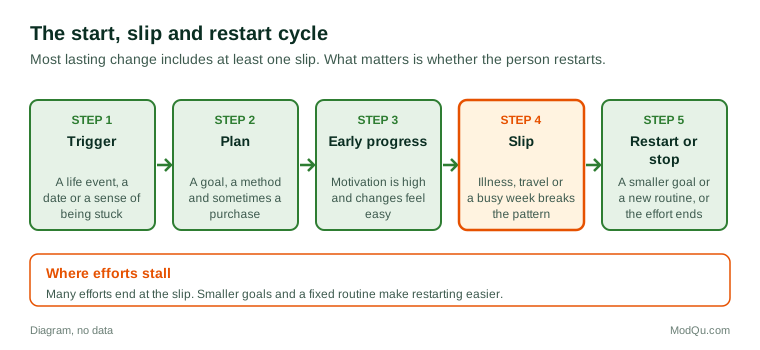
- Life gets in the way. Illness, travel, a busy period at work or a family need breaks the pattern, and restarting is hard.
- The reason is weak. Goals taken on to please others often fade faster than goals the person cares about.
The figure below shows a common cycle of starting, slipping and restarting.
The self-improvement industry
Self-improvement is also a large market. Publishers, app makers, coaches, gyms, course providers and wellness brands all sell products aimed at people who want to change. That brings choice and access, but it also brings some concerns.
- Quality varies. Anyone can call themselves a coach or publish a guide, and some advice is not based on evidence.
- Promises can be large. Marketing may suggest quick or total change.
- Pressure to improve. Some people say the constant message that they should be optimising themselves makes them feel worse, not better.
Supporters answer that cheap, widely available tools have helped many people learn, get healthier and feel more in control, and that people can judge for themselves what works.
Example
A young graduate follows several online creators who post morning routines, workout plans and reading lists. After a few months they notice they feel anxious when they miss a step. They unfollow most of the accounts, keep one simple habit of a daily walk, and say they feel better with fewer goals.
What people disagree about
Views on self-improvement differ, and survey research often explores these differences:
- Individual or social? Some see self-improvement as personal responsibility; others say problems such as low pay, poor housing or overwork need social solutions, not individual effort.
- Discipline or kindness? Some approaches stress strict routines and willpower; others stress self-acceptance and small, gentle steps.
- Measure or not? Tracking helps some people and makes others feel judged.
- Paid or free? Some feel paying makes them commit; others see paid programs as unnecessary.
Cultural background matters too. In some places self-improvement is mostly about career and money; in others it is closely tied to family duty, faith or community.
Key terms
- Self-improvementThe deliberate effort to change something about yourself for the better.
- GoalA specific result a person sets out to reach.
- HabitA behaviour repeated so often it happens with little thought.
- MotivationThe reasons and energy that make a person start and keep going.
- Fresh start effectThe tendency to set new goals at moments that feel like a new beginning, such as the new year.
- RelapseFalling back into an old pattern after a period of change.
- AccountabilityBeing answerable to someone else, such as a friend or coach, for progress.
- Growth mindsetThe belief that abilities can be developed through effort and practice.
Full glossary: business coaching terms on EditingTests.com.
Self-improvement vocabulary test
How well do you know the language of this topic? Try 8 quick questions. Your score is shown straight away and is not saved.
What the self-improvement survey asks
This survey is part of ModQu's Personal Development survey. The self-improvement part takes about five minutes and covers:
- Whether you are working on improving yourself, and in which areas.
- Why you started, and whether a life event played a part.
- Which methods you use: books, apps, courses, coaches, groups or others.
- How much you spend on self-improvement in a year, and how much time you give it.
- Which efforts lasted, which faded, and why.
- What you would like to work on next.
After that you can choose to continue with other short parts of the Personal Development survey, such as productivity and time management or life goals, or stop.
Ready to take part?
Your answers help show what people really think and do. Results are only ever reported as totals; no one can see your individual answers.
Start the surveyQuestions about this survey
Who can take part?
Adults.
Do I have to give my name?
No. You may be asked for your age group, region and similar details so results can be broken down, but not your name. ModQu never asks for passwords, card numbers or account numbers.
How are the results used?
Answers are combined into totals and percentages and published in ModQu reports. Individual answers are never shown.
Is the vocabulary test part of the survey?
No. It is optional and separate, and your score is not stored.
Is self-improvement the same as therapy?
No. Self-improvement is a broad personal effort; therapy is treatment from a qualified professional. Some people use both.
Do I need to be working on something to take the survey?
No. We also want to hear from people who are not working on self-improvement and why.