
Share your views on nuclear power
Tell us whether you support nuclear power, how safe you think it is and whether your country should build more reactors. Your answers are combined with other people's and reported only as totals.
Start the nuclear energy surveyAbout 5 minutes. No account needed. You can stop at any time.
How nuclear power works
A nuclear power plant makes electricity from heat released when atoms of uranium are split, a process called fission. The heat boils water into steam, which turns turbines connected to generators, as in many other power stations. The reactor is surrounded by thick shielding and a containment structure designed to keep radiation in. Plants are controlled by operators and automatic safety systems that can shut the reactor down.
Types of plant include:
- Large conventional reactors, which supply a steady output for decades.
- Small modular reactors, smaller designs intended to be built in factories and assembled on site, now in development or early use.
- Research reactors, used for science and to produce medical isotopes.
Nuclear fusion, which joins atoms rather than splitting them, is still being researched and is not yet used to supply power to the grid.
Where it is used
Some countries get a large share of their electricity from nuclear power, some a smaller share, and many none at all. Some countries are building new plants; others have decided to close existing ones; others are extending the life of older plants. Decisions depend on energy needs, climate targets, cost, public opinion, past accidents and access to other energy sources.
Arguments for nuclear power
Supporters point to:
- Low emissions: plants emit very little carbon dioxide while running.
- Steady supply: output does not depend on weather or time of day.
- Small land use compared with some other sources for the same output.
- Energy security: less dependence on imported fuels for some countries.
- Long life: plants can run for many decades.
Arguments against nuclear power
Opponents point to:
- Accident risk: rare but serious accidents have forced the evacuation of large areas.
- Waste: spent fuel stays radioactive for a very long time and needs secure storage.
- Cost and delays: new plants are expensive and many have run over budget and schedule.
- Weapons risk: some nuclear technology and materials can be linked to weapons.
- Alternatives: some argue that money is better spent on renewable energy, storage and efficiency.
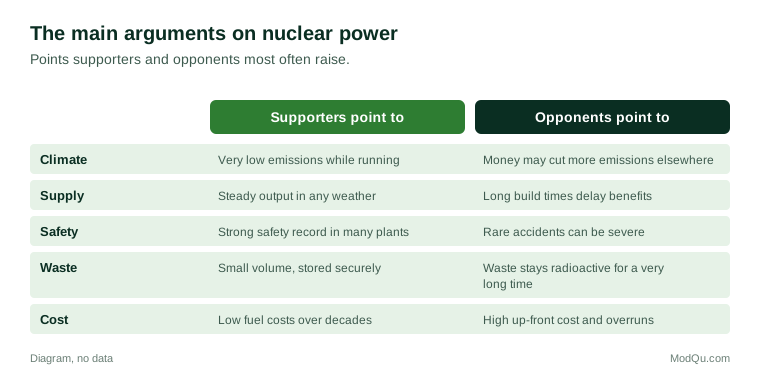
The figure below places the main arguments side by side.
Example
Two neighbours discuss a proposal to build a small reactor near their town. One supports it because it would bring jobs and steady power for the local factory. The other opposes it because she worries about an accident and about trucks carrying fuel through the town. Both say they want more information about the plan's safety record before a decision is made.
Safety and radiation
Nuclear safety is regulated by national authorities, and the International Atomic Energy Agency (IAEA) sets international safety standards and offers reviews. Plants are designed with several layers of protection. Radiation is a natural part of the environment, and people receive small doses from rocks, soil, food and medical scans. The concern with nuclear plants is the release of large amounts of radioactive material in an accident.
People's sense of risk is shaped by memories of major accidents, news coverage and how close they live to a plant. Researchers note that public risk judgments often differ from technical estimates, especially for rare events with severe consequences.
Waste
Nuclear waste ranges from lightly contaminated clothing and tools to highly radioactive spent fuel. Spent fuel is usually cooled in pools and then stored in sealed casks. Several countries are developing deep geological repositories, where waste would be placed in stable rock hundreds of metres underground. Finding sites that local communities accept is often one of the hardest parts.
Example
A town is asked whether it would host a study on a possible underground waste site in exchange for funding for local services. Some residents welcome the jobs and investment; others say no amount of money would make them accept it. The council holds public meetings and a local vote before deciding whether to continue.
Cost
Building a nuclear plant takes many years and large up-front investment, while fuel costs are relatively low once it runs. Comparing nuclear with other sources is hard because costs depend on interest rates, construction time, how long plants run, and the cost of backup and storage for other sources.
Example (hypothetical figures)
A project is planned to cost 10 billion and take 8 years. It ends up costing 16 billion and taking 12 years. The cost overrun is 6 billion, or 60 percent, and the project is 4 years late. Critics cite the overrun; supporters say the plant will still supply power for 60 years.
Nuclear power and climate plans
Because nuclear plants emit very little carbon while running, some climate plans include them as part of a low-carbon electricity mix alongside renewables. Others leave nuclear out, preferring wind, solar, hydro, storage and efficiency. This is one of the most debated questions in energy policy, and people who agree on the need to cut emissions can disagree about it.
What people disagree about
- Whether nuclear power is needed to meet climate targets.
- Whether existing plants should be closed or extended.
- Whether small modular reactors will be cheaper and safer.
- Where waste should be stored.
- How much public money should support nuclear projects.
Why surveys ask about nuclear energy
Questions that research bodies, energy firms, universities and public agencies want answered include whether people support nuclear power, how safe they think it is, whether they would accept a plant or waste site near them and how they see its role in climate policy. Answers are grouped and every question can be skipped.
Key terms
- FissionSplitting atoms to release energy, used in nuclear power plants.
- FusionJoining light atoms to release energy; still being researched for power.
- ReactorThe part of a plant where controlled fission takes place.
- ContainmentThe strong structure around a reactor designed to keep radioactive material in.
- Spent fuelUsed nuclear fuel, which is highly radioactive and must be stored safely.
- Geological repositoryA deep underground site for storing long-lived radioactive waste.
- Small modular reactorA smaller reactor design intended to be built in factories.
- BaseloadThe steady minimum level of electricity demand, often met by plants that run all the time.
Full glossary: green energy terms on EditingTests.com.
Nuclear energy vocabulary test
How well do you know the language of this topic? Try 8 quick questions. Your score is shown straight away and is not saved.
What the nuclear energy survey asks
This survey is part of ModQu's Science and Technology Attitudes survey. The nuclear energy part takes about five minutes and covers:
- Whether you support or oppose nuclear power.
- How safe you think nuclear power is.
- Whether your country should build more reactors, keep or close existing ones.
- Whether you would accept a plant or waste site near where you live.
- How you see nuclear power's role in cutting emissions.
- Which sources you trust on energy and safety.
After that you can choose to continue with other short parts of the Science and Technology Attitudes survey, such as trust in science or space exploration, or stop.
Ready to take part?
Your answers help show what people really think and do. Results are only ever reported as totals; no one can see your individual answers.
Start the surveyQuestions about this survey
Who can take part?
Adults.
Do I have to give my name?
No. You may be asked for your age group, region and similar details so results can be broken down, but not your name. ModQu never asks for passwords, card numbers or account numbers.
How are the results used?
Answers are combined into totals and percentages and published in ModQu reports. Individual answers are never shown.
Is the vocabulary test part of the survey?
No. It is optional and separate, and your score is not stored.
Is the survey for or against nuclear power?
Neither. It records what people think and treats every view the same way.
Can I say I am not sure?
Yes. "Not sure" is a valid answer to every question.